
table of contents

Core Anatomy of an Executive Assistant Cover Letter with Experience
Crafting a high-converting cover letter requires understanding what executive teams and Chiefs of Staff look for when reviewing candidates. In today’s market, generic administrative letters yield roughly a 40% interview rate. When optimized to showcase operational leverage, strategic partnership, and quantified outcomes, that rate jumps to 91%.
Senior leaders do not have time to read a multi-page memoir. The optimal executive assistant cover letter stays between 250 and 350 words across three focused paragraphs:

- The Strategic Hook (2–3 sentences): Immediately establishes your operating seniority, the executive level supported (CEO, CFO, Board of Directors), and a standout operational achievement.
- The Impact Engine (4–6 sentences): Delivers concrete evidence of operational anticipation, friction reduction, budget oversight, and platform mastery using quantifiable metrics.
- The Value Proposition & Next Step (2–3 sentences): Connects your domain background to the company’s current stage and invites an introductory conversation.
Treat your cover letter as an executive briefing document. By aligning your application with targeted personal branding, you show future employers that you already think and communicate like a strategic business partner rather than a clerical worker.
Hooking C-Suite Leaders in the Opening Paragraph
The opening lines determine whether a hiring executive reads on or moves to the next candidate. Avoid boilerplate openings like, “I am writing to express my enthusiastic interest in the Executive Assistant position.” Using “To Whom It May Concern” is the cover letter equivalent of sending a fax—it immediately dates your approach.
Instead, open with scope, executive level, and operational scale:
- Weak Opening: “I have over eight years of experience working as an executive assistant and I am looking for my next challenge in a corporate environment.”
- Strong Opening: “Over the past seven years supporting C-level executives across multi-entity organizations, I have managed 45+ weekly executive meetings, orchestrated cross-continental travel across 14 countries, and protected leadership focus to return an average of five deep-work hours weekly to the CEO.”
A strong hook immediately proves that handing over an executive’s calendar, inbox, and confidential communications will bring instant order.
Demonstrating Strategic Impact Over Routine Tasks
Administrative assistants support general team routines; executive assistants act as operational force multipliers for senior decision-makers. Your cover letter must articulate how you solve problems before they reach the executive’s desk.
Focus on core areas of strategic partnership:
- Operational Anticipation: Resolving complex scheduling gridlocks across global time zones before double-bookings occur.
- Gatekeeping and Discretion: Managing high-priority investor inquiries and confidential M&A documentation with zero disclosure risk.
- Meeting Rhythm Design: Structuring executive cadences, board agendas, and cross-functional follow-ups so leadership teams stay aligned on key deliverables.
When preparing for competitive C-suite opportunities, integrating these strategic narratives directly mirrors the techniques taught in strategic interview coaching and preparation.
How to Quantify Operational and Financial Impact
The most compelling way to prove your seniority is through hard numbers. Executive operations carry tangible financial and operational weight, from managing corporate travel budgets to streamlining board prep cycles.
Frame your achievements using the Problem-Action-Result (PAR) framework:
- Problem: Executive spent 10+ hours weekly sorting inbox requests and resolving calendar overlaps.
- Action: Built a color-coded Outlook triage workflow and daily briefing cadence.
- Result: Cut daily open inbox backlogs from 180 to under 25 messages, returning 4 hours of focus time each week.
| Weak, Task-Based Language | High-Impact, Metric-Driven Statement |
|---|---|
| Handled executive calendar and scheduling. | Managed a 40+ meeting weekly cadence across 8 time zones, reducing scheduling conflicts by 45%. |
| Booked corporate travel and filed expense reports. | Coordinated 120+ international trips annually and negotiated vendor contracts, reducing corporate travel spend by 18% ($60K/year). |
| Prepared materials for executive meetings. | Streamlined quarterly board deck creation across 6 department heads, cutting final delivery time by 3 days. |
| Organized team events and internal communications. | Directed logistics for annual 200-person leadership retreats while managing an operational budget of $250K under budget by 6%. |
Highlighting C-Suite Platforms and Tools
Applicant Tracking Systems (ATS) and recruiters scan executive support materials for modern tech stacks. Mention the platforms you use to maintain operational velocity, particularly in distributed environments.
Key platforms to feature include:
- Calendar & Communication: Microsoft 365, Google Workspace, Slack, Zoom, Microsoft Teams
- Travel & Expense Management: SAP Concur, Expensify, Navan, Coupa
- Project & Workflow Management: Asana, Monday.com, Trello, Notion
- Board & Document Security: Diligent, Boardvantage, Box, DocuSign
Demonstrating proficiency in asynchronous communication and cloud toolsets is essential for modern operations. For more on remote operational excellence, see remote work best practices for executive support.
Crafting an Executive Assistant Cover Letter with Experience for Tech vs. Finance
Tailoring your letter to industry nuances shows that you understand the operating pace and compliance landscape:
- High-Growth Tech & Startups: Emphasize adaptability, rapid context-switching, cross-functional project tracking in Asana, and managing ambiguous priorities during funding rounds or product launches.
- Private Equity, Banking & Finance: Focus on rigorous discretion, regulatory compliance, zero-defect document preparation, complex multi-leg travel itineraries, and managing interactions with high-net-worth stakeholders and board directors.
Navigating Employment Gaps, Career Pivots, and Salary Expectations

Senior professionals often navigate career shifts, relocations, or gaps due to caregiving, sabbaticals, or organizational restructuring. An executive assistant cover letter provides the ideal space to frame these transitions proactively. You can also explore foundational job search strategies to position your background effectively.
Addressing Gaps in an Executive Assistant Cover Letter with Experience
When addressing a career gap, be transparent, brief, and forward-looking. Avoid over-explaining:
“Following a planned career pause to complete my Certified Administrative Professional (CAP) credential and lead volunteer project logistics, I am eager to bring my 8+ years of C-suite support expertise to your leadership team.”
If you are pivoting from an adjacent role (such as Office Manager or Project Coordinator), highlight your transferable operational skills:
“In my role as Operations Lead, I managed facilities across three regional sites and served as primary gatekeeper for the VP of Operations, streamlining vendor contracts to save $45,000 annually.”
Framing career shifts with clarity helps candidates succeed while avoiding common job search pitfalls.
Structuring Layout, Word Count, and PDF Submissions
Executive communications should be clean, structured, and easy to read. A messy cover letter raises immediate doubts about an assistant’s document design standards.
Follow these formatting standards:
- Length: Exactly one page (250 to 350 words).
- Typography: Clean, modern fonts such as Arial, Calibri, or Helvetica at 10 to 11.5 pt size.
- Margins: Uniform 0.75″ to 1.0″ margins.
- File Format: Save and export as a PDF named
Firstname_Lastname_Cover_Letter.pdfto preserve styling. - Header: Match the exact header styling (name, contact info, LinkedIn URL) used on your résumé for visual consistency.
A polished application package helps you target top-tier opportunities and avoid dead end job postings that do not match your experience level.
Common Cover Letter Traps and How to Fix Them
Even seasoned administrative professionals can fall into habits that weaken their applications. Review our analysis of 13 big mistakes job seekers make along with the fixes below:
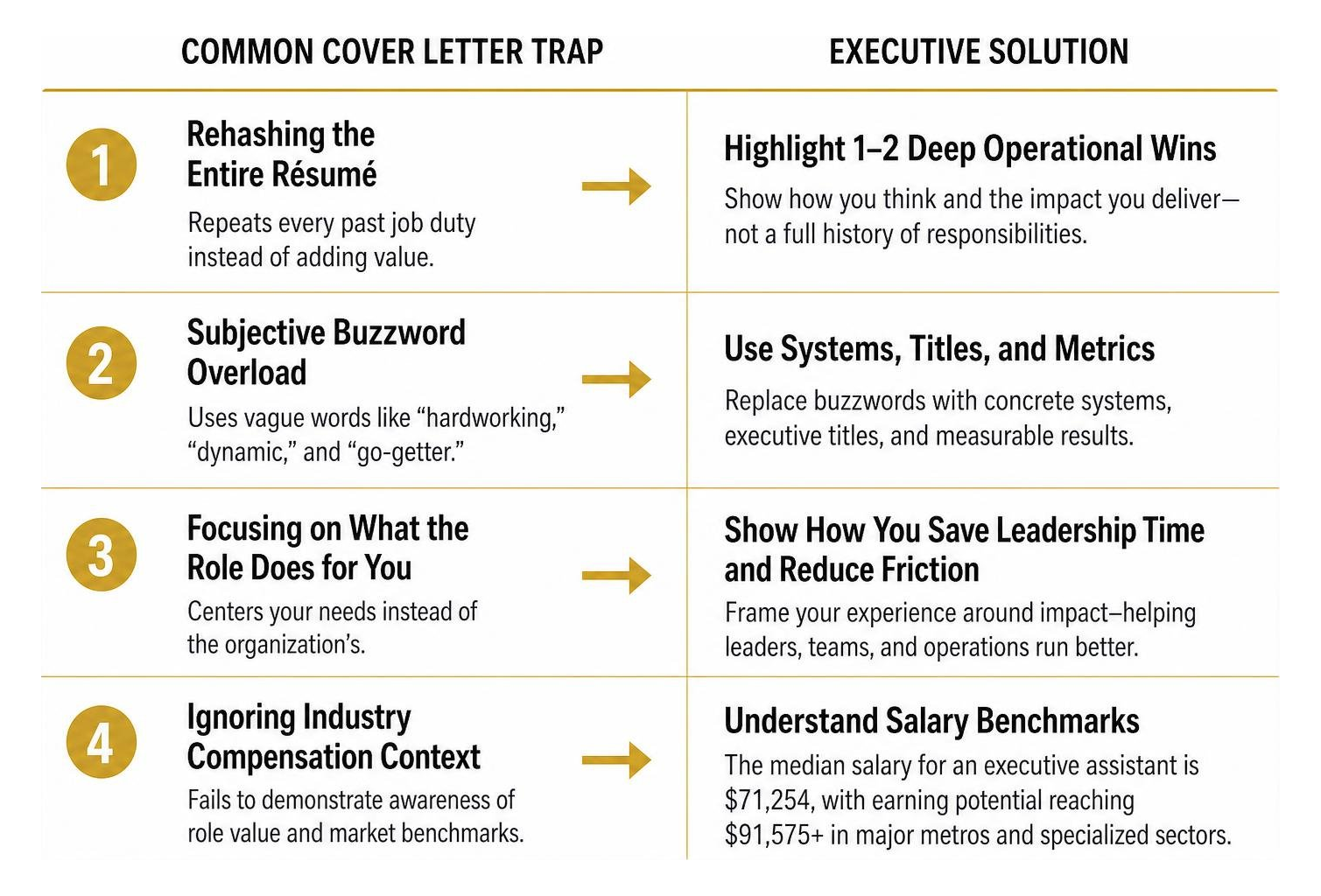
- Rehashing the Entire Résumé: Your cover letter should highlight one or two deep operational wins that show how you think, rather than repeating every past job duty.
- Subjective Buzzword Overload: Replace words like “hardworking,” “dynamic,” and “go-getter” with hard systems, executive titles, and concrete metrics.
- Focusing on What the Role Does for You: Frame your experience around how you will save leadership time and reduce organizational friction.
- Ignoring Industry Compensation Context: The median salary for an executive assistant is $71,254, with earning potential reaching $91,575+ in major metros and specialized sectors. Understanding industry salary benchmarks helps you position your seniority appropriately.
Frequently Asked Questions About Executive Assistant Cover Letters
What is the ideal length and format for a senior executive assistant cover letter?
A senior executive assistant cover letter should never exceed one page. Keep the word count between 250 and 350 words across three focused paragraphs. Use clean margins (0.75″–1.0″), professional typography (Calibri, Arial, or Helvetica at 10–11.5 pt), and submit as an ATS-compatible PDF.
Should I include salary expectations in my executive assistant cover letter?
Only mention salary if the job posting explicitly requests it. If required, provide a well-researched range tied to role scope and market benchmarks (e.g., “My compensation expectation is in the $75,000–$85,000 range, commensurate with executive support scope and responsibilities.”). Otherwise, leave compensation for the interview stage.
How do I address a cover letter when the hiring executive is not listed?
Spend five minutes researching the company on LinkedIn to identify the Chief of Staff, VP of Human Resources, or the executive leading the relevant division. If the specific leader cannot be determined, address the letter to “Dear Executive Search Committee” or “Dear Hiring Team” instead of outdated greetings like “To Whom It May Concern.”
Conclusion
An executive assistant cover letter is your first operational deliverable to a prospective leadership team. By opening with clear scope, highlighting quantifiable business outcomes, and demonstrating platform mastery, you prove that you are the trusted business partner their C-suite needs.
If you are ready to refine your career narrative and secure senior support roles, partner with executive resume and LinkedIn experts at My Expert Coach to turn your professional experience into consistent C-suite interview invitations.