
table of contents
Find Executive Recruiter Jobs That Match Your Level and Goals

The best executive recruiter jobs are not standard recruiting roles with a senior-sounding title. Look for positions where you own complex leadership searches, advise senior stakeholders on role design, map scarce talent markets, and close confidential hires.
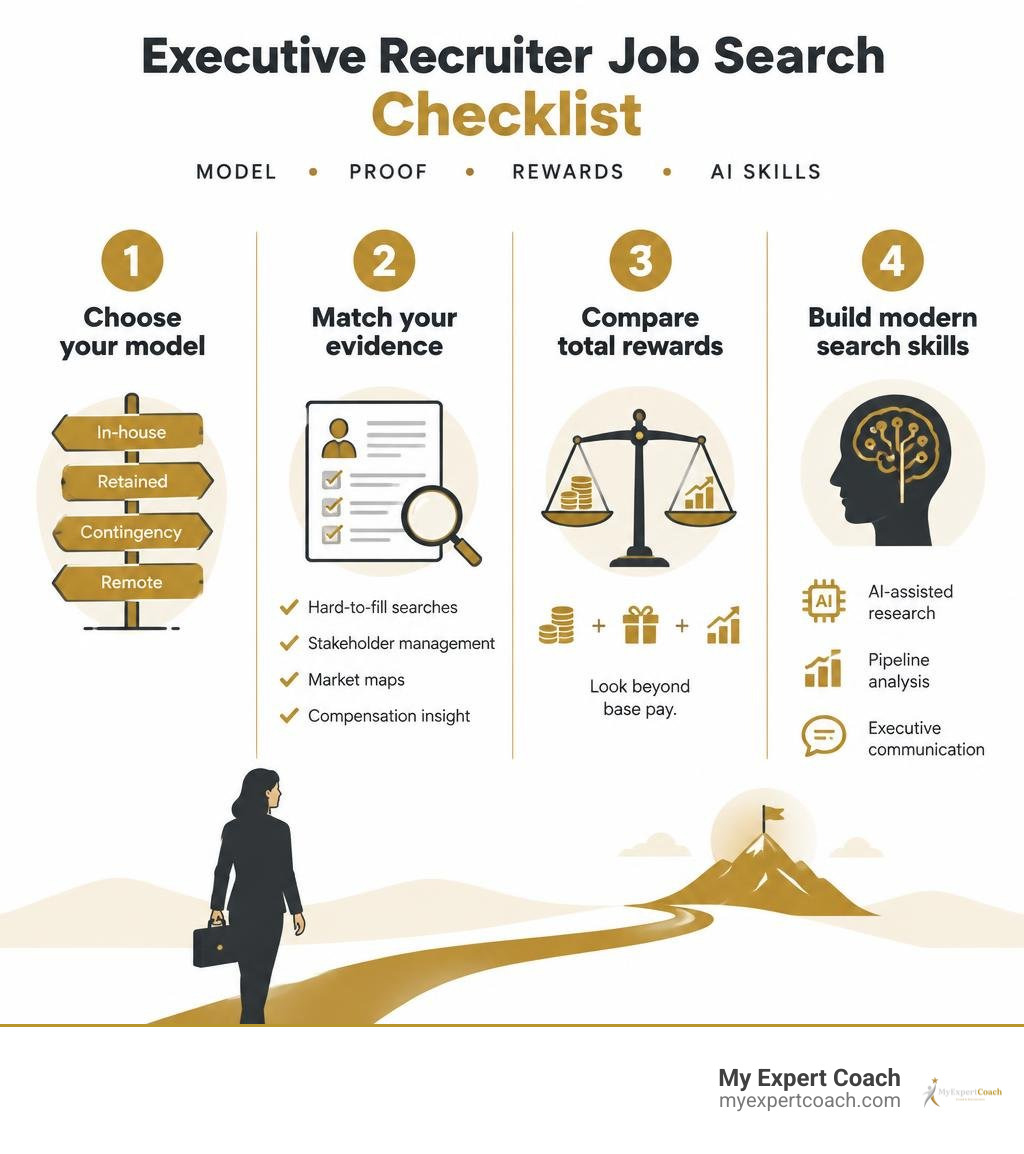
To find the right placement desk:
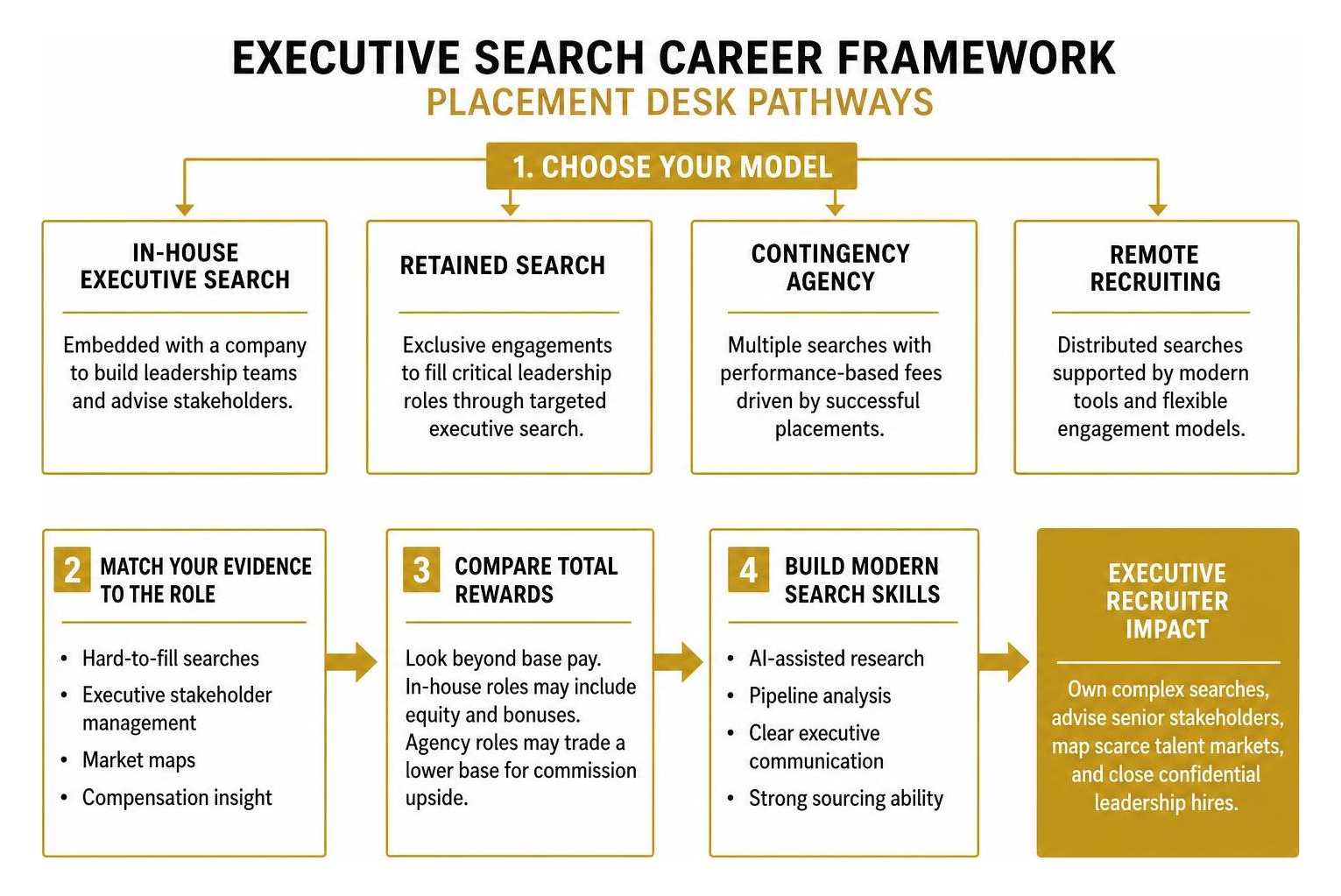
- Choose your model: in-house executive search, retained search, contingency agency, or remote recruiting.
- Match your evidence to the role: show hard-to-fill searches, executive stakeholder management, market maps, and compensation insight.
- Compare total rewards, not base pay alone: senior in-house roles may include equity and bonuses, while agency roles may trade a lower base for commission upside.
- Build modern search skills: AI-assisted research, pipeline analysis, and clear executive communication now matter alongside sourcing ability.
In 2026, the range is wide. Some agency roles begin around $50,000 to $70,000 plus incentives, while experienced in-house recruiters at high-growth technology companies can earn well above $200,000 with equity. The job title alone does not tell you the scope, pressure, autonomy, or long-term career value.
I am Sandy Spencer, a career coach and strategist with more than 38 years of HR and executive recruiting experience who has helped advance over 10,000 careers. I use that insider perspective to help professionals evaluate executive recruiter jobs, present their track record clearly, and pursue a placement desk that supports lasting growth.
Landscape and Compensation Models for Executive Recruiter Jobs
Executive search sits apart from transactional staffing. Rather than volume screening, executive recruiters run zero-to-one searches for critical leadership seats. Compensation models reflect this strategic weight across four primary environments: venture-backed tech startups, established corporate enterprises, global executive search agencies, and high-yield remote platforms.
Total compensation varies widely depending on ownership scope, company capitalization, and risk tolerance:
| Operating Model | Typical Base Salary | Incentive / Variable | Equity & Upside | Primary Search Focus |
|---|---|---|---|---|
| Frontier Tech / High-Growth In-House | $240,000 – $295,000 | Annual performance bonus (15%–30%) | High (RSUs / Stock Options) | Non-technical C-suite, VPs, Product, Legal, GTM |
| Energy & AI Infrastructure In-House | $255,000 – $275,000 | Discretionary annual bonus | Substantial RSUs | Cloud, Data Center, Engineering, C-Suite |
| Global Value Remote Platform | $200,000 ($100/hr flat rate) | Milestone-based bonuses | Minimal / None | High-difficulty problem searches, international leadership |
| Hybrid Staffing / Agency Partner | $50,000 – $70,000 base | Uncapped placement commissions | Rare | Mid-to-senior accounting, finance, operational direct-hires |
In-House Search at Frontier Tech and AI Startups
In high-growth AI and deep tech companies, executive recruiters operate as strategic advisors to founders and executive committees. These roles require extensive experience managing full-lifecycle searches across ambiguous, zero-to-one environments.
At frontier firms, an Executive Business Recruiter role commands base compensation between $240,000 and $295,000 plus significant equity. Recruiter responsibilities extend far beyond sourcing; they advise executive peers on org design, calibrate board expectations, and drive leadership hires across finance, legal, communications, policy, and go-to-market functions.
Similarly, in capital-intensive sectors like artificial intelligence infrastructure, climate-tech infrastructure searches carry salary ranges of $255,000 to $275,000 alongside RSUs and annual bonuses. Recruiters in these environments must understand technical architectures, energy dynamics, and GPU infrastructure while articulating a mission-driven narrative to prospective executives.
Agency, Contingency, and High-Yield Remote Executive Recruiter Jobs
Agency and remote placement desks operate under different economic dynamics. In agency and boutique search firms, base salaries generally range from $50,000 to $70,000, paired with uncapped commission structures tied directly to placement fees and client development. Recruiters are evaluated on business development, client retention, and speed of delivery.
In contrast, structured remote executive search models have introduced a global value pricing model. These roles often offer a flat $200,000 annual compensation ($100 per hour across a 40-hour work week) regardless of candidate geography. Rather than managing standard requisitions, these recruiters are assigned unfillable pipeline backlogs, tasked with solving structural hiring bottlenecks through bespoke diagnostics and rapid execution.
Core Competencies and AI Tooling in Modern Executive Search

Securing top-tier executive search desks requires proven mastery over complex candidate dynamics. Senior roles demand 7 to 10+ years of dedicated search experience, seasoned business acumen, and a deep understanding of executive incentive design.
Executive talent pools are highly constrained. Senior leaders rarely respond to cold outreach; engaging them requires calibrated peer-to-peer positioning. Top recruiters do not pitch vacancies—they diagnose strategic challenges within the target company and position the role as a platform for leadership impact.
Leveraging AI and Point Solutions to Fix Broken Requisitions
Modern search desks increasingly rely on custom technical workflows. Executive recruiters build autonomous point solutions using tools like Claude Code and custom Model Context Protocol (MCP) servers to analyze candidate pipelines and diagnose broken hiring processes.
Instead of waiting for engineering teams to build recruitment software, top search professionals deploy workflow automations to:
- Generate real-time talent maps and compensation benchmarks.
- Run automated pipeline diagnostics to identify where executive candidates drop out.
- Build custom evaluation rules to calibrate candidate assessments against board expectations.
- Conduct total-addressable-market (TAM) candidate analyses for niche technical leadership disciplines.
What Executive Recruiters Do Not Do on the Desk
A common misconception is that executive recruiting simply involves standard sourcing at higher pay grades. High-tier executive recruiters explicitly avoid several transactional tasks:
- No resume-volume screening: Executive recruiters do not sift through unqualified applicant pools.
- No transactional first-round screenings: They do not run generic 15-minute qualification check-ins.
- No reliance on scripted playbooks: They operate without step-by-step manuals, resolving conflicting executive requirements autonomously.
- No junior coordinator handoffs: High-touch, white-glove candidate experience remains directly within the executive recruiter’s remit to protect company reputation.
Step-by-Step Guide to Landing High-Paying Placement Desks
Moving into an elite executive search desk requires strategic planning. High-performing recruiters manage their own career advancement with the same precision they apply to leadership searches.
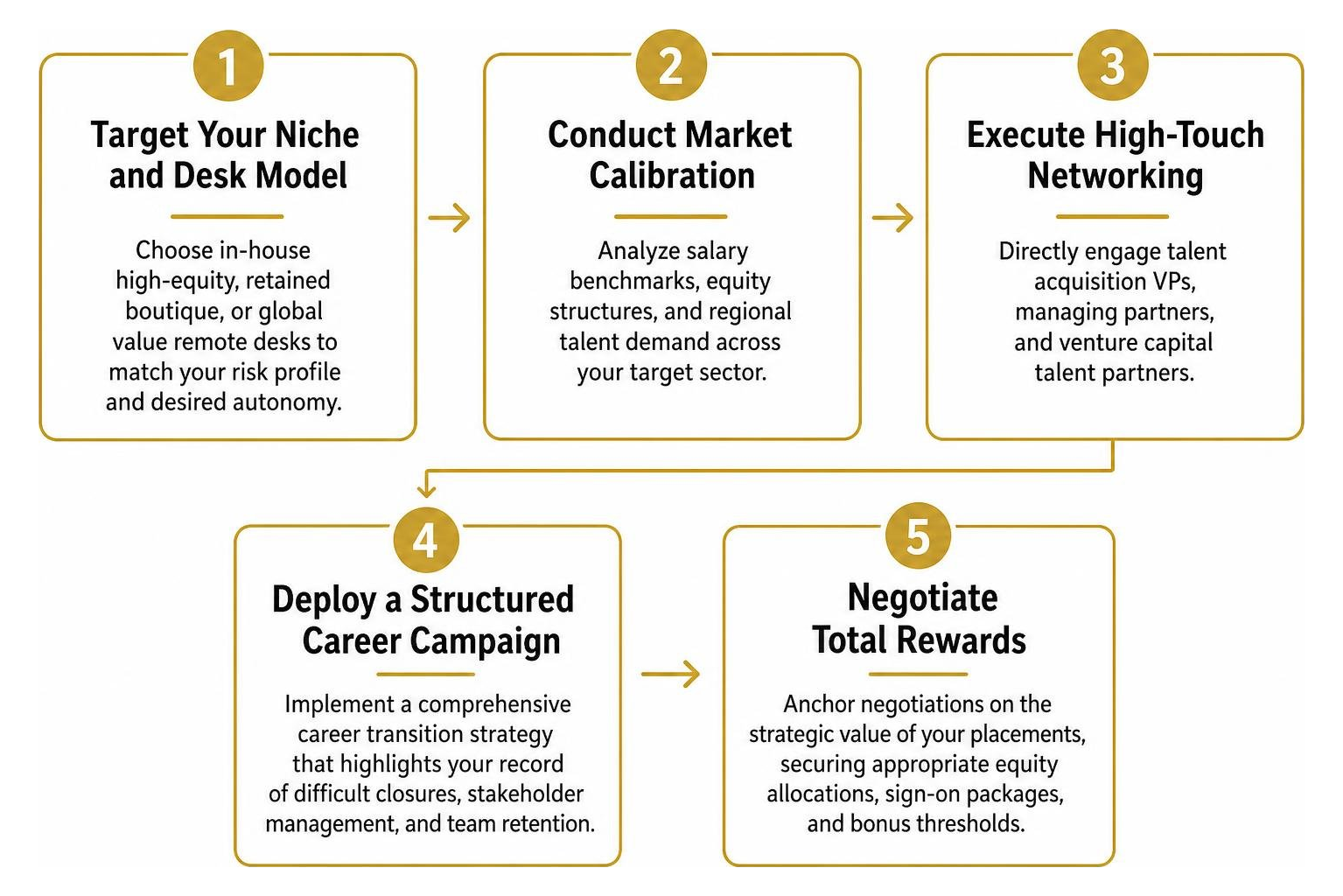
- Target Your Niche and Desk Model: Choose whether to pursue high-equity in-house corporate search, retained executive boutique firms, or global value remote desks based on your risk profile and desired autonomy.
- Conduct Market Calibration: Analyze salary benchmarks, equity structures, and regional talent demand across your target sector.
- Execute High-Touch Networking: Directly engage talent acquisition vice presidents, managing partners, and venture capital talent partners.
- Deploy a Structured Career Campaign: Implement a comprehensive executive career transition strategy that highlights your record of difficult closures, stakeholder management, and team retention.
- Negotiate Total Rewards: Anchor negotiations on the strategic value of your placements, securing appropriate equity allocations, sign-on packages, and bonus thresholds.
Essential Portfolio Assets to Win Executive Recruiter Jobs
Landing a high-tier search role requires tangible proof of capability rather than generic statements:
- Search Diagnostic Case Studies: Documented reviews of unfillable requisitions you turned around, detailing candidate pipeline metrics and time-to-fill improvements.
- Confidential Talent Maps: Visual breakdowns illustrating how you map competitive ecosystems for rare C-suite profiles.
- Executive Calibration Frameworks: Examples of stakeholder alignment matrices used to reconcile competing founder or board expectations.
- Optimized Professional Positioning: A cohesive narrative established through targeted resume and LinkedIn optimization that presents you as a strategic search partner.
Navigating Multi-Stakeholder Calibration and Board Interviews
Interview loops for executive recruiting desks mirror C-suite evaluations. You will be assessed on business acumen, emotional intelligence, and crisis management by founders, board members, and business unit heads.
Prepare for complex case presentations, live role-scoping exercises, and behavioral assessments regarding stakeholder conflict. Using tailored interview coaching and preparation ensures you present structured frameworks for handling executive pushback, managing candidate drop-offs, and negotiating sensitive multi-million-dollar executive offers.
Overcoming Critical Search Obstacles, Imposter Syndrome, and Golden Handcuffs

Operating in high-stakes search desks brings significant psychological and professional pressures. Executive recruiters manage demanding stakeholders, handle failed searches, and navigate volatile market cycles.
Managing Imposter Syndrome During Career Inflection Points
Coined in 1978 by psychologists Pauline Clance and Suzanne Imes, imposter syndrome affects up to 70% of professionals at some point in their careers. High-performing recruiters stepping into executive-level desks often experience self-doubt when advising board members or negotiating nine-figure leadership packages.
Combating this requires evidence-based self-management:
- Empirical Win Logging: Maintain an active record of quantifiable outcomes, including completed searches, placed executives’ tenures, and systemic workflow improvements.
- Reframing Discomfort: Recognize that feeling challenged indicates career growth rather than incompetence.
- Applying Objective Scrutiny: Evaluate your performance using the same data-driven criteria you apply to candidate assessments.
- Strategic Advisory Support: Engage targeted executive leadership coaching to refine executive presence and reinforce your strategic authority.
Avoiding Golden Handcuffs and Poison Chalice Roles
Recruiting professionals often face attractive offers that carry hidden career risks:
Attractive cash packages can sometimes tether recruiters to broken environments with unrealistic expectations, high turnover, and unclosable searches. Evaluate every placement desk for organizational health, leadership support, and realistic search parameters. Building strong personal branding helps ensure your market reputation remains tied to strategic expertise rather than a single firm’s brand.
Frequently Asked Questions about Executive Search Careers
What is the primary difference between a corporate recruiter and an executive recruiter?
Corporate recruiters typically manage high-volume requisitions across early-to-mid career tiers using established applicant tracking workflows. Executive recruiters manage low-volume, high-impact searches for directors, vice presidents, and C-suite executives. Their work involves confidential talent mapping, deep compensation design, organizational design advisory, and high-touch stakeholder management.
How are remote executive search roles structured in 2026?
Remote executive search positions increasingly utilize global value compensation models. Rather than adjusting pay based on local living costs, firms offer fixed high-value hourly rates (such as $100/hr or $200,000 annually) focused on outputs and candidate closures. Recruiters operate autonomously, using custom AI workflows and direct stakeholder communication to solve difficult hiring mandates without geographical constraints.
What skills are non-negotiable for 7+ year senior executive recruiters?
Senior executive search professionals must demonstrate:
- Comprehensive candidate ecosystem mapping and confidential sourcing.
- Executive stakeholder management and board-level calibration.
- Sophisticated executive compensation structuring (including equity, profits interests, and retention packages).
- Proficiency with AI-driven search analytics and automated workflow tooling.
- Advanced negotiation and white-glove closing strategies.
Conclusion
Securing a high-performing executive recruiter seat requires market clarity, demonstrated search leadership, and a distinct professional value proposition. Whether your goal is leading in-house searches at high-growth technology companies or managing high-yield remote placement desks, sustained career growth comes from structured planning and rigorous execution.
We invite you to explore our job search strategies or contact us directly to position your search career for its next high-impact placement desk.