
table of contents
Core Elements of a Winning Executive Bio
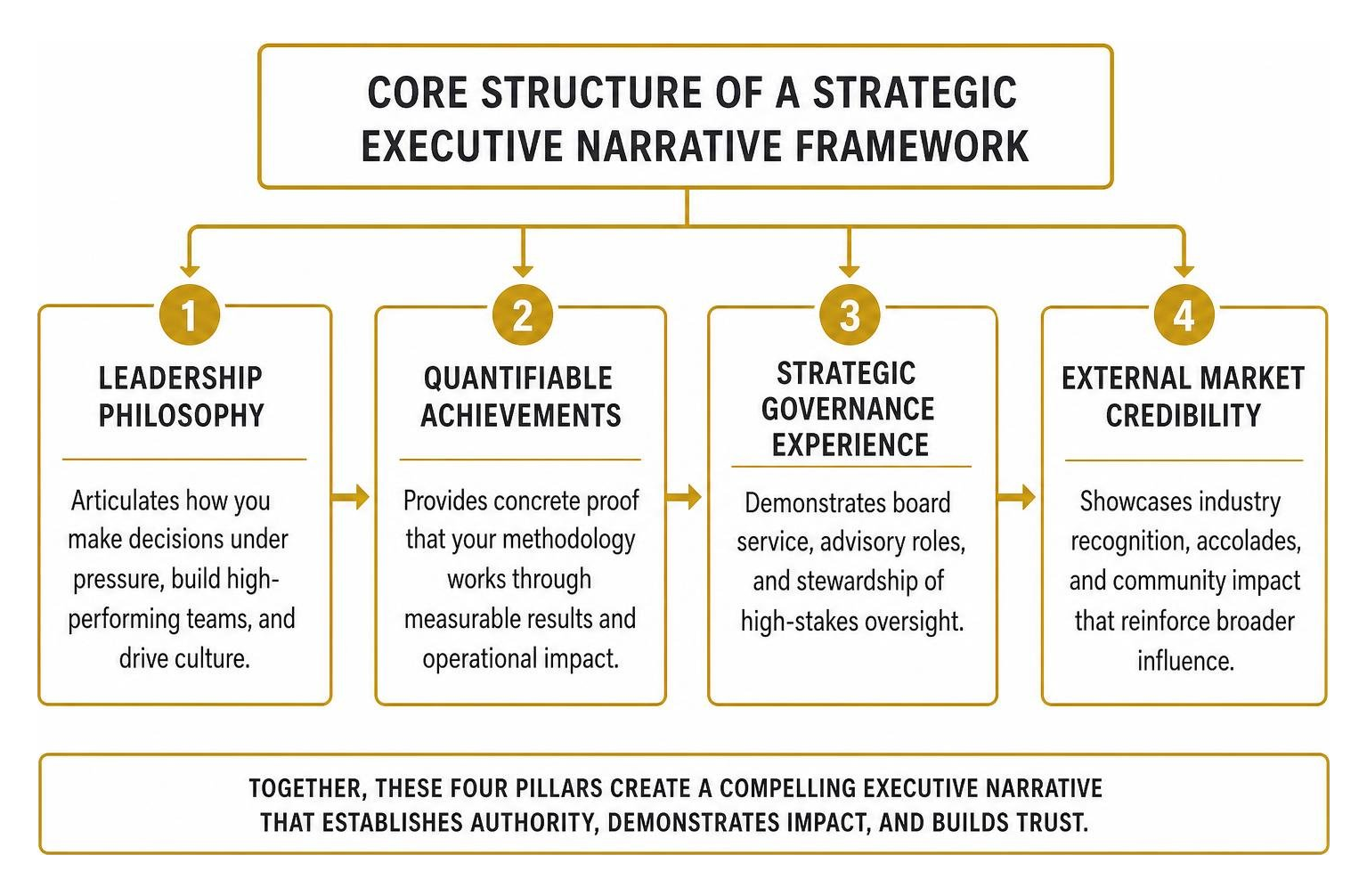
Writing a powerful narrative requires moving beyond raw job descriptions. When we craft leadership profiles for top-tier executives, we focus on translating dense work histories into high-level strategic assets. A winning biography balances four foundational pillars: a distinct leadership philosophy, hard quantifiable achievements, strategic governance experience, and external market credibility.
Your leadership philosophy articulates how you make decisions under pressure, build high-performing teams, and drive organizational culture. Meanwhile, your quantifiable achievements provide concrete proof that your methodology works. Stating that you “led operational transformations” carries far less weight than noting that you “scaled business unit revenues by 40% while navigating enterprise restructuring.” By intentionally advancing your personal branding, you ensure every metric serves a broader story about your commercial acumen.
A truly effective executive bio also communicates the scale and complexity of the environments where you have operated. Whether you have managed global P&L responsibility, overseen multi-billion-dollar capital allocation, or led thousands of employees across international markets, these details help boards and investors understand the magnitude of your decision-making authority. The strongest profiles connect leadership philosophy to measurable outcomes, showing not only what you believe but how those beliefs have produced tangible enterprise value.
| Dimension | Executive Bio | Executive Resume |
|---|---|---|
| Primary Purpose | Storytelling, establishing authority, humanizing leadership | Detailed career accounting, skills verification, hiring screening |
| Tone & Voice | Narrative, third-person editorial, warm yet authoritative | Structured, concise, bullet-driven, action-verb oriented |
| Format & Layout | Fluid paragraphs, thematic sections (300–500 words) | Reverse-chronological, segmented by job titles and dates |
| Primary Audience | Board members, media, conference organizers, investors | Executive recruiters, search committees, talent acquisition |
| Core Focus | High-level vision, major career milestones, philosophy | Granular duties, day-to-day scope, specific software/tools |
Structuring Your Executive Bio for Maximum Impact
A well-structured narrative guides the reader seamlessly from your current high-stakes responsibilities to your overarching vision. We recommend a four-part narrative arc:
- The Opening Hook & Executive Scope: State your current executive mandate, industry domain, and the overall enterprise scale you oversee (such as balance sheet accountability, market cap, or global workforce size).
- Career Trajectory & Pivotal Milestones: Highlight the strategic turnarounds, market expansions, and operational triumphs that define your climb to executive leadership.
- Strategic Milestones & Operational Excellence: Provide 2–3 quantified examples of how your leadership directly improved profitability, operational efficiency, or technological capabilities.
- Foundations, Education & Values: Anchor your authority with advanced credentials, executive education, core personal values, and community impact.
Consider how Denise Dignam’s corporate leadership is framed in the chemicals sector: her profile establishes her executive mandate at Chemours while demonstrating that she previously oversaw business units generating over 68% of the company’s net sales. Anchoring operational scale alongside a clear narrative creates instant authority.
Weaving Governance, Accolades, and Community Legacy
True executive influence extends beyond internal operational metrics. Senior decision-makers, search committees, and advisory boards look for indications of broader industry standing. Integrating board appointments, advisory committee roles, high-profile awards, and philanthropic commitments signals that your leadership carries weight across the wider business ecosystem.
Mentorship and community responsibility also show how you invest in long-term enterprise sustainability. A prime example is the global energy leadership from Amin H. Nasser, whose profile highlights his stewardship of massive upstream capital programs alongside his prestigious SPE Lifetime Achievement Award, board positions at MIT and BlackRock, and personal championing of youth development initiatives. These external markers of credibility demonstrate that your influence extends beyond quarterly results and into the broader communities and institutions you serve.
Developing the Executive Narrative: From Early Career to Visionary Leadership
Every executive journey is shaped by foundational experiences, early technical training, and distinct career pivots. When developing your narrative, we look at the entire arc of your professional history to understand how past milestones inform your current leadership strengths. Whether you are seeking new board seats or navigating an executive career transition strategy, highlighting your foundational roots demonstrates resilience and versatility.
Non-linear career paths often make for the most compelling biographies. An executive who started in engineering before moving into corporate finance brings a rare balance of technical literacy and fiscal discipline. Highlighting these intersections shows search committees that you possess the multidimensional problem-solving skills required for modern C-suite roles. The most memorable executive bios do not simply list promotions; they reveal the strategic reasoning behind each pivot and the transferable capabilities gained along the way.
Highlighting Milestones, Challenges, and Strategic Evolution
Great leadership is tested in complex, volatile environments. Rather than glossing over industry downturns or operational hurdles, your narrative should illustrate how you guided organizations through turbulence. Detail the turning points: how you managed regulatory overhauls, rebuilt broken supply chains, or engineered post-merger integrations. These moments of challenge often reveal more about your leadership character than years of steady-state performance.
Demonstrating strategic advocacy and resilience is central to Suzanne P. Clark’s policy advocacy at the U.S. Chamber of Commerce. Her leadership narrative highlights proactive modernization, spearheading major infrastructure and tax policy wins, and leading landmark legal defenses to protect enterprise growth across international forums like the G20 and B7. By framing her career around pivotal advocacy victories rather than routine responsibilities, her bio communicates the scale and significance of her executive influence.
Showcasing Innovation, Modernization, and Future Vision
In today’s landscape, senior executives must demonstrate tech fluency and forward-looking market vision. Whether your focus involves generative AI integration, digital transformation, or sustainable modernization, your profile must show that you proactively anticipate industry shifts rather than merely react to them. Boards and investors increasingly prioritize leaders who can articulate a clear vision for how emerging technologies will reshape their competitive landscape.
Bridging technical domain expertise with bold modernization is evident in Najat Khan’s TechBio innovations, where her narrative centers on combining artificial intelligence with biological data to build bilingual teams, execute major industry mergers, and radically accelerate drug discovery pipelines. Her profile demonstrates how forward-looking executives position themselves at the intersection of scientific rigor and technological disruption, signaling to stakeholders that they are prepared to lead through the next wave of industry transformation.
Strategic Distribution and Multi-Channel Alignment

An executive narrative is only as effective as its distribution. Your profile must be tailored across multiple touchpoints to maintain a consistent executive presence, from keynote speaker introductions and corporate annual reports to press kits and digital platforms. Ensuring seamless continuity across these formats begins with optimizing your resume and LinkedIn so your public persona aligns with your formal board dossier.
Tailoring the Executive Bio Across Media and Platforms
Different audiences require different levels of detail. We recommend maintaining three distinct versions of your profile:
- The Full-Length Narrative (400–600 words): Designed for corporate websites, investor relations packets, venture funding prospectuses, and board candidacy packets.
- The Short Profile (150–250 words): Ideal for conference speaker pages, panel introductions, guest editorial bylines, and advisory bios.
- The Micro Bio (50–75 words): Built for social media summaries, podcast introductions, and media press releases.
Notice how Samuel C Wilson’s technology leadership balances these elements across platforms, combining his military veteran background as a U.S. Army Captain with quantifiable executive metrics—such as scaling annual enterprise billings from $26M to $200M and driving 121% year-over-year AI adoption. His approach illustrates how a single leadership narrative can be compressed or expanded without losing its core authority and impact.
Translating Bio Narratives into High-Stakes Interactions
Your written narrative serves as the script for high-stakes conversations. When engaging with institutional investors, media outlets, or executive search committees, the themes in your profile should naturally anchor your spoken communication. Partnering with professionals for interview coaching and preparation ensures that your verbal presence matches the authority established in your written materials.
A cohesive narrative bridges decades of execution with strategic foresight, much like S. N. Subrahmanyan’s infrastructure milestones at Larsen & Toubro. His profile connects his 1984 start as a planning engineer to his leadership in delivering the world’s tallest statue and pioneering massive digital transformations across a multi-billion-dollar global conglomerate. When your written bio and spoken presence tell the same story, you project a level of executive coherence that resonates with boards, investors, and media alike.
Frequently Asked Questions About Executive Bios
What is the ideal length for a senior executive bio?
For most executive applications, a standard full-length bio should be between 350 and 500 words across three to four focused paragraphs. However, leaders should maintain a suite of lengths, including a 150-word short bio for speaking engagements and a 50-word micro bio for media mentions. The key is to ensure that each version preserves your core leadership narrative while adapting the level of detail to the context. A board submission may require deeper governance detail, while a conference program bio should emphasize your most relevant speaking credentials and industry authority.
How does an executive bio differ from a standard resume?
While a resume is a chronological record of positions, tools, and tactical responsibilities designed for recruiters, an executive bio is a high-level narrative. It synthesizes leadership philosophy, major career milestones, commercial impact, and industry vision into a cohesive editorial story. Resumes answer the question “What did you do?” while executive bios answer the deeper question “Who are you as a leader, and what value do you bring to organizations?” This distinction matters because boards and investors are evaluating not just your qualifications but your strategic judgment, communication style, and cultural fit.
How often should a C-level executive update their bio?
Executives should conduct a comprehensive review of their biography at least once a year. Additionally, immediate updates should occur following major trigger events, such as joining a new board, completing a significant M&A transaction, winning industry awards, or pivoting organizational strategy. An outdated bio can undermine your credibility in high-stakes situations, so treat your executive narrative as a living document that evolves alongside your career trajectory and market positioning.
Conclusion
Your executive bio is far more than a summary of past roles; it is the strategic narrative that establishes your leadership footprint, validates your commercial authority, and defines your ongoing career legacy. In an increasingly competitive global market, senior leaders cannot rely on generic templates or dry resumes to convey their value proposition.
At MyExpertCoach, our team brings over 25 years of insider recruiting expertise to build fully customized, non-template executive branding suites. By pairing an authoritative written narrative with proven executive job search strategies, we help senior leaders articulate their vision, command board attention, and secure their next high-impact leadership mandate. Whether you are preparing for a board candidacy, a major media appearance, or a strategic career pivot, a compelling executive bio is the foundation upon which your entire executive presence is built.