
table of contents
How to Write a Cover Letter for an HR Executive With Experience
To write a cover letter for an HR executive with experience, lead with the business problem you can solve. Name the role, then show one or two results that match the company’s needs, such as lower turnover or faster hiring. Explain how you led the work, connect it to a company goal, and close by asking to discuss the role. Keep the letter to one page, ideally 250-350 words.
Your résumé shows what you have done. Your cover letter should show why that work matters to this employer.
I’m Sandy Spencer, an executive career coach with 38 years of experience in HR and executive recruiting. I’ll help you turn a search for “cover letter for hr executive with experience” into a focused pitch for your next leadership role.
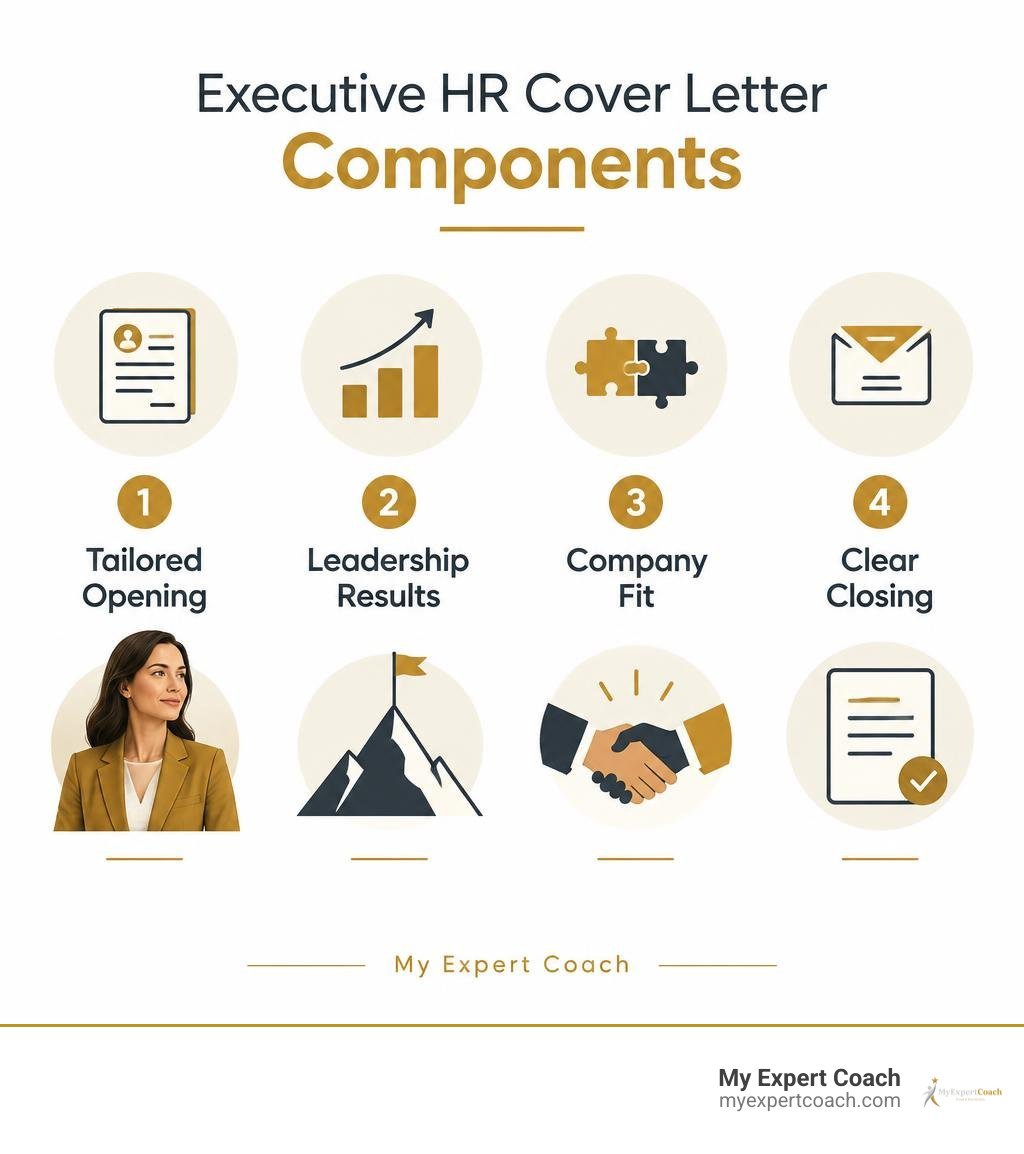
Strategic Blueprint for a Cover Letter for an HR Executive with Experience
Writing a high-level pitch requires stepping out of the day-to-day administrative mindset. As senior HR leaders, we spend our careers reading candidate materials, which often makes writing our own surprisingly difficult. When targeting Chief Human Resources Officer (CHRO), Vice President of People, or Head of Talent roles, your letter must reflect executive poise, commercial acumen, and strategic clarity.
The gold standard for senior applications remains a strict one-page limit. Modern hiring committees and executive recruiters evaluate dozens of high-caliber profiles; they do not have time to wade through two pages of dense paragraphs. Aiming for an ideal length of 250 to 350 words across three to four punchy paragraphs allows you to showcase strategic vision without overwhelming the reader.
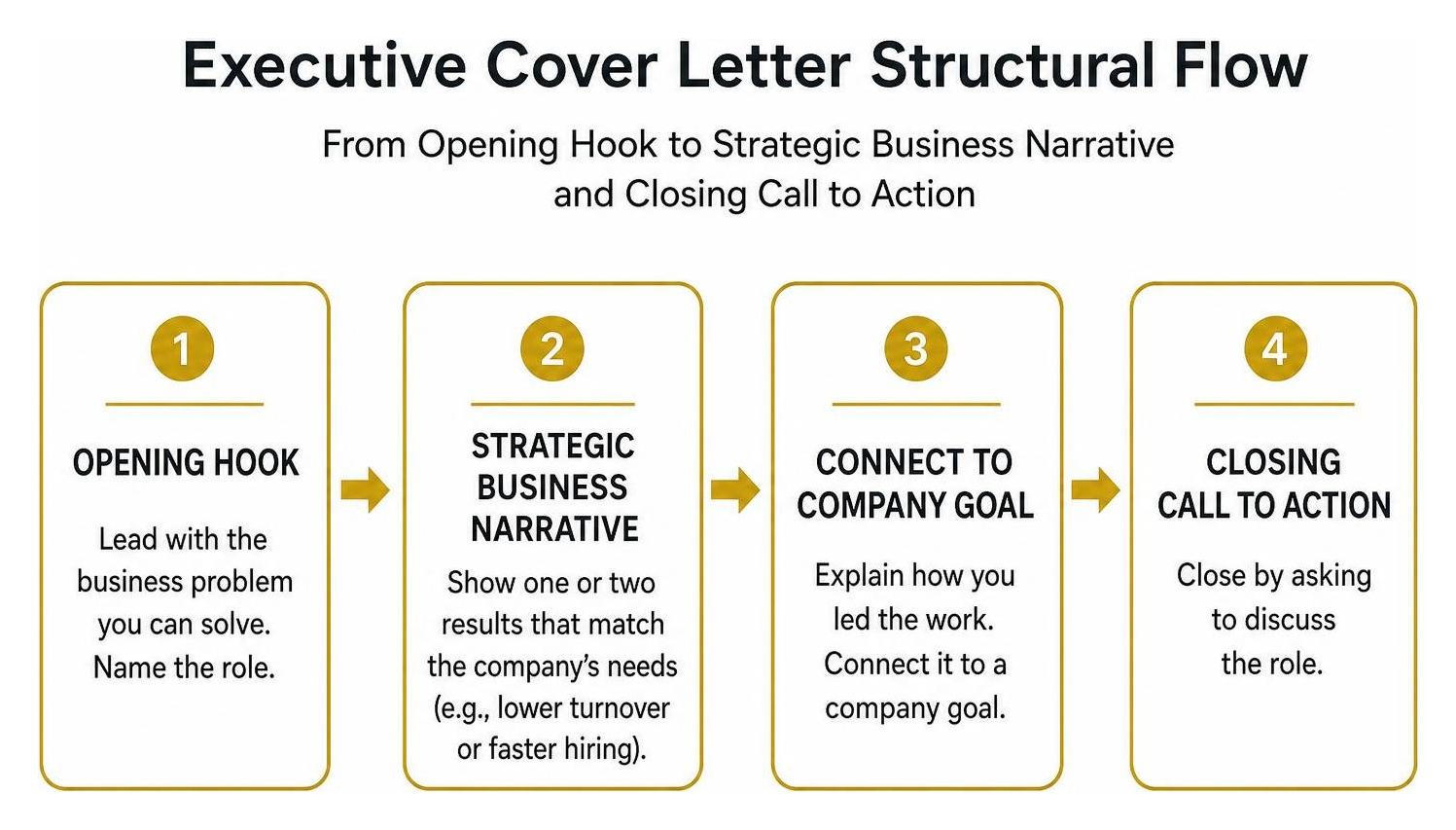
Anatomy of a High-Impact Cover Letter for an HR Executive with Experience
A well-structured cover letter guides the reader’s eye directly to your value proposition. Every element on the page should reinforce your authority and leadership brand:
- Header Architecture: Position your full name, location, phone number, professional email, and optimized LinkedIn URL cleanly at the top. Ensure formatting aligns visually with your résumé.
- Personalized Salutation: Avoid generic openers like “To Whom It May Concern.” Direct your letter to the Board Chair, CEO, or the specific Search Committee Lead by name.
- The Hook: Open with immediate impact by stating the executive position you are pursuing and your defining leadership value proposition.
- Strategic Narrative (The Core): Deliver one or two quantifiable business transformations where your talent strategy directly solved an operational or cultural challenge.
- Cultural & Vision Alignment: Articulate why their mission aligns with your leadership philosophy and how you plan to guide their workforce into its next growth phase.
- Confident Call to Action: Close professionally by proposing an introductory dialogue, expressing appreciation for their consideration.
When refining your overall presentation, aligning your document structure with The Ultimate Guide to Executive Resume Best Practices ensures your entire application suite delivers a cohesive message.
Executive HR Cover Letter vs. Mid-Level Generalist Applications
A common mistake seasoned HR leaders make is drafting an expanded generalist letter. Executive recruiting panels are not looking for someone who simply administers employee handbooks; they are hiring an organizational architect who protects the bottom line, scales culture, and partners with the C-suite.
| Feature | Mid-Level HR Generalist Pitch | Executive HR Leadership Pitch |
|---|---|---|
| Primary Scope | Tactical HR delivery, policy enforcement, conflict resolution | Enterprise workforce strategy, talent governance, executive succession |
| Core Language | “Managed benefits enrollment and onboarding workflows” | “Architected human capital strategies scaling headcounts from 400 to 2,500” |
| Business Alignment | Departmental efficiency and day-to-day compliance | Board-level governance, human capital ROI, M&A integration |
| KPIs Highlighted | Requisition fill counts, training hours completed | Enterprise turnover reduction, healthcare spend containment, revenue per employee |
Translating Talent Strategy and Leadership into Measurable Business Value
To win C-suite trust, your application must demonstrate how your initiatives drive business performance. Boards view human resources not as a cost center, but as a primary lever for operational growth, risk mitigation, and enterprise valuation.

Quantifying Business ROI in Your Cover Letter for an HR Executive with Experience
Data provides objective proof of your leadership impact. When discussing past initiatives, pair your strategic narrative with exact metrics, percentages, and financial outcomes. Consider how your people initiatives translated into bottom-line gains:
- Turnover Reduction: “Spearheaded an enterprise-wide employee retention and wellness framework across 1,800 employees, driving a 20% decrease in voluntary turnover and lifting team satisfaction scores by 15% within 12 months.”
- Cost Containment: “Restructured multi-state self-funded healthcare plans and vendor partnerships, reducing annual insurance premiums by 36% without reducing employee coverage tiers.”
- Talent Acquisition Velocity: “Transformed talent acquisition pipelines for high-demand engineering teams, cutting average time-to-hire by 4 weeks while reducing external agency spend by $450,000 annually.”
- Workforce Upskilling: “Designed and launched a scalable sales leadership development academy that directly contributed to a 10% increase in regional sales performance over six months.”
Integrating these quantifiable outcomes helps recruiters understand the scale of your past oversight immediately.
Demonstrating Organizational Transformation and Culture Alignment
Beyond the numbers, executive search committees want to see how you steer organizations through volatility, mergers, or rapid expansion. Detail your change management capabilities by highlighting how you built consensus among department heads, modernized legacy policies, or embedded robust diversity, equity, and inclusion (DEI) governance into hiring frameworks.
Consulting industry guidance like How to Write a Great HR Cover Letter reinforces the importance of showing emotional intelligence alongside strategic planning. Show that you understand the target employer’s market challenges and can build an agile culture capable of meeting them.
Tailoring Formats and Strategic Hooks for Executive Search and C-Suite Roles
Senior executive hiring often bypasses traditional automated intake portals. Whether you are connecting through retained executive recruiters or reaching out directly to a corporate board, your delivery format must fit the context of your outreach.
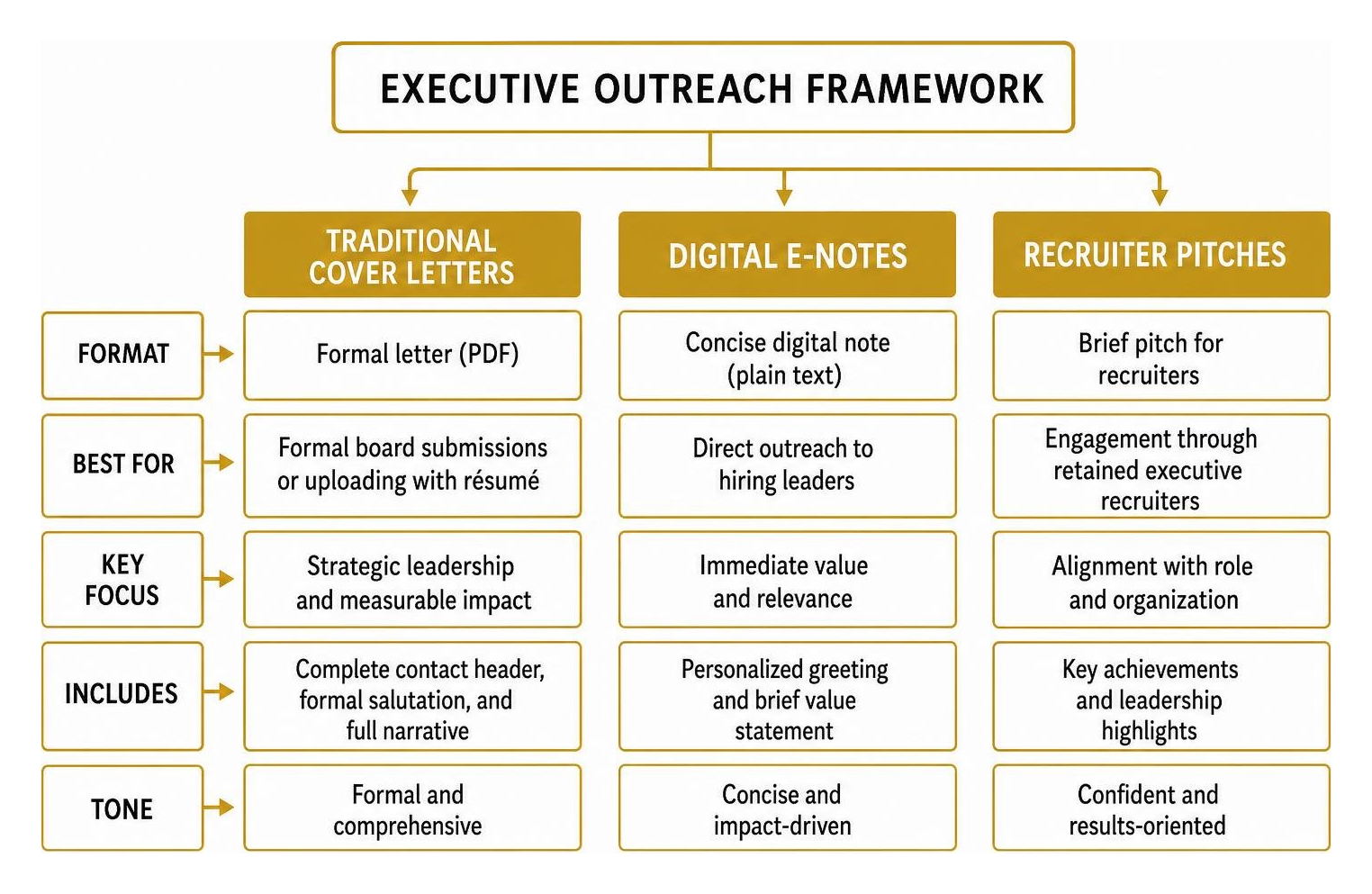
Choosing Between Traditional Letters, E-Notes, and Recruiter Outreach
Different channels require slight variations in formatting:
- Traditional Formal Letters (PDF): Best for formal board submissions or when uploading materials alongside your executive résumé. These include a complete formal contact header, formal salutation, and full narrative layout.
- Executive E-Notes (Direct Email): Ideal when contacting a search firm partner, CEO, or board member directly via email. Strip out the top postal addresses and jump straight into an engaging greeting, two concise value-driven paragraphs, and a closing invitation to connect.
- Recruiter Networking Inquiries: Tailored specifically for retained search consultants managing confidential searches. Focus heavily on your functional domain expertise, compensation expectations scope, and mobility.
When executing an executive career transition strategy, pairing an impactful e-note with a well-timed outreach email drastically improves response rates from top search partners.
Compelling Openings and High-Conversion Closing Statements
Your opening sentence sets the tone for your leadership authority. Avoid passive statements like “I am writing to express my interest in…” Instead, lead with strategic ownership:
Strong Opening Example:
“As an HR executive who has scaled high-growth technology enterprises through two successful IPOs, I have built people frameworks that align talent strategy directly with enterprise EBITDA goals. I am eager to bring this background to the Chief People Officer role at [Target Company].”
High-Conversion Closing Example:
“I welcome the opportunity to discuss how my background in modernizing talent architecture, containing operational costs, and cultivating leadership pipelines can support [Target Company]’s international expansion. Thank you for your time and strategic consideration.”
Preparing these high-impact talking points early also pays dividends later when transitioning into interview coaching and preparation sessions.
Common Pitfalls to Avoid in Senior Human Resources Cover Letters
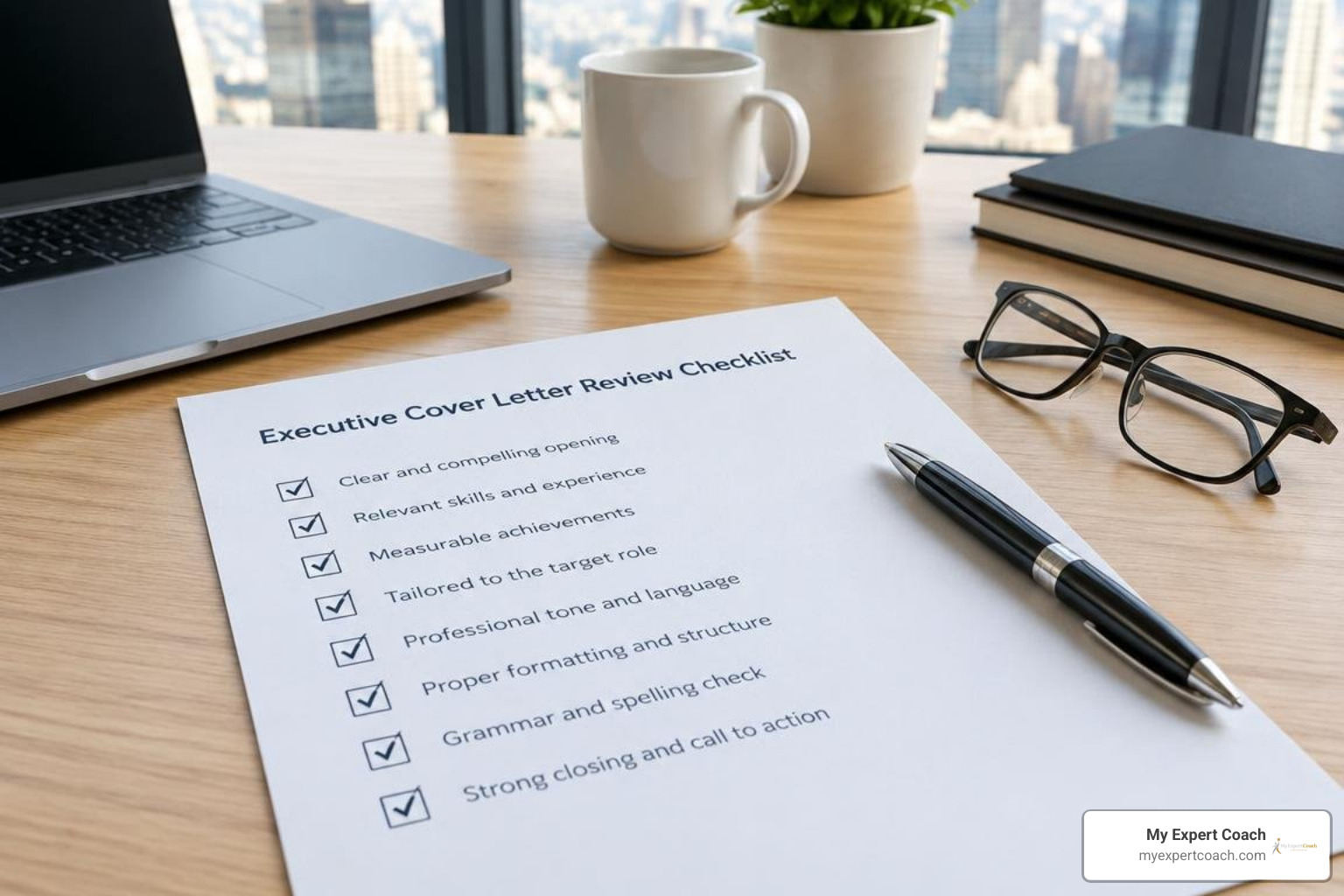
Even seasoned leaders sometimes stumble when writing about themselves. Keep your pitch sharp by avoiding these frequent missteps:
- Using Cookie-Cutter Templates: Generic text communicates a lack of genuine interest. Every letter must be uniquely tailored to the company’s business stage.
- Rehashing Your Résumé Verbatim: Your cover letter should interpret your journey, explain the context behind your major wins, and connect your past success to the company’s future goals.
- Focusing on Tactical Administration: Avoid spending valuable space explaining how you run payroll cycles or manage basic personnel files. Keep the focus on strategy, organizational design, and governance.
- Exceeding the One-Page Boundary: Brevity signals executive communication skills. If your letter approaches 500 words, edit ruthlessly to keep it between 250 and 350 words.
- Omitting Tangible Metrics: Claims of being a “transformational talent leader” fall flat without real numbers, percentages, or cost-containment metrics to back them up.
- Neglecting Final Proofreading: As an aspiring HR executive, your written communication is evaluated as an example of your standard for the entire organization. Review names, titles, and metrics thoroughly.
Frequently Asked Questions About Senior HR Cover Letters
How long should a senior HR executive cover letter be?
Your letter should be exactly one page, ideally between 250 and 350 words divided into three or four structured paragraphs. Executive decision-makers value leaders who can distill complex career histories into clear, strategic narratives.
How do I tailor my executive HR pitch to a company’s strategic goals?
Review the organization’s recent annual reports, press releases, leadership interviews, and market performance. Identify their primary workforce challenges—such as scaling post-merger, entering international markets, or reducing attrition—and position your past accomplishments as direct solutions to those needs.
What is the most effective way to address executive search consultants?
When working with retained executive recruiters, address them by name and immediately clarify your strategic scope (e.g., enterprise headcount managed, global vs. domestic oversight, industry verticals). Emphasize your board-level experience, governance credentials, and willingness to lead organizational transformation.
Conclusion
Your cover letter is your introduction to the C-suite and the board. By framing your human capital expertise around measurable business value, fiscal discipline, and strategic vision, you position yourself as a true business partner who drives growth through people.
At MyExpertCoach, we combine over 25 years of insider HR and executive recruiting experience with bespoke, non-template strategies that have advanced more than 10,000 careers. When you are ready to position your leadership brand for top-tier opportunities, explore our custom executive resume and LinkedIn optimization services to build an application portfolio that commands C-suite attention.