
table of contents
Where to Find Executive Career Opportunities in 2026
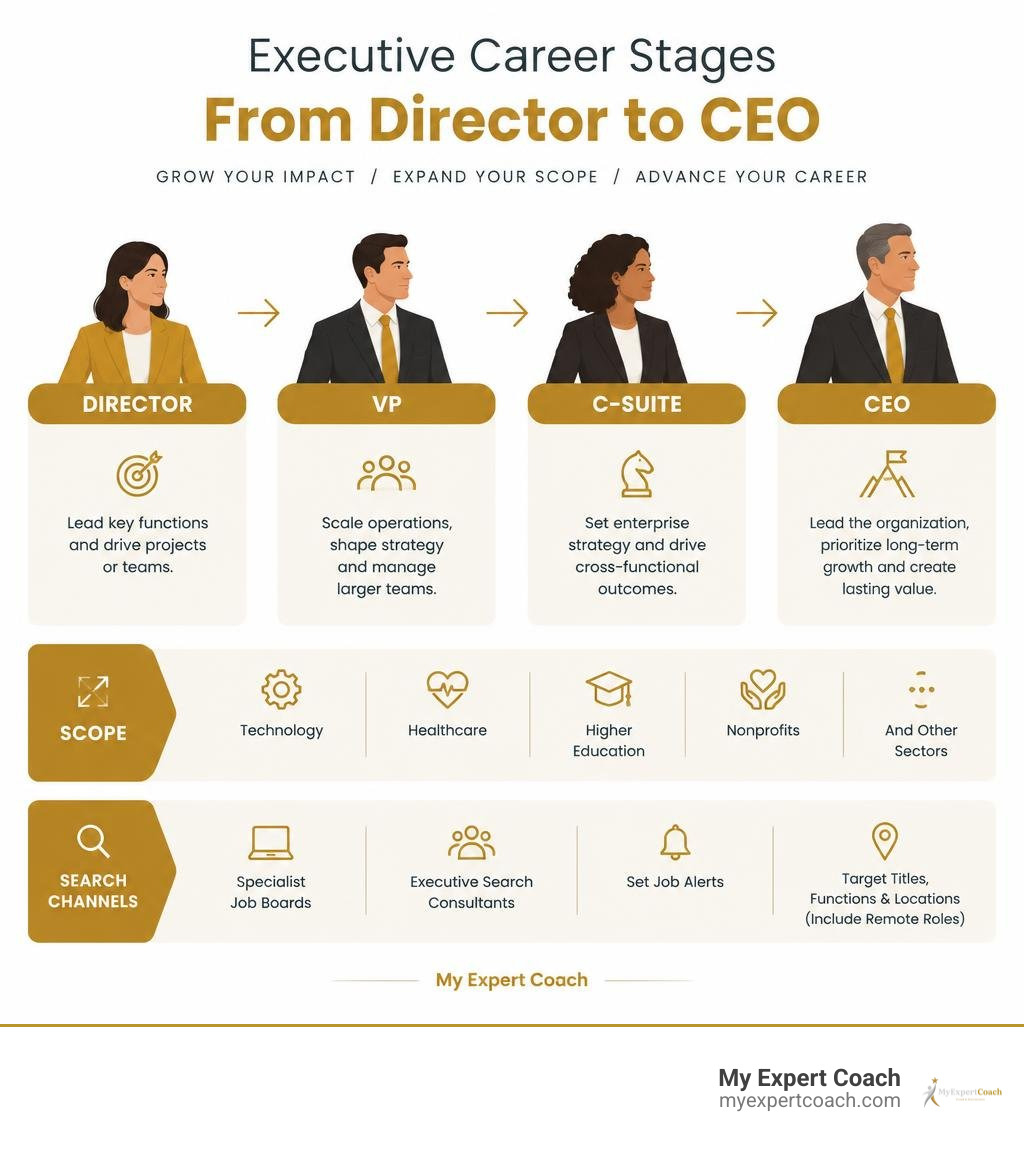
Start with the role you want, then search in more than one place. Director, VP, and C-suite openings span technology, healthcare, higher education, nonprofits, and other sectors. Check specialist job boards for posted roles, and build relationships with executive search consultants to hear about confidential openings. Set alerts for your target titles, functions, and locations, including remote roles.
Before you apply, make sure your CV and LinkedIn profile show the results you led, not just the teams you managed. That makes it easier to assess which roles fit your next move.
I’m Sandy Spencer, a career coach with more than 38 years of experience in HR and executive recruiting. I’ve helped senior leaders position themselves for executive career opportunities, from VP roles to the C-suite.
Executive Career Opportunities Across the Leadership Hierarchy: Director, VP, and C-Suite
Navigating executive career opportunities requires an understanding of where your profile sits within corporate governance frameworks. Moving up the organizational hierarchy is rarely about managing more people. Instead, it involves expanding enterprise impact, taking on direct financial accountability, and translating ambiguous business goals into measurable value.

Director vs. VP vs. C-Suite Responsibilities and Compensation
Director-level positions focus heavily on operational execution, team performance, and resource alignment. Moving into a Vice President role demands cross-functional strategy, market development, and shared profit-and-loss (P&L) accountability. At the C-suite level, leaders carry total enterprise risk, answer directly to the board of directors, drive shareholder value, and set long-term vision.
Compensation packages evolve dramatically across these tiers. While Director pay consists primarily of base salary and performance bonuses, C-suite packages heavily weight long-term equity, enterprise incentives, and severance protections. To browse real-time compensation trends and openings, explore curated platforms like C-Suite Jobs – Chief Jobs | The C-Suite Job Board.
| Leadership Level | Primary Scope & Focus | Typical Reporting Lines | Compensation Structure Breakdown |
|---|---|---|---|
| Director | Departmental execution, operational oversight, program delivery | Reports to VP or Senior VP | 70–80% Base Salary, 15–20% Annual Bonus, limited equity |
| Vice President (VP) | Multi-team strategy, budget management, functional vision | Reports to Executive VP or C-Suite Officer | 55–65% Base Salary, 25–35% Performance Bonus, structured equity/options |
| C-Suite (CXO/CEO) | Enterprise governance, total P&L, board relations, corporate strategy | Reports to CEO, Executive Committee, or Board of Directors | 30–50% Base Salary, significant equity (RSUs/Options), long-term incentives |
Evaluating Rotational Leadership and Executive Fast-Track Pathways
Not all executive careers follow a single vertical climb within one department. Large global enterprises offer structured pathways designed to develop cross-functional leaders rapidly.
For instance, programs such as the Executive Fast Track Program | Bosch Global provide 12-month accelerated tracks featuring rotational assignments every 3 to 4 months. These initiatives pair emerging leaders with top-management mentors, dedicated training budgets, and pre-negotiated permanent leadership roles upon completion. Programs like these demonstrate how deliberate exposure across operations, finance, and international business builds enterprise-ready executives.
Navigating Industry Sectors and Global Market Trends in 2026
The executive hiring market in 2026 is defined by industry diversification. High-caliber leaders are moving seamlessly across commercial enterprises, research organizations, and institutional foundations.
High-Growth Sectors: Tech, Healthcare, Higher Education, and Nonprofits
Leadership demand remains strong across several distinct industries:
- Technology & Artificial Intelligence: Fast-scaling companies in artificial intelligence, cloud infrastructure, and cybersecurity are recruiting specialized C-suite talent, including Heads of AI, Chief Compliance Officers, and VPs of Product.
- Higher Education: Academic leadership represents a robust, distinct executive market. Current academic job boards show 160 open positions for Academic Vice Presidents and Provosts, 45 open roles for Presidents and Chancellors, and 673 Dean positions (including 78 Business Deans and 115 Health Sciences Deans).
- Nonprofit & Foundations: Mission-driven organizations are hiring transformative executive directors and advancement leaders. Compensation ranges from $90,000–$100,000 for specialized regional directors to $350,000–$500,000 for major healthcare foundation chief executives.
- Healthcare & Life Sciences: Biotechnology and clinical research institutes offer highly competitive CEO compensation packages, regularly ranging from $275,000 to over $350,000 annually.
Remote and International Executive Career Opportunities
Distributed leadership is now permanent. With more than 1101 Remote Executive Jobs in October 2026 | RemoteOnly listed across the market, senior executives can manage global teams without relocating to corporate headquarters.
International expansion has also surged. European and cross-border tech enterprises are actively securing VPs of International Growth, Chief of Staff operators, and operational leaders across major hubs like London, Berlin, and Paris. Fractional and asynchronous C-suite engagements allow seasoned leaders to advise multiple high-growth entities simultaneously.
Accessing the Hidden Job Market and Executive Search Firms
The most lucrative executive positions are rarely posted on public job boards. Boards of directors and private equity firms use confidential searches to protect market sensitive information and manage public relations during leadership transitions.
How to Target Confidential and Unadvertised Leadership Roles
Accessing off-market positions requires a proactive approach. Executive search platforms such as Executive Jobs | C-Suite, VP, and Board Openings operate on strict per-opportunity consent models. Recruiters maintain private candidate networks and only introduce profiles to hiring committees after vetting the candidate’s alignment with the role’s non-negotiables.
To unlock these hidden roles:
- Identify specialist retained search firms in your sector.
- Submit a concise executive briefing document outlining target compensation, functional strengths, and geographic parameters.
- Build ongoing relationships with executive recruiters before you launch an active job search.
Partnering with Retained Recruiters and Search Consultants
Executive recruiters are paid by the employer, never the candidate. Because search consultants represent client organizations, your goal is to make their calibration process effortless.
Position your leadership profile so that search partners can immediately recognize your ability to solve their clients’ operational problems. For a deeper understanding of recruiter operations and placement desks, read our breakdown on navigating executive recruiter positions and landing your next placement desk.
Structuring Cross-Functional Transitions Without Sacrificing Compensation
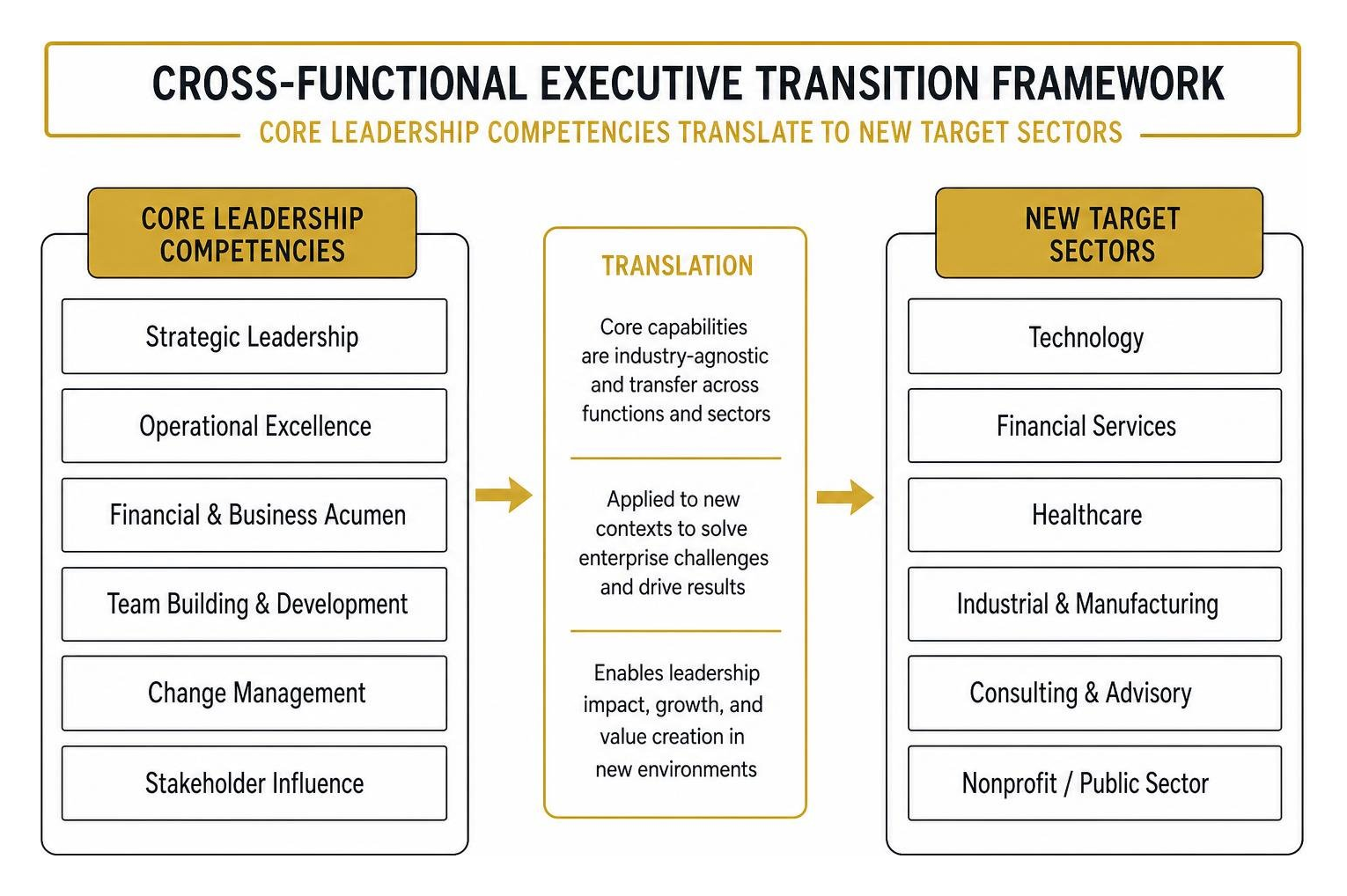
Senior executives often assume that changing industries or functions requires taking a pay cut. That is a myth. Executive compensation is tied to your ability to lead, manage enterprise risk, and generate revenue, not your mastery of narrow software tools or legacy processes.
Pivoting to Adjacent Executive Career Opportunities in Consulting and Operations
Financial and operational acumen translates smoothly into high-demand advisory and management fields:
- Strategic Consulting: Executive advisors and partners help companies scale, restructure, or streamline operations. Firms evaluate critical thinking, advisory presence, and client acquisition abilities over rigid industry backgrounds.
- Human Resources & People Leadership: Senior leaders with strong business acumen frequently transition into Chief People Officer or HR leadership roles by pairing their operational background with specialized HR credentials.
- Program & Project Management: Large-scale transformation programs require enterprise oversight. A background in P&L ownership and risk mitigation positions leaders for high-paying portfolio director positions.
Developing a targeted executive career transition strategy helps you map these transferable skills to target market requirements without sacrificing your earning power.
Strategic Positioning and Executive Branding Assets
Senior leaders cannot rely on standard, chronological resumes. When competing for seven-figure packages or board seats, your career narrative must showcase your personal brand and governance philosophy.
We help our clients develop bespoke, non-template portfolios that position them as industry authorities. Review the ultimate guide to executive resume best practices to ensure your LinkedIn presence and executive CV present an aligned, results-driven narrative.
Mastering the Executive Hiring and Compensation Process
Executive interviews are business meetings, not standard question-and-answer screenings. The hiring committee wants to assess your strategic vision, emotional intelligence, and cultural alignment.
The 4-to-8 Week Senior Leadership Interview Cycle
While entry-level recruiting moves fast, the executive hiring cycle typically takes four to eight weeks across several structured phases:
- Confidential Recruiter Screening: A 30-to-45 minute evaluation covering functional scope, leadership style, and compensation expectations.
- C-Suite & Hiring Committee Rounds: In-depth strategic interviews with the CEO, peer executives, and key operational stakeholders.
- Board Panel Presentation or Business Case: Delivering a 90-day plan, organizational redesign strategy, or operational vision to board directors.
- Psychometric & Leadership Assessment: Standardized evaluations measuring decision-making style, cognitive flexibility, and executive presence.
- Deep Reference Audits: Extensive 360-degree reference checks with former board chairs, direct reports, and peers.
Negotiating Equity, Incentives, and Severance Packages
Executive offers involve multi-component compensation packages. The base salary is just one piece of the puzzle.
When negotiating your agreement, focus on the complete package:
- Signing Bonuses & Clawback Terms: Offsetting unvested equity or lost annual bonuses from your previous employer.
- Long-Term Incentives (LTI): Stock options, restricted stock units (RSUs), or enterprise profit participation.
- Change-of-Control Clauses (Golden Parachutes): Accelerated vesting and defined severance payouts if the company is acquired or merged.
- Severance Agreements: Establishing 6 to 12+ months of base pay and benefits continuation in the employment contract.
Mastering salary negotiation ensures you preserve equity upside while protecting yourself against market volatility.
Frequently Asked Questions About Executive Career Opportunities
How long does the hiring process typically take for executive-level positions?
The standard interview process for senior directors, VPs, and C-suite leaders takes four to eight weeks, though complex board-level or higher-education appointments can take three to six months. This timeline includes multi-stakeholder panel interviews, strategic presentations, executive assessments, and formal contract negotiations.
What is the most effective way to access unlisted or confidential executive roles?
Partner directly with retained executive search firms and maintain an updated executive profile on specialist leadership networks. Because search consultants manage unposted mandates under non-disclosure agreements, establishing warm relationships with recruiters in your sector gives you access to off-market opportunities before they reach public channels.
How do executive compensation packages differ between C-suite and VP roles?
VP packages focus on competitive base salaries and substantial performance-based annual cash bonuses, with moderate equity grants. C-suite packages place significantly more weight on long-term equity participation, milestone-driven enterprise incentives, change-of-control protections, and comprehensive severance guarantees.
Conclusion: Positioning Your Executive Brand for Maximum Market Impact
Landing your next executive leadership role requires strategic positioning, targeted networking, and clean execution. Whether you are stepping into a VP role, securing a Dean appointment, or preparing for a C-suite position, your market value is defined by your strategic clarity and ability to drive organizational performance.
At MyExpertCoach, our team brings more than 25 years of insider HR and recruiting expertise to every engagement. Having advanced more than 10,000 careers, we partner with senior leaders to develop bespoke, non-template career assets, articulate their value proposition, and negotiate top-tier compensation packages.
Ready to position your leadership brand for the next level? Explore MyExpertCoach executive resume and LinkedIn branding services and accelerate your executive career trajectory today.

[…] closes this capability gap by preparing senior leaders for executive career opportunities. Rather than focusing solely on P&L management, mentors teach executives how […]