
table of contents
Why Salary Negotiation Can Change Your Career Earnings

Salary negotiation works best when you prepare a clear, evidence-based counteroffer after receiving a written offer. Research the market range for the role, quantify the business results you have delivered, choose a high but realistic target, and negotiate the full package – not only base pay.
Many executives hesitate because they worry they will seem difficult or lose the offer. That fear is usually larger than the actual risk. A professional negotiation is expected by many hiring managers, and fewer than 2% report rescinding an offer because a candidate negotiated appropriately. Yet 58% of workers accept the first offer without asking for more.
The stakes compound over time. Base pay can influence future raises, bonuses, retirement contributions, and the salary used as a benchmark for your next role. One widely cited estimate finds that people who negotiate can earn more than $600,000 extra across a 30-year career compared with those who accept the first offer.
You do not need to be aggressive. You need to be specific, calm, and ready to connect your request to market data and the value you can create. If the base salary has little room, signing bonuses, equity, incentives, title, flexibility, and review timing may offer other paths to a stronger total compensation package.
I am Sandy Spencer, a career coach and strategist with more than 38 years of experience in HR, executive recruiting, and career development. Having helped advance over 10,000 careers, I help senior leaders approach salary negotiation with stronger evidence, clearer positioning, and greater confidence.

Most employers intentionally build 10% to 20% headroom into their initial job offers. When candidates pass on the opportunity to negotiate, they leave that budgeted surplus behind. Stepping into compensation discussions with a strategic mindset transforms how organizations perceive your executive value.
The Psychological Barriers to Salary Negotiation (and How to Overcome Them)

Leaving money on the table rarely happens because candidates lack talent. It happens because negotiation triggers deep-seated psychological discomfort. Imposter syndrome, conflict aversion, and fear of being labeled demanding cause qualified professionals to negotiate down before the conversation begins.
Overcoming Internal Concessions and Fear of Conflict
Many candidates compromise with themselves before ever stating an ask. You might calculate an ideal figure of $195,000, but fear of conflict makes you suggest $175,000 to remain agreeable. This pre-concession trap damages your earning potential from day one.
As outlined in Harvard Law School research on overcoming internal concessions, professionals frequently discount their achievements due to subjective discomfort. You can overcome this by separating emotional fear from commercial reality.
Define your walk-away number and establish your Best Alternative to a Negotiated Agreement (BATNA). Knowing what you will do if discussions stall provides an emotional anchor. For senior leaders navigating career changes, building an intentional executive career transition strategy ensures you never enter a compensation discussion from a place of scarcity.
Shifting from Adversarial Mindset to Collaborative Problem-Solving
Negotiation is not a zero-sum conflict; it is a shared problem-solving session. According to a Robert Half survey, 70% of hiring managers expect candidates to negotiate. They do not view a thoughtful counteroffer as an insult; they view it as evidence of commercial acumen.
Frame your compensation around shared business goals:
- Solve their core pain points: Connect your desired compensation to the revenue expansion or operational efficiency you will deliver.
- Form an alliance with the hiring manager: Help them justify the request to finance and HR using your track record.
- Reinforce mutual investment: Treat the discussion as two partners establishing the terms of a productive partnership.
When you align your value proposition with proactive job search strategies, you enter discussions as a high-impact solution provider.
Strategic Preparation and Data-Driven Market Benchmarking
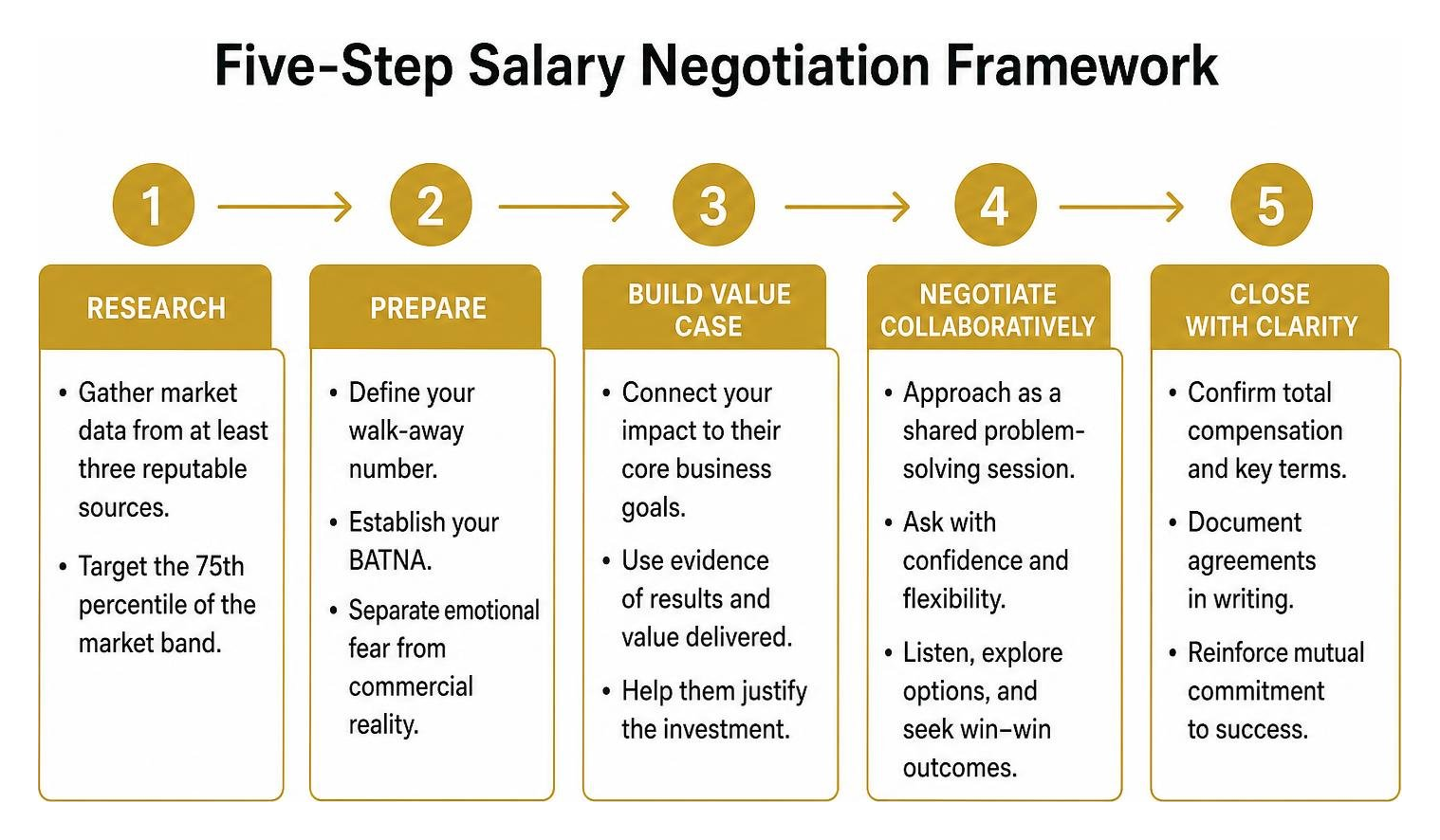
Entering a negotiation without data is guessing. Employers rely on detailed salary bands, compensation surveys, and regional talent metrics. To negotiate effectively, you must match their analytical rigor with verified market benchmarks.
Building Objective Value with Defensible Compensation Data
Gather objective data across at least three reputable sources, such as compensation databases, professional association surveys, and government wage indexes. For senior and executive positions, target the 75th percentile of the market band rather than the midpoint.
Frame the request around fairness and objective standards rather than personal financial requirements. As highlighted in the Program on Negotiation guide on post-offer counteroffers, presenting a data-backed counteroffer without asking permission signals professionalism and executive authority.
Your track record forms the foundation of this conversation. Presenting measurable achievements on an optimized executive resume and LinkedIn profile ensures your market value is visible well before compensation terms are discussed.
Anchoring and Precision: The Science of Effective Salary Negotiation
The opening number in any financial negotiation establishes a psychological reference point known as the anchor. According to behavioral economics research on negotiation tactics, high anchors paired with factual rationale pull final outcomes upward.
Research in the Journal of Experimental Social Psychology demonstrates that precise, non-round numbers (such as $163,500 rather than $160,000) are more persuasive. Specific figures signal that you calculated your worth using market data rather than pulling a number out of thin air.
Once you deliver your precise counteroffer and state your rationale, use strategic silence. Pause completely and let the other party respond. Rushing to fill conversational lulls often leads to unprompted concessions.
Expanding Beyond Base Pay: Negotiating Total Compensation
When an employer faces strict limits on base salary, focusing solely on base pay leaves substantial value on the table. Executive packages contain multiple levers that combine into a lucrative total compensation structure.
Structuring Multi-Issue Trade-Offs and Non-Salary Levers
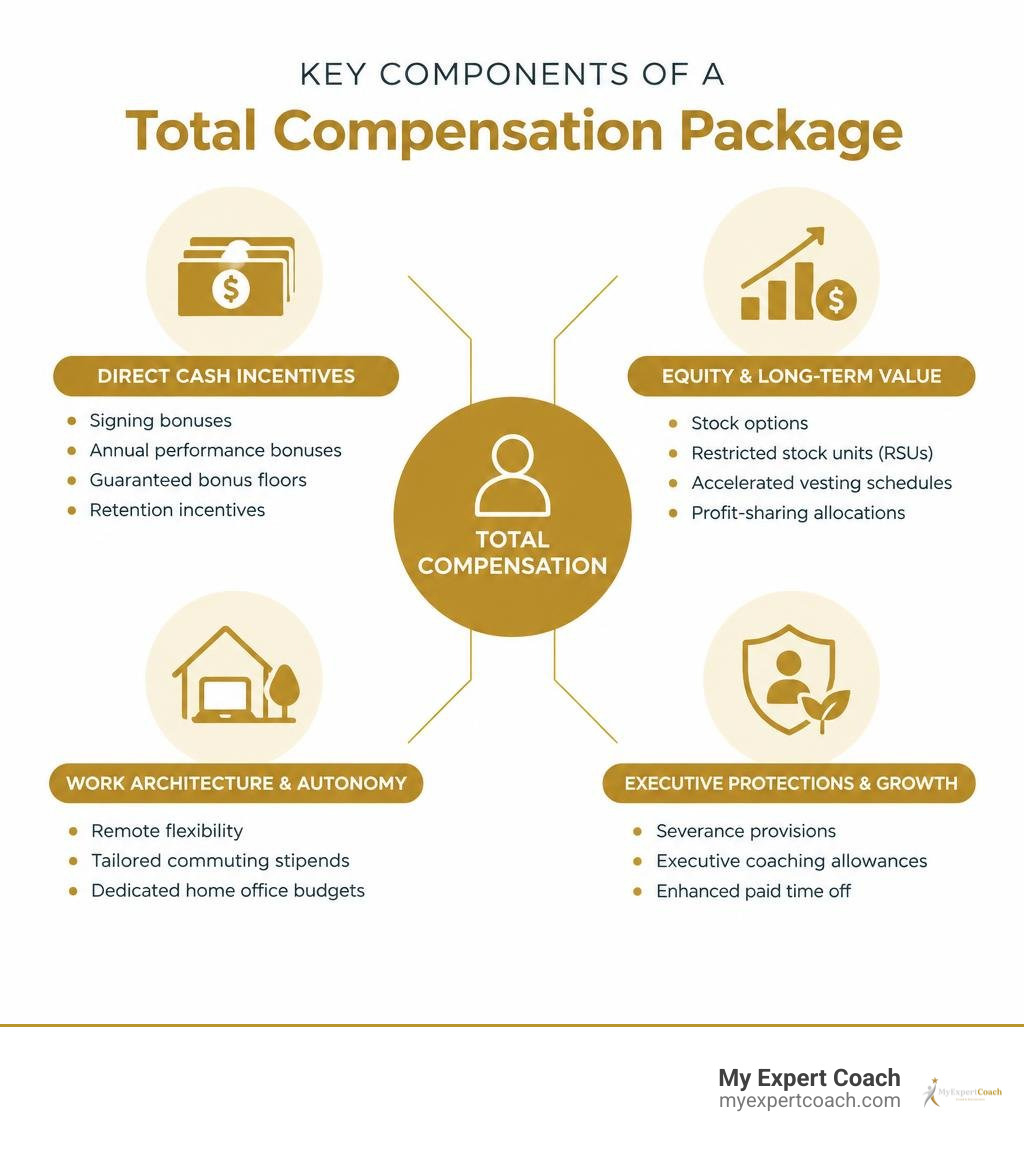
Review the complete compensation agreement across all available components:
- Direct Cash Incentives: Signing bonuses, annual performance bonuses, guaranteed bonus floors, and retention incentives.
- Equity and Long-Term Value: Stock options, restricted stock units (RSUs), accelerated vesting schedules, and profit-sharing allocations.
- Work Architecture and Autonomy: Remote flexibility, tailored commuting stipends, and dedicated home office budgets.
- Executive Protections and Growth: Severance provisions, executive coaching allowances, and enhanced paid time off.
Packaging these elements into multi-issue trade-offs makes it easier for employers to say yes. Reinforcing your authority through consistent personal branding gives you the leverage to negotiate these broader package components effectively.
Navigating Timing: When to Initiate the Conversation
Timing influences negotiation leverage:
- Never name a number during initial screenings: Deflect early inquiries by focusing on role alignment until a formal offer is made.
- Initiate after receiving the offer in writing: Your leverage peaks when the company selects you and issues an offer letter.
- Align internal raises with budget cycles: Request raises two to three months before formal reviews, while department budgets are still open.
- Leverage milestones: Initiate compensation discussions immediately following major operational wins or revenue achievements.
Practicing your phrasing out loud beforehand builds delivery confidence. Working through dedicated interview coaching and preparation ensures you present your case with clarity under pressure.
Tactical Execution: Channels, Scripts, and Overcoming Objections

Choosing the right communication channel helps you maintain rapport while clearly conveying your data.
Mastering Salary Negotiation Across Email, Phone, and Video
| Channel | Key Advantages | Primary Disadvantages | Best Used For |
|---|---|---|---|
| Phone / Video | Maximizes real-time rapport, vocal inflection, and emotional calibration. | Requires immediate thinking; high stress under pressure. | Primary counteroffer delivery, exploratory discussions, and executive alignment. |
| Creates a precise written record; eliminates conversational anxiety; reduces gender bias. | Removes vocal warmth; risks misinterpretation of tone. | Follow-up summaries, complex equity breakdowns, and initial written counter proposals. |
Handling Low Initial Offers and “Non-Negotiable” Budget Caps
When an employer states their offer is non-negotiable or capped by strict pay bands, use collaborative counter-frameworks:
- When the initial offer is below expectations:
“Thank you for the offer. Based on market benchmarks for this scope and my track record delivering a 25% efficiency improvement, I was targeting $168,500. What flexibility do we have to bridge this gap?” - When they cite strict budget caps:
“I understand base salary bands are set for this grade. If base salary is fixed at $145,000, can we explore a $15,000 signing bonus or an accelerated six-month performance review tied to specific milestones?” - When they claim internal equity constraints:
“I respect your focus on internal parity. Given the compensation ceiling for this title, let’s explore adjusting the equity grant, adding an extra week of PTO, or allocating an executive professional development budget.”
Frequently Asked Questions About Salary Negotiation
Can negotiating a job offer cause the employer to rescind it?
Fewer than 2% of hiring managers report rescinding an offer due to professional negotiation. Employers invest significant resources into the interview process. As long as your counteroffer remains polite, collaborative, and grounded in market data, negotiating will not put your offer at risk. For more guidance on navigating hiring stages, explore our career transition FAQs.
How much above the initial offer should you ask for?
A standard counteroffer targets 10% to 15% above the employer’s initial base salary figure. This allows room for discussion, with typical agreements settling 5% to 10% above the original offer. Entry-level and early-career negotiations often yield an immediate $5,000 to $10,000 increase, while senior executive discussions can secure adjustments of 15% to 30% or more across total compensation.
What should you do if an employer asks for your current salary?
Many regions ban salary history inquiries. If asked, pivot the focus away from past earnings toward your target market value:
“My previous compensation reflected the scope of that specific position. Based on the responsibilities of this role and current market data, I am targeting a range of $155,000 to $170,000.”
Conclusion
Negotiating your compensation is a standard commercial conversation that shapes your lifetime earnings. Stepping into discussions with clear data, structured trade-offs, and steady delivery ensures you secure terms that reflect the value you bring to the organization.
At MyExpertCoach, we provide tailored, one-on-one guidance to help senior executives navigate complex offer evaluations, counteroffer scripting, and total compensation strategy. To secure compensation that reflects your true market worth, explore our executive career coaching services today.

[…] your counter accounts for earned, prorated annual bonuses and unpaid commissions. Standard salary negotiation principles apply here: frame requests using objective milestones and documented performance rather […]
[…] execute effective salary negotiation strategies, you must recognize the differences between public and private pay […]
[…] it is about knowing which levers have internal corporate flexibility. In tech hiring, strategic salary negotiation means identifying where the compensation team can approve adjustments without triggering executive […]