table of contents
How to Write a CV for Nursing Student Jobs
Start with your nursing degree and expected graduation date, then show what you did during clinical placements. For each placement, name the care setting and give two or three specific examples of skills you used under supervision. Add relevant certifications, a short list of clinical and people skills, and any research, volunteer work, or jobs that show you are ready to learn and contribute.
You do not need years of paid nursing work to make a strong case. A clear example from a rotation can tell an employer more than a long list of duties.
I’m Sandy Spencer, a career coach with more than 38 years of experience in HR and executive recruiting. I’ve helped over 10,000 professionals present their strengths clearly, and the same approach can help you build a CV for nursing student applications.
Essential Sections and Structure of a CV for Nursing Student Applications
Writing an initial healthcare CV feels daunting when you have spent more time in lecture halls and simulation labs than on a paid hospital payroll. Hiring managers know this reality. When evaluating entry-level nursing candidates, nurse recruiters look for clinical safety, role-relevant competencies, attention to protocol, and an eagerness to learn within multidisciplinary teams.
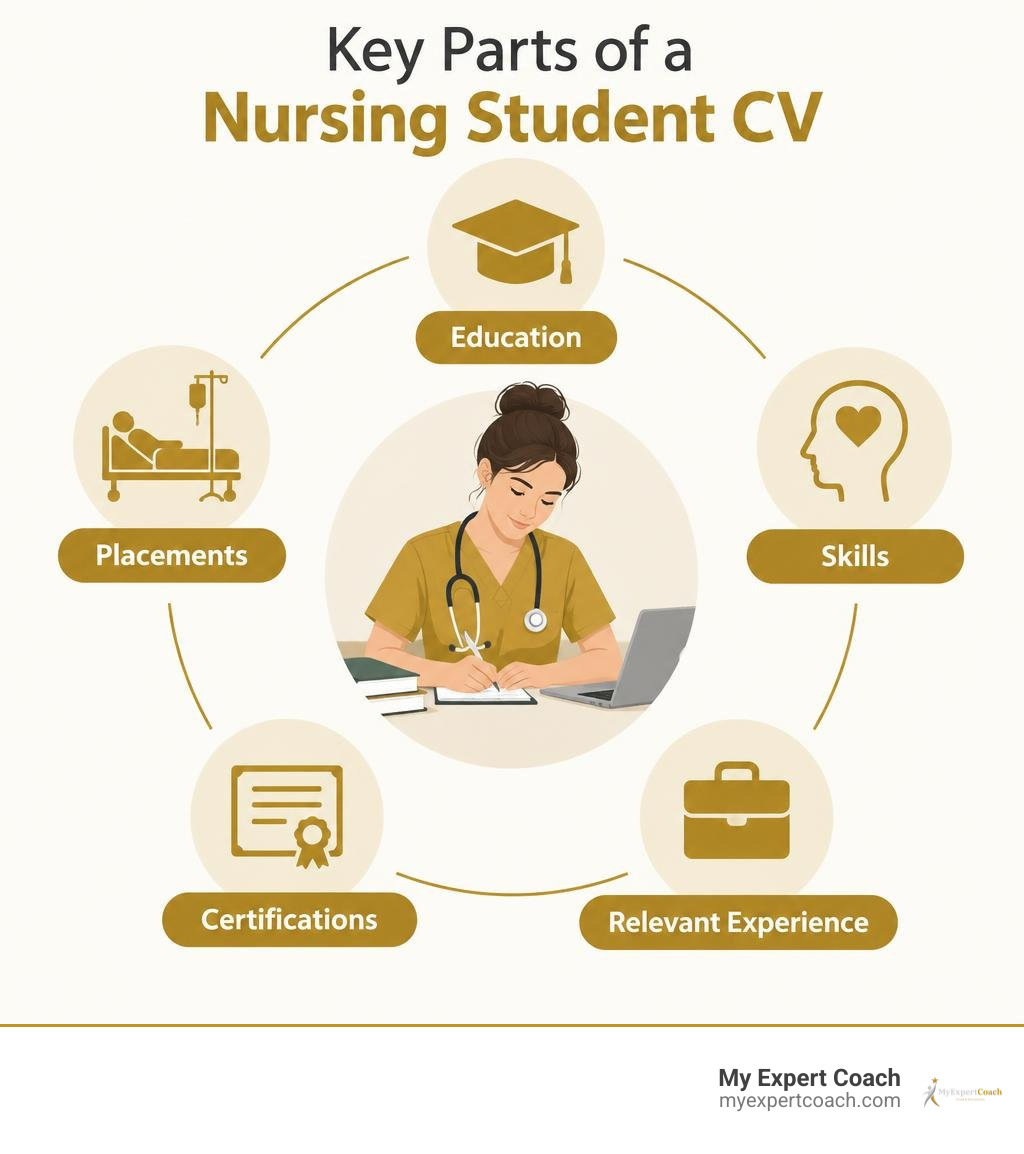
To present your credentials clearly, organize your document into logical sections that highlight your training right away:
- Header & Contact Details: Include your full legal name, professional title (e.g., Student Nurse or Graduate Nurse Candidate), phone number, professional email address, location (City, State/Region), and a link to your polished LinkedIn profile.
- Professional Registration & Certifications: Place active credentials like Basic Life Support (BLS), Advanced Cardiovascular Life Support (ACLS), or student nursing board registration directly beneath your header so recruiters instantly verify your clinical eligibility.
- Personal Profile / Summary: A 3 to 4-sentence snapshot defining your academic standing, clinical specialties of interest, core competencies, and dedication to patient advocacy.
- Education: Your degree program, institution name, expected graduation date, and notable academic achievements.
- Clinical Placements & Practicum Experience: The core of your document, detailing ward environments, hours completed, patient demographics, and hands-on skills practiced.
- Key Clinical & Interpersonal Skills: A balanced summary of your hard procedural abilities and vital soft skills.
- Employment History & Volunteer Experience: Any healthcare-adjacent work (like medical assistant or healthcare aide roles) or customer-facing positions demonstrating workload management and communication under pressure.
- Professional Activities, Awards & Affiliations: Student nursing associations, committees, or special research projects.
Academic institutions emphasize that clear organization and verifiable metrics make all the difference. As noted in the university Personal Statements and Curriculum Vitae guidelines, structuring academic background, clinical training, and professional certifications with consistent formatting allows evaluators to assess your readiness for rigorous healthcare settings immediately.
Writing an Impactful Personal Profile for Nursing Students
Your personal profile functions as your elevator pitch. Instead of writing a vague objective statement like “Passionate student seeking a nursing job to gain experience,” construct a tailored summary that anchors your profile in real care settings.
Highlight your clinical rotations, dedication to safe patient care, and enthusiasm for the specific unit you are applying to join.
Example:
Dedicated Final-Year Nursing Student with 600+ hours of hands-on clinical rotation experience across acute medical-surgical and pediatric units. Proven capability in comprehensive patient assessment, sterile wound management, and electronic health record (EHR) documentation. Certified in BLS with a strong commitment to evidence-based, compassionate care and eager to contribute to the telemetry team at General Hospital.
Documenting Education and Academic Achievements
Because you are still completing or recently finished your training, your education section should sit prominently on the first page. State your exact degree title (e.g., Bachelor of Science in Nursing), your university, and your expected completion month and year.
Include academic honors, relevant coursework (such as Advanced Pathophysiology, Pharmacology for Nurses, or Community Health Nursing), and any specialized healthcare projects. If your grade point average is an academic strength, you can list it; otherwise, let your clinical rotation hours and hands-on competencies take center stage.
How to Turn Clinical Rotations and Academic Projects into Work Experience

Many students worry that they have “no real experience.” Your clinical rotations are professional experience. You administered medications under preceptor supervision, conducted head-to-toe assessments, monitored vitals, educated families, and used hospital-wide software systems.
To convert these rotations into compelling proof of your clinical competence, replace simple duty lists with outcome-focused bullet points. Using strategic, action-driven accomplishment keywords such as Administered, Conducted, Collaborated, Monitored, and Educated demonstrates proactive patient care.
| Task-Based Duty (Weak) | Outcome-Based Bullet Point (Strong) |
|---|---|
| Responsible for taking vital signs and charting. | Conducted comprehensive vital sign monitoring and physical assessments for up to 5 acute care patients per shift, reporting subtle baseline changes promptly to the preceptor. |
| Helped with patient medication. | Assisted in safe medication administration and dual-verification checks for IV infusions and oral medications across 120 clinical hours with zero safety incidents. |
| Handled post-op surgical patients. | Delivered holistic post-operative care, including sterile wound dressing changes, drain management, and mobility assistance, supporting a 98% observation compliance rate. |
Formatting Clinical Placements on a CV for Nursing Student Candidates
Structure each clinical placement just like a formal job entry. Clearly outline the facility name, unit specialty, dates, and total hours completed. Underneath, provide three to four detailed bullet points showing safe practice and team communication.
Following practical advice from the Your CV guidance by RCN Starting Out, you can make your clinical rotations stand out by detailing the specific patient groups you supported, multidisciplinary handovers, and documentation standards you maintained during each clinical placement.
Leveraging Coursework, Simulation Labs, and Mentorship
If you have unique academic or simulation lab milestones, include them! High-fidelity simulation training, virtual reality disaster triage scenarios, and capstone research projects showcase critical thinking.
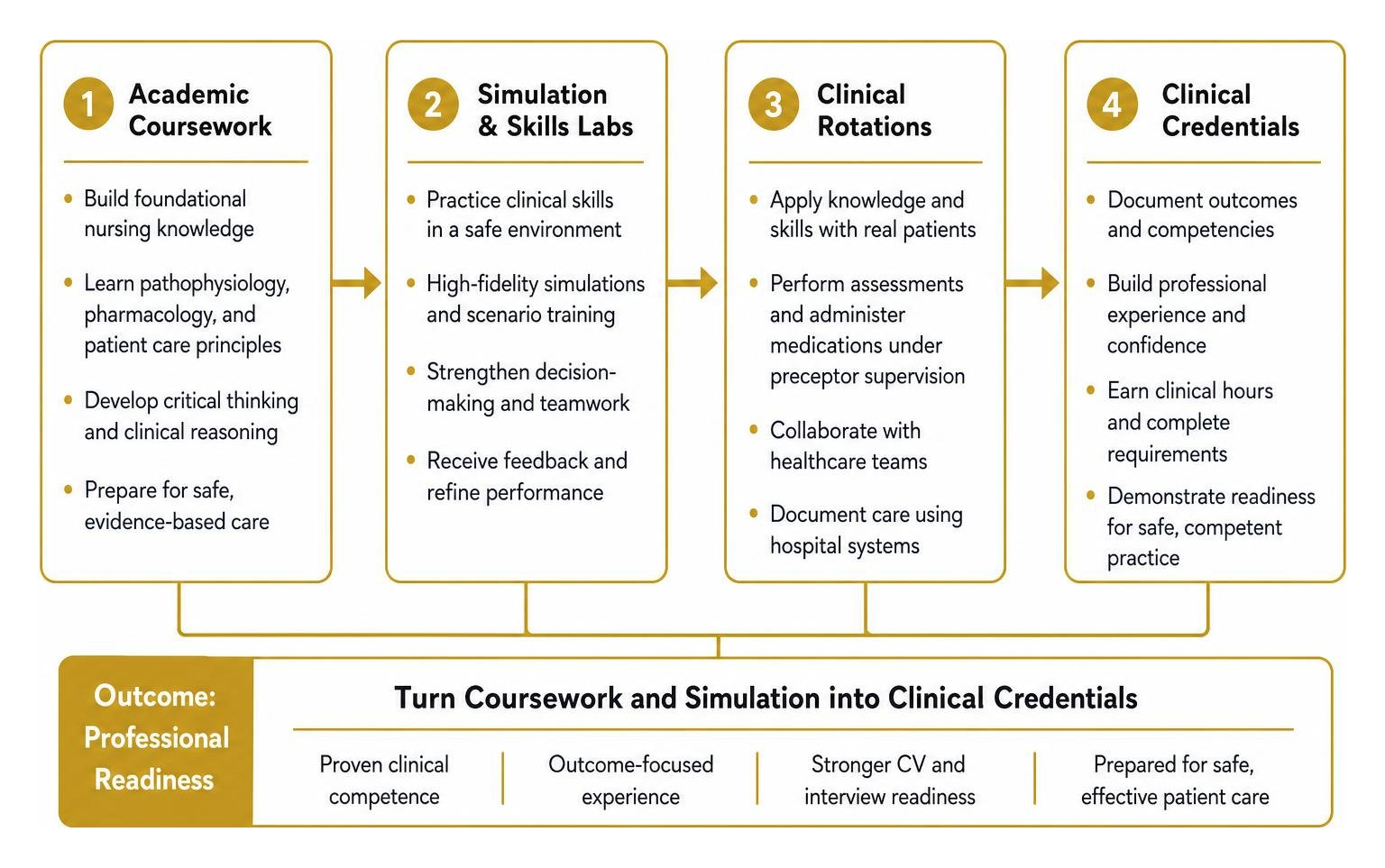
Detail how your simulation lab training prepared you for rapid clinical decision-making. Mention positive feedback from clinical instructors or preceptors regarding your bedside manner, calm demeanor during mock resuscitations, or thorough charting practices.
Core Clinical and Transferable Skills to Feature
Nursing recruiters scan CVs quickly to see if candidates meet essential baseline requirements. Group your skills into clear categories so hiring managers can easily evaluate your procedural capabilities alongside your interpersonal strengths.
Hard Skills: Patient Care, EHR Systems, and Clinical Competencies
Hard skills represent your technical and procedural training. Be specific about the tools, procedures, and systems you know:
- Patient Assessment & Care: Head-to-toe physical assessments, vital signs interpretation, intake/output monitoring, fall risk reduction, aseptic wound care.
- Medication & IV Therapy: Assisting with medication reconciliation, five rights of medication administration, IV pump monitoring, subcutaneous and intramuscular injections.
- Technical Systems & Software: Epic, Cerner, Meditech, PointClickCare, automated medication dispensing systems (e.g., Pyxis, Omnicell).
- Infection Control & Safety: Standard and transmission-based precautions, personal protective equipment (PPE) compliance, sterile field maintenance, emergency response protocols.
Soft Skills: Compassion, Communication, and Interprofessional Teamwork
While clinical skills keep patients safe, soft skills determine how well you connect with patients and work within a high-pressure team:
- Active Listening & Bedside Manner: Building rapport with anxious patients, explaining procedures clearly, and advocating for patient comfort and dignity.
- Interprofessional Collaboration: Coordinating smoothly with physicians, physical therapists, occupational therapists, social workers, and nursing aides.
- Prioritization & Time Management: Balancing competing needs across multiple patients while maintaining patient safety.
- Emotional Resilience & Cultural Safety: Remaining composed during clinical emergencies and delivering culturally sensitive, unbiased care to diverse populations.
Best Formats, ATS Optimization, and Tailoring Strategies

Modern hospitals and healthcare networks use Applicant Tracking Systems (ATS) to filter candidate applications before a clinical manager ever sees them. Applying smart, strategic healthcare job search methods ensures your CV makes it past automated filters and reaches the hiring panel.
Choosing the Best Layout for a CV for Nursing Student Job Seekers
For almost all nursing students, a reverse-chronological format or a hybrid layout is the gold standard. A reverse-chronological structure organizes your placements and education with your most recent experience first, which recruiters prefer.
Keep your visual design clean and professional:
- Typography: Choose standard, easy-to-read fonts such as Arial, Calibri, or Helvetica in 10 to 12 point size.
- Margins & Spacing: Use 0.5 to 1-inch margins and clear section dividers.
- Color Palette: Stick to black text on a white background, using subtle navy or slate accents if desired. Avoid overly decorative, multi-column graphics that confuse ATS parsers.
- File Format: Save and upload your CV as a standard PDF unless the application portal explicitly requests a Microsoft Word document.
Tailoring Your Application for Specific Hospital Wards and ATS Systems
Never send a generic, one-size-fits-all CV to every hospital opening. Read the job description carefully and identify the exact keywords, unit specialties, and software names the employer mentions.
If an oncology ward posting highlights “central line care,” “chemotherapy patient support,” and “empathy in palliative care,” adjust your profile summary and clinical placement bullet points to showcase your rotations that align with those exact areas.
Common Mistakes to Avoid When Building Your Healthcare Application
Even bright nursing students sometimes hurt their chances with avoidable resume missteps. As we frequently see in our practice, avoiding common resume mistakes job seekers make keeps your application strong and credible:
- Listing Tasks Instead of Clinical Impact: Merely writing “Answered call lights” sounds passive. Instead, write “Responded promptly to patient call lights, prioritized urgent care needs, and maintained fall-prevention precautions across a 24-bed unit.”
- Omitting Essential Certifications: Forgetting to place your BLS, ACLS, or CPR renewal dates at the top of your document can lead to automated rejection by screening software.
- Using Unprofessional Contact Information: An email address like [email protected] looks unprofessional. Use a simple, clean address like [email protected].
- Vague Clinical Claims: Claims like “Excellent communicator” carry little weight without evidence. Back them up by detailing successful patient handoffs or family education sessions during rotations.
- Spelling and Medical Terminology Errors: Misspelling clinical terms such as sphygmomanometer, antiemetic, or arrhythmia signals a lack of attention to detail to a clinical reviewer.
Frequently Asked Questions About Nursing Student Applications
What is the difference between a nursing student CV and a resume?
In North America, a resume is typically a concise, one- to two-page summary of your clinical placements, skills, and certifications targeted at specific bedside nursing jobs. A curriculum vitae (CV) is a comprehensive, longer document detailing your complete academic history, clinical rotations, research projects, publications, presentations, and teaching assistantships, commonly used for academic programs, graduate school, or research fellowships. In regions like the UK, Ireland, and Australia, the term “CV” is standard for both clinical job applications and academic purposes.
| Factor | Nursing Student Resume | Nursing Student Academic CV |
|---|---|---|
| Primary Audience | Hospital recruiters, nurse managers, unit supervisors | Academic committees, graduate admissions, research directors |
| Typical Length | 1 to 2 pages | 2 to 4+ pages |
| Primary Focus | Bedside clinical skills, rotation hours, certifications | Research, publications, teaching, deep academic history |
How long should an entry-level nursing CV be?
For most students and newly qualified nurses, keep your CV to one to two pages. Focus on your most relevant rotations, direct patient care experiences, and active healthcare credentials. Concise, high-impact bullet points will serve you far better than multiple pages of filler.
Should I list my GPA on my nursing CV?
You should include your GPA if it represents an academic achievement (typically a 3.5 on a 4.0 scale or equivalent). If your GPA is lower, omit it and highlight your clinical rotation hours, specialized skills, and preceptor feedback instead. Healthcare employers care far more about your patient safety and bedside competence than your test scores from freshman year.
Conclusion
Transitioning from student nurse to a hired, practicing professional begins with translating your clinical hours into evidence of safe, compassionate care. By clearly structuring your placements, quantifying your clinical exposure, and highlighting your technical and interpersonal skills, you prove to hiring managers that you are ready for the bedside.
Once your application document is polished, refine your interview strategy with structured interview coaching and preparation to speak confidently about your clinical decision-making.
To ensure your materials and online presence stand out in a competitive job market, explore our professional resume and LinkedIn optimization from MyExpertCoach to build an application package that opens doors across top healthcare networks.