table of contents
A Career Transition for Executives Starts With Clarity, Not a Resume

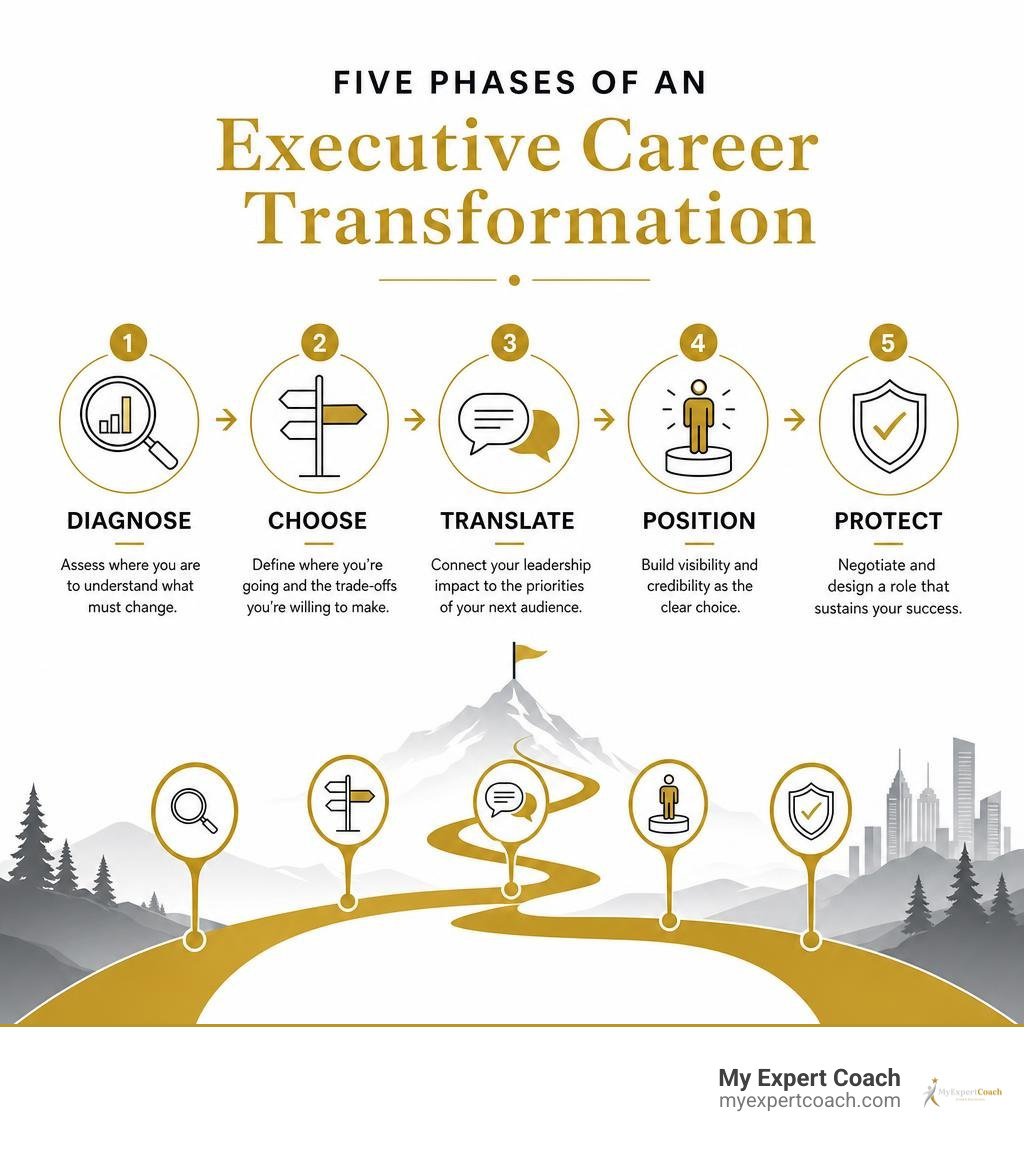
A successful career transition for executives begins by deciding what must change before updating LinkedIn, calling recruiters, or sending a resume. First, identify whether the problem is the work, the organization, burnout, or an identity tied to your current title. Then define the next role’s non-negotiables: the problems you want to solve, the level of risk and responsibility you want, and the trade-offs you will make for compensation, flexibility, and fulfillment.
Executive moves carry more visibility, financial impact, and reputational risk than earlier career changes. A title alone will not explain your value in a new sector, business model, or advisory role. You need a clear story that connects your leadership results to the priorities of the audience you want to reach.
The opportunity is real: U.S. employment for top executives is projected to grow 4% from 2024 to 2034, with about 331,000 openings each year, largely driven by replacement needs. But the right next chapter is not simply the first available senior role. It is the role where your strengths, life priorities, and leadership credibility can work together.
I am Sandy Spencer, a career coach and strategist with more than 38 years of experience in HR, executive recruiting, executive coaching, resume writing, and LinkedIn strategy. Having helped advance more than 10,000 careers, I help senior leaders approach a career transition for executives with sharper positioning, stronger market confidence, and a practical plan for what comes next.
Why High-Stakes Career Transition for Executives Differs from Traditional Job Hunting
When mid-level professionals switch jobs, the process is largely transactional: align functional skills with a job description, submit an application, pass a few competency screenings, and negotiate a modest salary bump. At the enterprise tier, that playbook completely breaks down.
In the modern landscape of September 2026, enterprise leadership demands holistic stewardship. According to the U.S. Bureau of Labor Statistics, the median annual wage for chief executives was $206,420 in May 2024 (with top earners in enterprise management exceeding $239,200), while general and operations managers earned a median of $102,950. Across the roughly 309,400 chief executive positions and 3.7 million general management roles nationwide, annual turnover generates approximately 331,000 top executive openings each year. Crucially, the vast majority of these vacancies stem not from rapid net-new job creation, but from retirements, executive outplacement, and replacement dynamics.
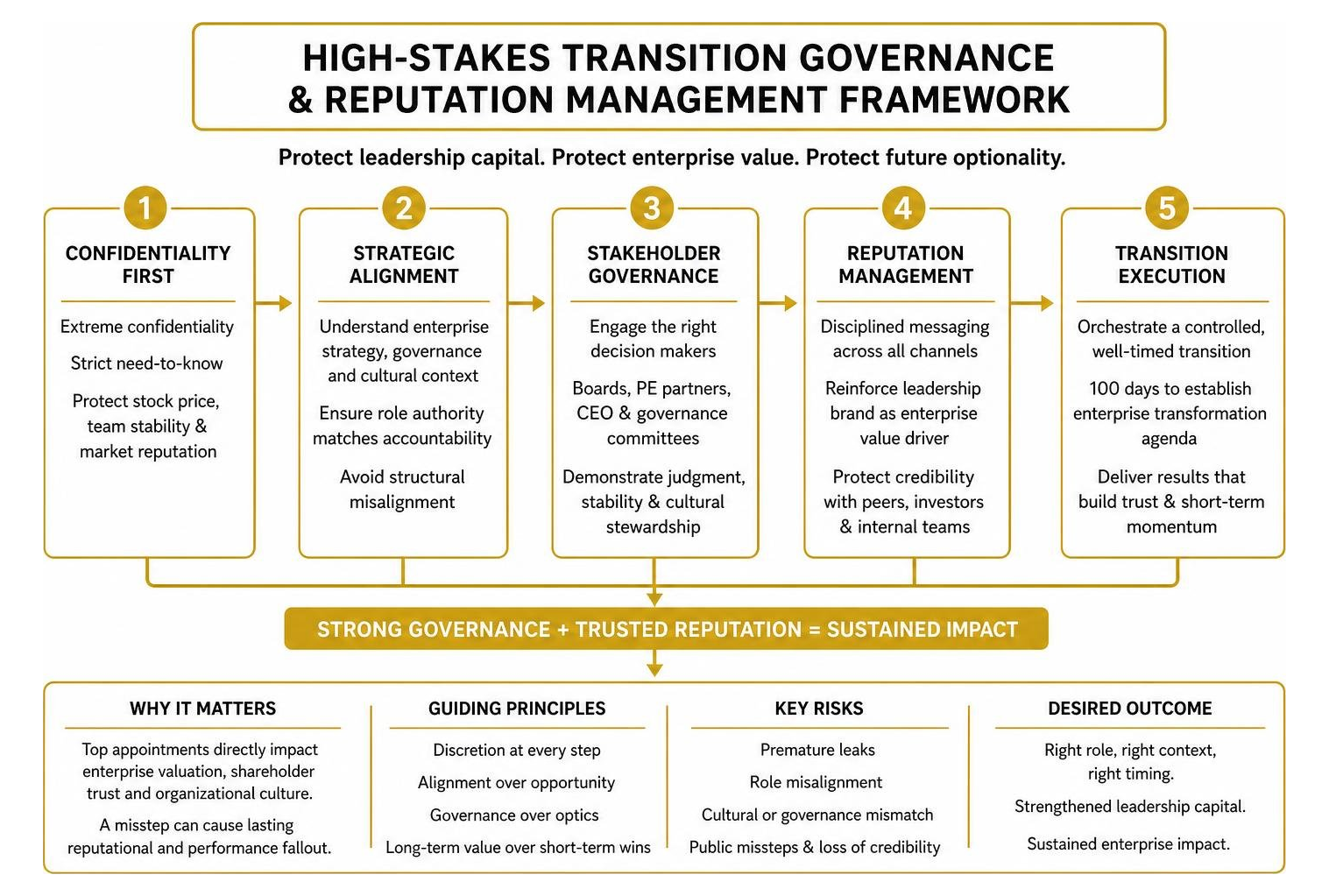
Because top appointments directly impact enterprise valuation, shareholder trust, and organizational culture, boards and search committees do not hire for raw tactical ability. They hire for judgment, emotional stability, and cultural stewardship.
| Dimension | Mid-Career Job Search | Senior Executive Transition |
|---|---|---|
| Primary Currency | Technical competencies & functional execution | Strategic judgment, leadership capital & vision |
| Search Channels | Job boards, internal mobility & contingency recruiters | Retained executive search, board referrals & private networks |
| Hiring Scrutiny | Departmental managers & HR screening teams | Board of Directors, PE partners, CEO & key governance committees |
| Confidentiality | Low to moderate risk | Extreme; premature leaks threaten stock price & team stability |
| Economic Stakes | Individual salary & departmental output | Enterprise EBITDA, market share, shareholder equity & public reputation |
| Onboarding Horizon | 30 to 90 days to achieve tactical competency | 100 days to establish multi-year enterprise transformation agenda |
When navigating these heights, you cannot rely on automated application portals. Finding the right fit requires an intentional, multi-layered executive career transition strategy that protects your market equity while opening doors to the private, unadvertised market.
The Compounding Costs of Visibility, Reputation, and Misalignment
The higher an executive climbs, the narrower the landing strip becomes. A poorly calculated move at the director level is a minor speed bump; a misaligned C-suite appointment can derail enterprise performance and cause lasting reputational fallout.
When a chief executive, vice president, or managing director makes a move, the transition occurs under intense scrutiny from industry peers, institutional investors, and internal teams. A public misstep—such as taking a high-profile role where governance structures actively prevent execution—burns valuable social capital. Maintaining leadership credibility requires total message discipline and strict confidential search protocols. You cannot simply test the waters openly; every conversation must be curated to reinforce your market reputation as an enterprise value driver.
Understanding the 5 Core Types of Career Transition for Executives
Not every executive pivot begins from the same baseline. To build an effective roadmap, we must first categorize the exact structural nature of your move:
- The Forced Transition: Triggered by mergers, board reorganizations, private equity takeovers, or strategic differences with the CEO. The immediate challenge is managing the emotional decompression of an unexpected exit while reclaiming market momentum without showing defensiveness.
- The Strategic Pivot: Driven by a calculated desire to pivot operational expertise into a new industry, a higher-growth asset class, or emerging operational disciplines.
- The Values-Driven Shift: Occurs when an executive realizes their current environment no longer aligns with their personal ethics, lifestyle, or sense of purpose. The focus shifts toward mission-driven organizations, sustainable business models, or community impact.
- The Late-Career Portfolio Redesign: Moving away from 70-hour operational weeks toward a blended model of non-executive board directorships, fractional advisory engagements, and specialized consulting.
- The Cross-Sector Move: Transitioning between public, private, non-profit, or entrepreneurial sectors, where your operational credibility depends on bridging disparate governance frameworks.
Understanding these structural differences underscores that sustainable reinvention demands strategic alignment rather than rushed tactical movement.
Root Cause Diagnostics: Distinguishing Role Dissatisfaction from Environment and Identity
A frequent misstep we witness in senior leaders is misdiagnosing why they feel dissatisfied. When an executive experiences prolonged exhaustion or friction, their instinct is often: “I need to leave this industry entirely.” Yet in many cases, the work itself is not the problem.

Before making radical moves, you must run a diagnostic assessment on your current state. We regularly guide leaders through this process during executive leadership coaching engagements, helping them separate environmental friction from core career fatigue.
A valuable benchmark to apply is the 18-Month Horizon Test: If your compensation, title, and team remained identical for the next 18 months, does the thought bring a sense of steady progress or profound dread?
If the answer is dread, you must determine whether that friction lives in the role, the environment, or your own professional identity.
The Role, Environment, or Identity Diagnostic Framework
To pinpoint the true source of your career friction, evaluate these three distinct operational dimensions:
- Role Friction (The Work Itself): You are fundamentally exhausted by the day-to-day mechanisms of your operational mandate. You no longer want to manage enterprise budget cycles, negotiate labor union contracts, or navigate regulatory compliance audits. The core problem is that your daily tasks no longer spark curiosity or leverage your strengths.
- Environment Friction (The Governance & Culture): You still love high-stakes operational problem-solving, but the ecosystem around you is toxic. Broken board relationships, conflicting private equity directives, or dysfunctional executive peers create friction that drains your energy. Here, the solution is not a career overhaul—it is finding a healthy organizational culture that shares your operating values.
- Identity Friction (The Lingering Self-Concept): You have evolved as an individual, but you remain anchored to a legacy title or external prestige. You might cling to the identity of a “Fortune 50 Enterprise COO” even though your personal priorities now demand schedule autonomy and intellectual variety.
To uncover these blind spots, tenured leaders frequently benefit from 360-degree psychometric evaluations and structured stakeholder audits. These assessments highlight perceptual gaps between how you view your leadership footprint and how your enterprise peers experience your presence.
Evaluating the Trade-Offs of Freedom, Finance, and Fulfillment
Every executive pivot involves three competing operational priorities: Freedom, Finance, and Fulfillment.
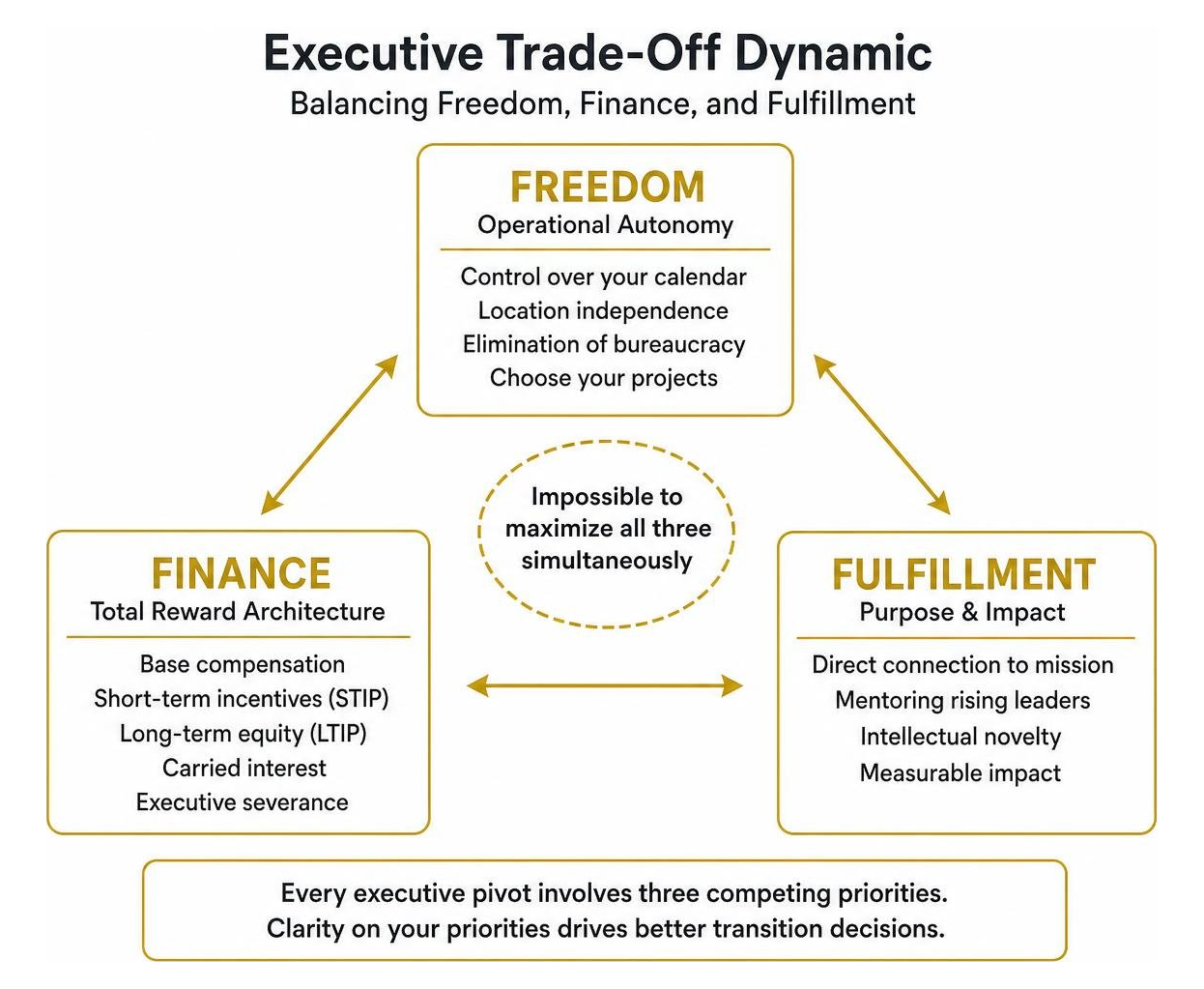
It is virtually impossible to maximize all three simultaneously when entering a new domain. Trying to do so causes analysis paralysis and leads to poor compromises.
- Finance (Total Reward Architecture): Base compensation, short-term incentive plans (STIP), long-term equity grants (LTIP), carried interest, and executive severance protections.
- Freedom (Operational Autonomy): Control over your calendar, location independence, elimination of administrative bureaucracy, and the ability to choose your projects.
- Fulfillment (Purpose & Impact): Direct connection to enterprise mission, mentoring rising leaders, intellectual novelty, and seeing the measurable impact of your decisions.
When preparing for your next move, you must clearly define your current non-negotiables. A leader with substantial accumulated wealth may readily trade enterprise compensation for the freedom of a board portfolio. Conversely, an executive funding long-term family milestones may choose to maximize equity and financial upside, accepting the operational constraints of private equity portfolio management.
Translating Leadership Capital Across New Sectors and Operating Models
The modern business environment is shaped by continuous disruption, distributed teams, and digital acceleration. Successfully competing in a post-pandemic world requires modern leaders to articulate how their hard-won capabilities apply across varied operating environments.
Cross-sector mobility does not rely on niche technical knowledge; it is built on transferable enterprise competencies. A healthcare executive who successfully navigated complex regulatory reforms, multi-stakeholder governance, and digital patient delivery possesses competencies that translate directly into financial services, higher education, or enterprise SaaS.
The secret lies in framing your past achievements around universal business fundamentals:
- Risk mitigation and governance stewardship
- Capital allocation and balance-sheet optimization
- Complex stakeholder alignment during turnarounds
- Building high-performance, resilient leadership pipelines
Builder vs. Steward: Mapping Core Strengths to Market Complexity
Organizations seek specific executive archetypes to match their maturity level. Misalignment occurs when a “Builder” takes a “Steward” role, or vice versa.
- The Builder: Thrives in ambiguity, rapid scaling, turnarounds, and cross-functional integration. Builders excel at establishing operational infrastructure where none exists, making high-conviction decisions with incomplete data, and rallying teams through major market pivots.
- The Steward: Thrives in operational rigor, enterprise governance, risk mitigation, and incremental efficiency. Stewards excel at protecting enterprise value, optimizing balance sheets, navigating highly regulated environments, and sustaining operational excellence across mature global workforces.
Understanding your core profile ensures you target organizations that genuinely need your natural leadership style, rather than fighting against an incompatible corporate mandate.
Articulating Value and Overcoming Lingering Professional Identities
One of the deepest psychological hurdles in an executive transition is shedding the protective armor of a past corporate identity. When you step out of a senior role, the immediate loss of authority, administrative infrastructure, and institutional identity can feel disorienting.
To succeed in a new market, you must unlearn legacy titles and translate your operational wisdom into language your new target audience immediately trusts. This is the foundation of strategic personal branding.
If you are a corporate executive transitioning into independent consulting or advisory work, your market equity is no longer measured by the size of your previous staff or budget. It is measured by your ability to diagnose complex enterprise problems, solve targeted pain points, and de-risk board-level decisions. If your narrative relies entirely on your past title rather than the prospective value you create, prospective clients and boards will view you as an expensive legacy operator rather than an agile strategic asset.
Executing a Tactical Strategy: Branding, Search Channels, and Reputational Protection
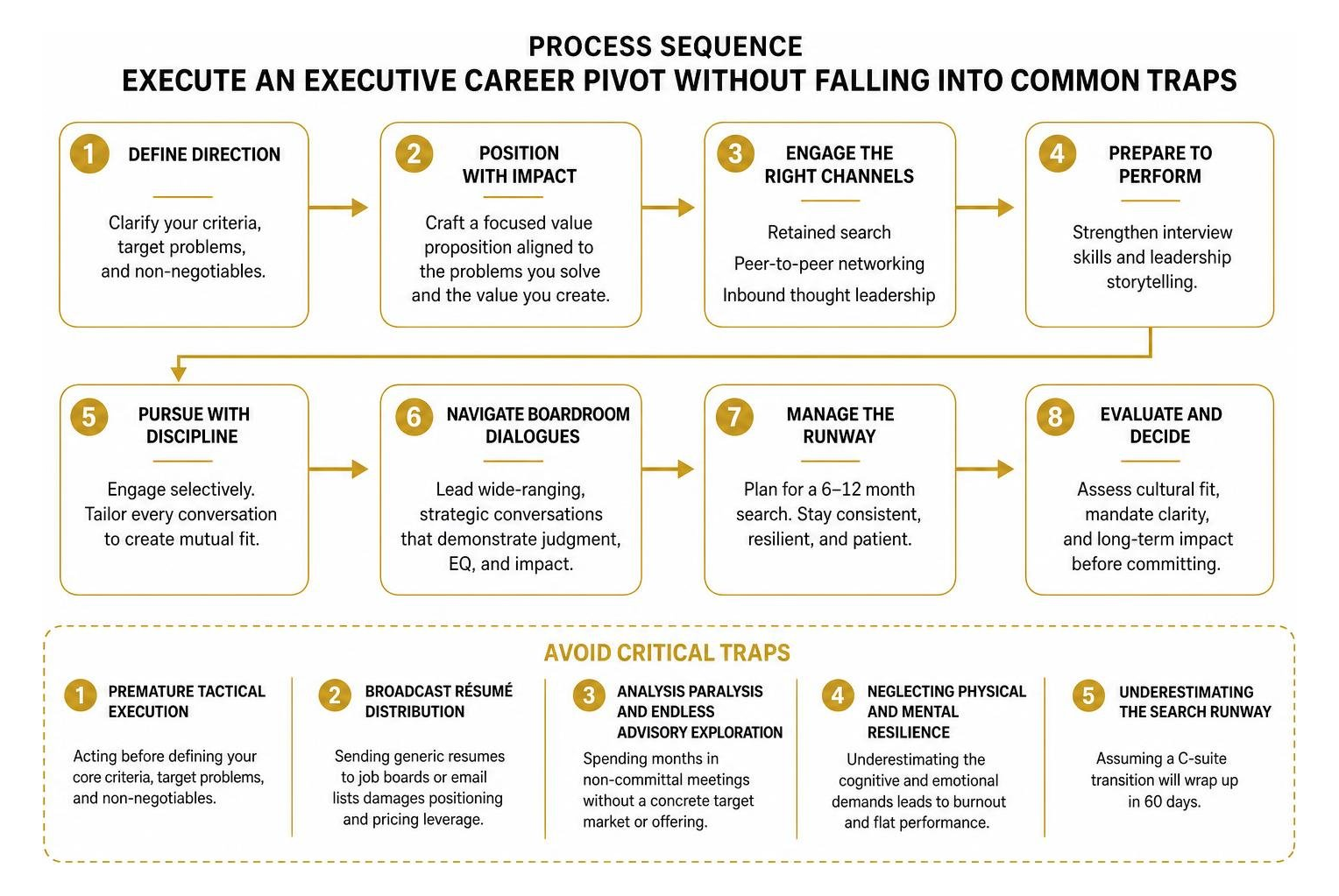
Once you have established directional clarity, you can turn your focus toward tactical execution. Far too many executives make the mistake of reversing this order: they commission a generic resume, blast it across retained search databases, and then wonder why the market responds with silence.
Tactical execution at the executive tier requires elite packaging. Your narrative assets—including your executive biography, board profile, digital footprint, and comprehensive resume and linkedin assets—must position you as a transformative enterprise leader.
Your collateral should avoid lengthy lists of daily tasks. Instead, it must clearly present your enterprise value proposition:
- Clear metrics on EBITDA growth, capital efficiency, and market share expansion
- Evidence of steering organizations through crises, divestitures, or rapid scale
- Validation of cross-functional team leadership and talent development
- Boardroom contributions and governance experience
Navigating Executive Search, Direct Outreach, and Thought Leadership
Senior-level appointments rely on three primary sourcing channels:
When engaging with executive recruiters, understand the fundamental business model: retained search consultants work for the hiring client’s board of directors, not for individual job candidates. To build productive relationships with recruiters, present a sharply focused value proposition that clearly aligns with their active search mandates.
Simultaneously, sharpen your communication skills through dedicated interview coaching and preparation. Boardroom interviews are rarely standard Q&A sessions; they are wide-ranging strategic dialogues. Mastering modern strategies for addressing behavioral interview questions allows you to share authentic leadership stories that illustrate your emotional intelligence, crisis management capabilities, and decision-making rigor under pressure.
Avoiding Critical Traps in a Career Transition for Executives
Over decades of advising senior leaders, we have documented recurring pitfalls that derail executive career transitions. Keep these top of mind to protect your time and momentum:
- Premature Tactical Execution: Updating marketing materials and scheduling recruiter coffee meetings before deciding on your core criteria, target problems, and non-negotiables.
- Broadcast Résumé Distribution: Sending standardized executive resumes to blind job postings or blast email distribution lists. This damages your market positioning and eliminates your pricing leverage.
- Analysis Paralysis and Endless Advisory Exploration: Spending months taking non-committal exploratory meetings without committing to a concrete target market or clear offering.
- Neglecting Physical and Mental Resilience: Executive transitions are cognitively and emotionally demanding. Underestimating the stamina required leads to executive burnout and flat, uninspired interview conversations.
- Underestimating the Search Runway: Assuming a C-suite transition will wrap up in 60 days. Executive searches move at the deliberate pace of board meetings, background checks, and committee governance.
Frequently Asked Questions About Executive Transitions
How long does an executive-level career transition typically take?
An executive-level search typically takes 6 to 12 months, depending on market conditions, the role’s compensation tier, and your target industry.
Unlike entry or mid-level hiring, C-suite appointments require alignment across search committees, CEOs, and corporate boards of directors. Board approval schedules, comprehensive background checks, and detailed contract negotiations all extend the timeline. Executives should plan their transition runway with at least 9 to 12 months of financial and emotional support, ensuring they can negotiate from a place of strength rather than financial urgency.
How should senior leaders balance compensation expectations during a pivot?
When pivoting into a new industry, an early-stage venture, or a non-profit organization, your baseline cash compensation may adjust. However, experienced executives evaluate the Total Reward Architecture rather than focusing solely on base salary.
A lower base salary can often be offset by higher equity upside, performance incentives, accelerated vesting schedules, or the flexibility to maintain outside board advisory positions.
What is the most effective way to engage executive search firms during a transition?
The most effective way to engage retained search firms is through warm, trusted introductions from current board members, corporate directors, or executives previously placed by that firm.
When reaching out to search partners, deliver a concise overview of your target market, your enterprise capabilities, and the specific board-level challenges you solve. Retained recruiters keep detailed talent registries; maintaining professional, low-pressure touchpoints every few quarters ensures your profile remains top of mind when relevant search mandates emerge.
Conclusion: Securing Your Next Leadership Chapter
An executive career transition is not a standard job search—it is a high-stakes leadership pivot that redefines your professional legacy, your lifestyle autonomy, and your enterprise impact.
By focusing on deep root-cause diagnostics, prioritizing fit over exterior prestige, translating your core leadership capital into modern market language, and protecting your brand reputation, you can step confidently into your next chapter.
At My Expert Coach, we bring more than 25 years of insider HR, retained search, and career advisory expertise to guide you through every stage of this journey. We replace boilerplate templates with bespoke career positioning, tailored boardroom interview preparation, and confidential transition management.
When you are ready to define your next leadership chapter with clarity, explore our proven job search strategies to position your enterprise value where it delivers the greatest impact.