
table of contents
Build an Executive Resume That Shows Leadership Impact

An executive resume is a focused, typically two-page career document for senior leaders. It should show how you created business value, led people and change, managed risk, and delivered measurable results, not simply list job duties.
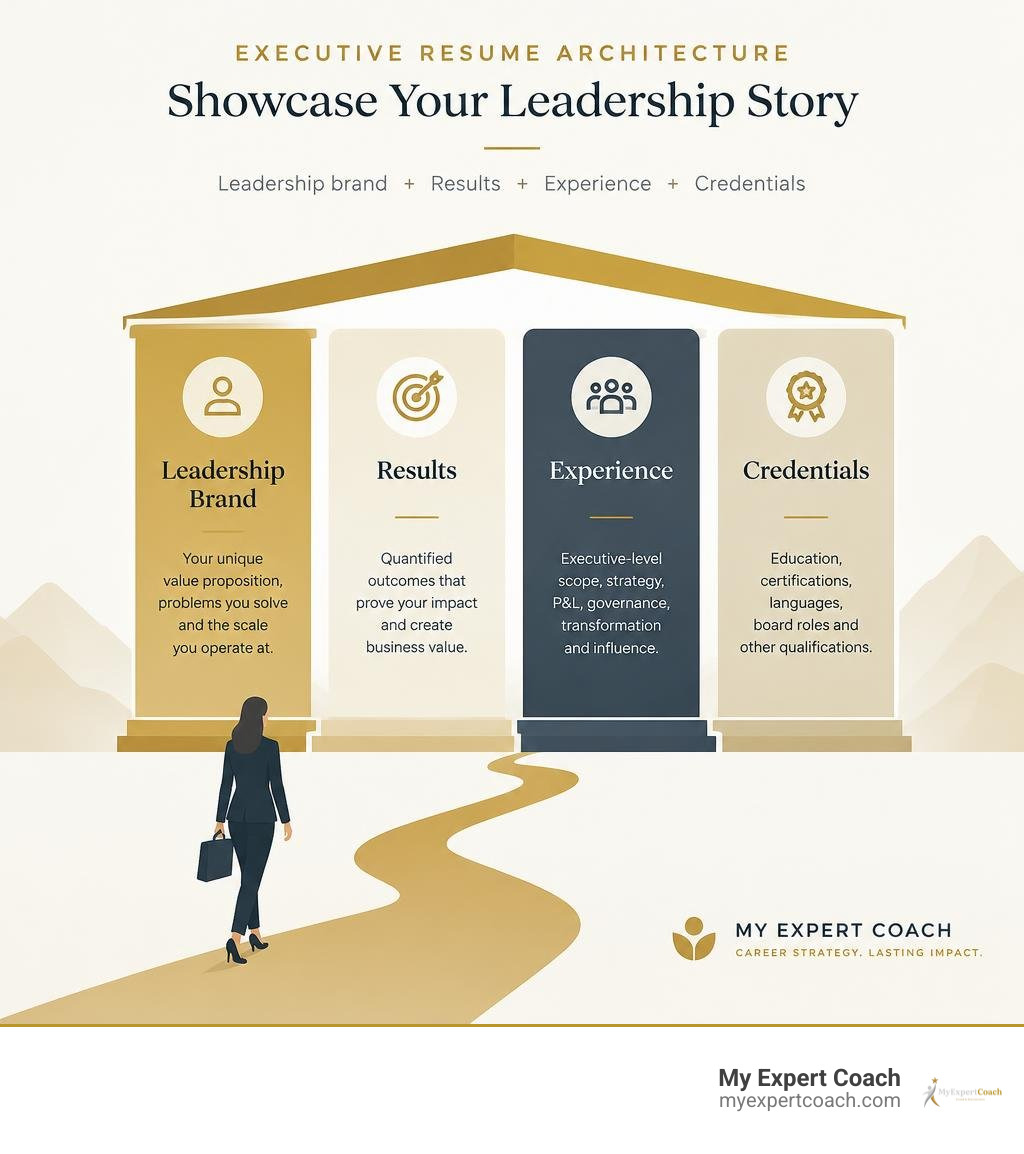
For VP, senior director, C-suite, and board-level roles, make these priorities clear from the first page:
- Your leadership value proposition: the business problems you solve and the scale at which you operate.
- Proof of impact: quantified outcomes such as revenue growth, cost reduction, market expansion, operational improvement, or team performance.
- Executive-level scope: P&L ownership, strategy, governance, transformation, stakeholder leadership, and cross-functional influence.
- A readable structure: use the main column for career narrative and accomplishments, while reserving compact space for contact details, skills, certifications, languages, or board roles.
The goal is not to fit every achievement from a 15- or 20-year career onto one page. It is to build a clear leadership story that helps both applicant tracking systems and hiring committees see why you are ready for the role.
I am Sandy Spencer, a career coach and executive career strategist with more than 38 years of experience in HR, executive recruiting, resume writing, and LinkedIn optimization. Having helped advance over 10,000 careers, I know how an executive resume can turn underused accomplishments into a credible case for senior leadership.
Executive Resume vs. Standard Resume: Key Distinctions for Senior Leadership
The gulf between a standard professional CV and an executive document comes down to perspective. Standard resumes focus on tactical execution—what tasks you performed, which tools you configured, and how you supported daily workflows. In contrast, an executive document demonstrates enterprise stewardship, strategic vision, fiduciary governance, and how you steer teams through complex transformations.
| Dimension | Standard Professional Resume | Executive Resume |
|---|---|---|
| Core Purpose | Demonstrates operational execution and functional competence | Proves strategic vision, market positioning, and enterprise value creation |
| Primary Scope | Team-level tasks, individual contributors, day-to-day duties | Multi-million-dollar P&L, global operating budgets, enterprise risk |
| Accountability | Reports up to department heads; manages tactical deliverables | Reports to Boards, CEOs, or shareholders; exercises governance |
| Impact Framing | Project completion milestones, task output, activity metrics | Revenue growth, EBITDA gains, M&A integration, market share expansion |
| Document Length | 1 page (early career) to 2 pages (mid-level management) | Strictly 2 curated pages reflecting 15+ years of progressive leadership |
| Reader Focus | Screened primarily by initial recruiters for technical keyword matches | Evaluated in full by search committees, Nominating & Governance boards, and C-level peers |
When navigating higher-echelon appointments, many leaders benefit from tailored executive leadership coaching to help reframe their daily management duties into broad, board-level value propositions.
Target Audience and Seniority Thresholds
Understanding who is reading your document determines how you present your background. Junior candidates write for junior recruiters seeking exact tactical skill matches. Senior candidates write for search firm partners, compensation committees, Chief Human Resources Officers, and private equity operating partners.
This executive framework is built specifically for:
- Vice Presidents (VP) and Senior Vice Presidents (SVP) directing business units or enterprise divisions.
- C-Suite Officers (CEO, CFO, COO, CIO, CTO, CMO) responsible for bottom-line health and organizational scale.
- Senior Directors and Managing Directors overseeing cross-functional global initiatives.
- Board Candidates and Advisory Board Members offering specialized governance or industry expertise.
- Senior Practitioners with 15+ Years of Experience stepping into enterprise leadership.
If you are early in your career or pursuing non-supervisory individual contributor roles, a dense executive layout can work against you. It is designed to frame deep authority, not emerging potential.
Anatomy of a Modern Executive Resume: Structure and Formatting
Effective visual design guides the reader’s eye naturally through your career progression. An executive resume must strike an immediate balance between sophisticated visual authority and digital scannability.
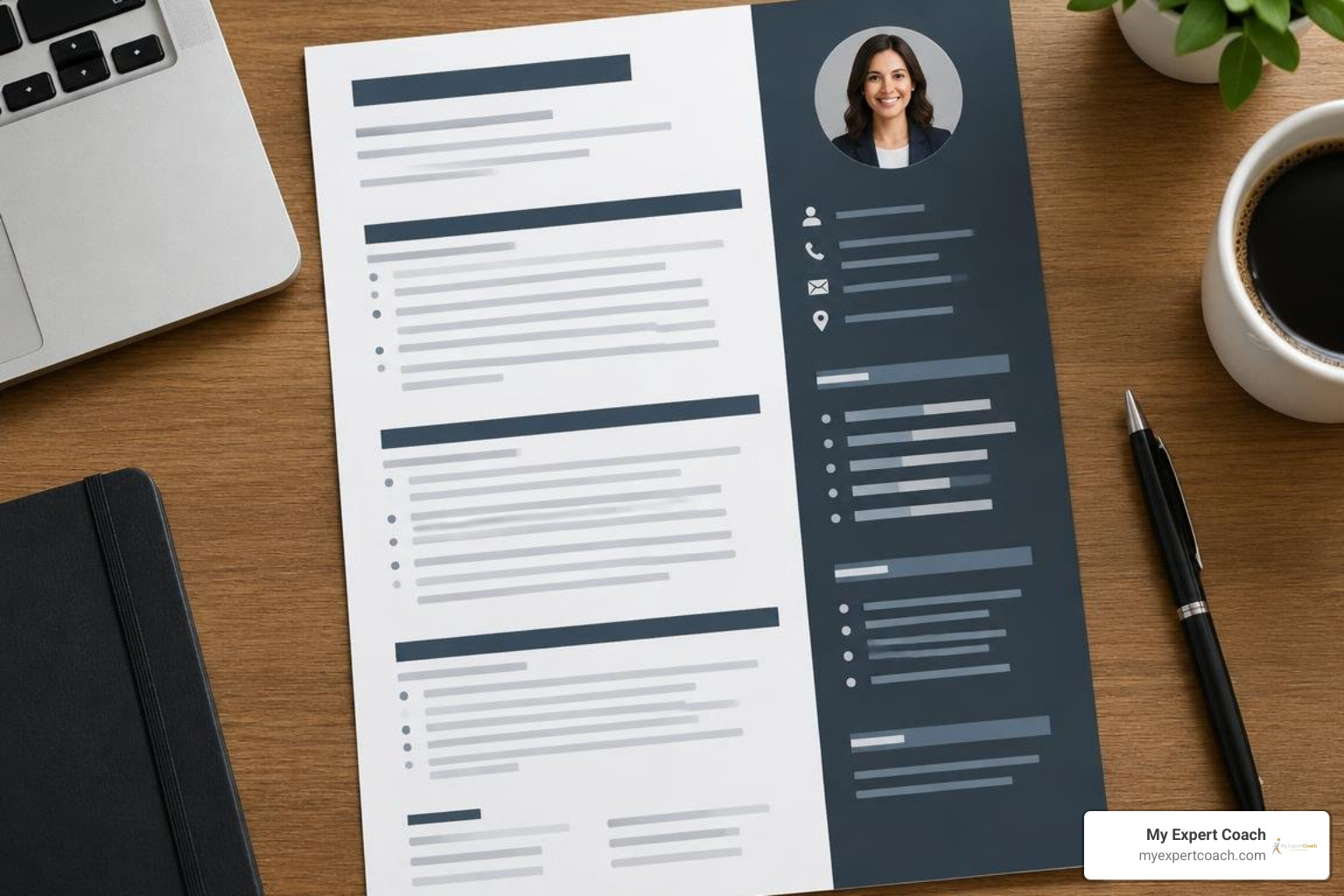
A modern two-column layout—featuring a wide primary column alongside a condensed sidebar—allows you to present dense, multifaceted careers without visual clutter. For the color palette, we recommend sticking to an authoritative neutral like dark slate. Vibrant neon highlights or matching a target company’s brand colors can undermine executive gravitas.
Main Column Narrative vs. Sidebar Lookup Content
To maximize readability, segment your content into narrative storytelling and lookup data:
- The Main Column (70% width): Reserved for your career history, reverse-chronological leadership positions, and high-impact accomplishments. This is where you deploy contextualized, results-oriented keywords that demonstrate revenue growth, change management, and cost optimization.
- The Sidebar Column (30% width): Designed for rapid scanning. It houses contact coordinates, LinkedIn profile links, core executive competencies, technical or operational certifications, board appointments, and foreign language proficiencies.
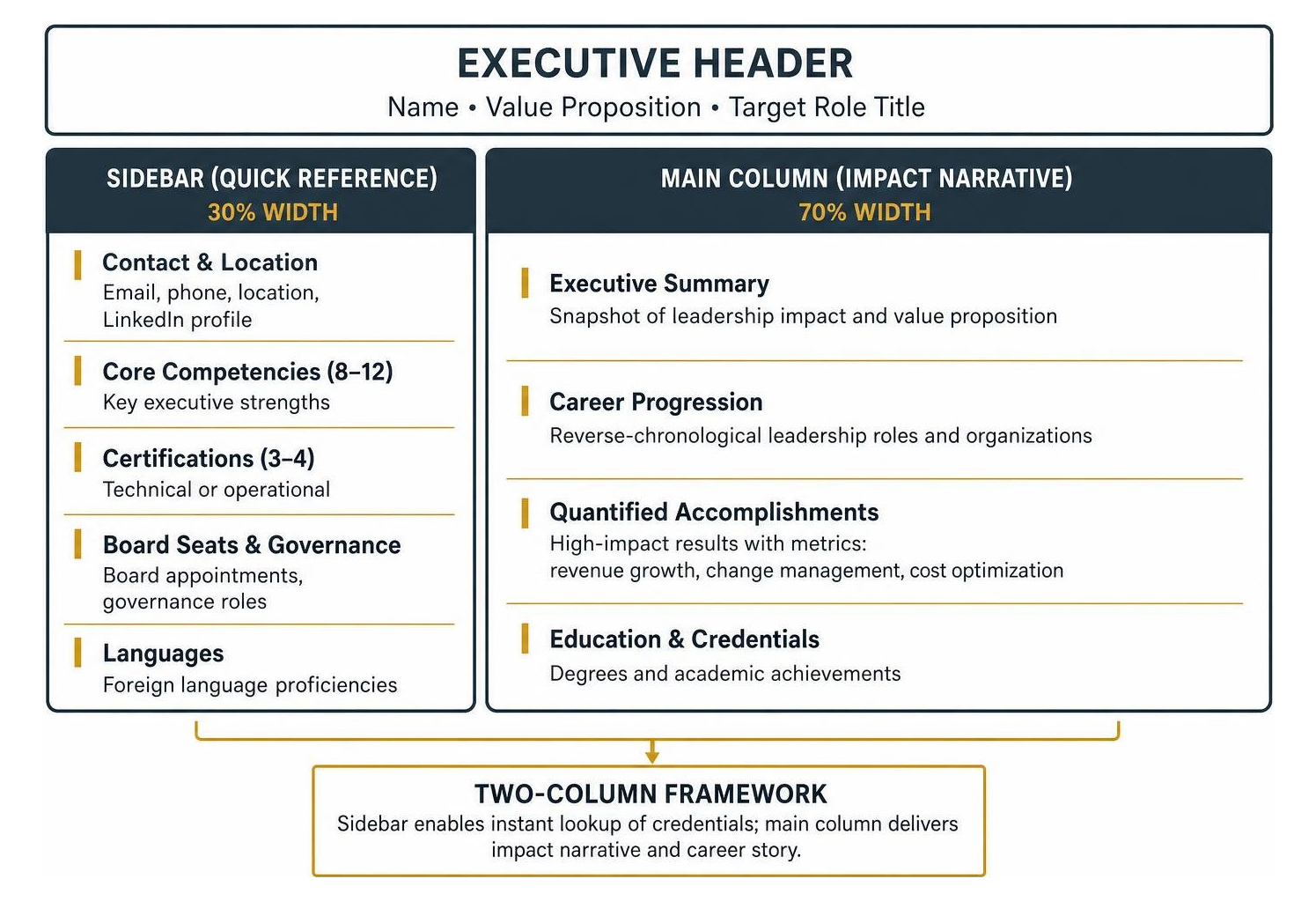
This structure ensures that when an executive search consultant scans your resume for table-stakes credentials, they find them instantly in the sidebar, freeing them to evaluate your real-world business impact in the main section.
Core Components of an Effective Executive Resume Strategy
Every section of your document should serve a strategic purpose:
- Executive Headline & Value Proposition: Immediately state your target leadership tier (e.g., Chief Operating Officer | Scaling Global SaaS Enterprises through Operational Excellence).
- Executive Summary: A 3–4 sentence synthesis of your career mandate, scope of P&L oversight, and core functional specialties.
- Core Competencies: A focused list of 8–12 high-level strategic competencies (such as Capital Allocation, Cross-Border M&A, Organizational Restructuring, or Enterprise Risk Management).
- Professional Experience: Reverse-chronological career history featuring a brief 2-sentence scope statement for each role, followed by 3–5 bullet points demonstrating measurable business outcomes.
- Certifications & Education: Highlight advanced degrees (MBA, MS, JD) and top-tier credentials, limiting this section to 3–4 relevant certifications.
- Governance & Board Memberships: Dedicated real estate highlighting advisory or fiduciary roles that demonstrate cross-industry perspective.
For candidates who want a reliable, pre-structured starting point, a clean executive resume template gives you a balance of sidebar lookup efficiency and main-column impact.
Optimizing for ATS and Executive Hiring Committees
A common misconception is that senior leadership candidates bypass applicant tracking systems (ATS) entirely. While personal referrals and executive search firms play a large role, modern talent platforms still ingest, parse, and rank executive applications behind the scenes.

Two-column executive layouts built with modern column-order-safe standards successfully parse across 4 out of 5 major enterprise ATS platforms. The rare edge cases involve outdated legacy software that reads straight across a page horizontally. By maintaining standard header naming conventions and clean text hierarchies, you satisfy digital parsing algorithms without sacrificing the visual presentation human decision-makers expect.
Integrating clean document design into your broader job search strategies helps ensure your credentials pass automated initial reviews and land cleanly in front of board search committees.
Condensing 15+ Years of Experience into Two Pages
One of the biggest hurdles for senior leaders is distilling two decades of milestones into a concise two-page format. Board members and hiring committees do not need an exhaustive log of every project you led in the late 1990s or early 2000s; they want to see your trajectory and current leadership capabilities.
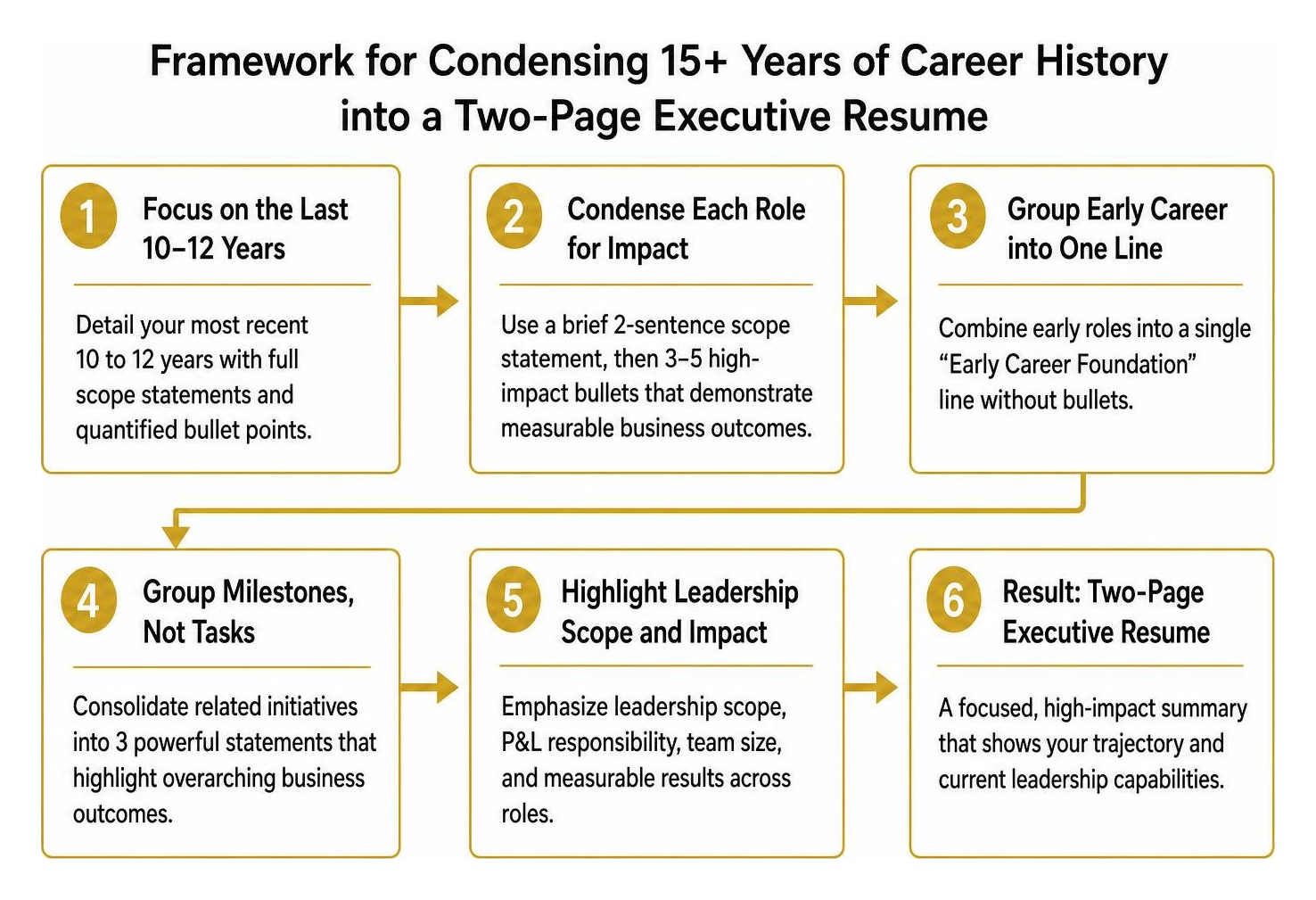
When preparing an executive career transition strategy, apply these pruning techniques:
- The 10-to-15-Year Rule: Detail your most recent 10 to 12 years with full scope statements and quantified bullet points.
- Early Career Summary: Group early roles into an un-bulleted, single-line “Early Career Foundation” section (e.g., Earlier career includes roles as Financial Analyst at Company A and Audit Associate at Firm B).
- Group Milestone Achievements: Instead of listing seven bullet points per role, consolidate related initiatives into three powerful, high-impact statements that highlight overarching business outcomes.
Customizing Your Executive Resume for Board and C-Suite Roles
C-suite and board roles require a clear shift from operational leadership to governance, capital allocation, and shareholder value creation.
Aligning your resume with your broader personal branding helps communicate this transition:
- Spotlight Governance and Risk Oversight: Clearly showcase committee memberships (such as Audit, Risk, or Nominating & Governance) and instances where you advised senior leadership on regulatory landscapes.
- Quantify Shareholder Value: Emphasize margin expansion, enterprise valuation growth, capital raises, and successful liquidity events.
- Highlight Stakeholder Alignment: Detail how you unite disparate groups—from labor unions and regulatory bodies to institutional investors and executive peers—around unified strategic goals.
Common Executive Resume Pitfalls to Avoid
Even highly accomplished leaders can fall into formatting and messaging traps that weaken their candidacy.
- The Single-Page Trap: Forcing a 20-year executive background onto a single page leads to unreadable typography and strips out the context needed to understand your scope of responsibility.
- Skill Stuffing: Cramming 30+ generic buzzwords into a sidebar clutters the page and dilutes your core value proposition. Keep your list to 8–12 distinct competencies.
- Task-Oriented Bullet Points: Writing “Responsible for overseeing international supply chain operations” reads like a basic job description. Instead, highlight your actual impact: “Re-architected APAC supply chain operations across 14 distribution centers, cutting logistics costs by $18M while improving fulfillment rates to 99.4%.”
- Ignoring the Human Element: While metrics are critical, hiring teams also look for your ability to build culture, navigate leadership succession, and resolve high-stakes conflict.
Refining these narrative points is a core focus of structured interview coaching and preparation, ensuring the leadership stories you tell verbally match the caliber of your written materials.
Frequently Asked Questions About Executive Resumes
Is a two-column resume format safe for modern ATS platforms?
Yes. Modern, professionally designed two-column layouts are column-order-safe and parse cleanly across 4 out of 5 major ATS systems. Enterprise platforms read the main text column and sidebar categories in sequence. If you anticipate your resume will be processed through older legacy software, a traditional single-column format offers universal compatibility, though modern two-column formats provide a stronger visual hierarchy for human readers.
How many pages should an executive resume be?
An executive resume should be exactly two pages. A single page rarely provides enough space to showcase enterprise-level P&L, organizational change, and strategic impact across a 15+ year career. Conversely, three or more pages often point to a lack of curation and executive brevity. Two pages give you the ideal balance to highlight your leadership scope while respecting the search committee’s time.
How should board appointments and advisory roles be presented?
Present board appointments in a dedicated “Board Memberships & Governance” section or within a targeted sidebar block. For each appointment, include the organization name, your committee assignments (e.g., Audit Committee Chair), your tenure, and a brief statement on your strategic contributions, such as guiding an M&A transition, advising on capital structure, or modernizing risk governance frameworks.
Conclusion
Your executive resume is more than a record of your past employment—it is a strategic marketing asset that establishes your leadership scope, your operational instincts, and the value you bring to an enterprise. By pairing a clean, scannable layout with quantifiable achievements, you make it easy for search committees, boards, and recruiters to see your potential impact.
If you are ready to refine your executive narrative, our team at MyExpertCoach is here to help. Explore our expert resume and LinkedIn services to transform your career milestones into a compelling, market-ready leadership brand.