
table of contents
Can I Negotiate After Accepting Offer Letter Agreements? Legal and Professional Realities

Yes, you can legally negotiate after accepting an offer letter in most U.S. corporate settings due to at-will employment, but doing so carries professional risks and requires a legitimate justification such as an expanded job scope, a late-arriving competing offer, or newly discovered benefits discrepancies. When you find yourself asking, “Can I negotiate after accepting an offer letter?”, the answer involves balancing contract law with workplace dynamics. While you are rarely trapped in a legal corner, the social contract you establish with your future team is delicate. Reopening compensation after saying “yes” requires a firm grasp of both your rights and your professional standing.
Legally and Professionally, Can I Negotiate After Accepting Offer Letter Terms?
In the United States, employment is overwhelmingly “at-will” across 49 states (with Montana being the sole exception). Under at-will employment, an offer letter is typically an outline of expected compensation and duties rather than an ironclad, binding employment contract. According to detailed legal analysis of signed offer letters, unless your document contains explicit clauses guaranteeing fixed-term employment or restrictive covenants, either party can alter terms or terminate the relationship at any point.
From a purely legal standpoint, asking to modify terms after signing does not constitute a breach of contract in standard corporate settings. However, the legal doctrine of promissory estoppel serves as a reminder of how serious an accepted offer is: if an employer relies on your acceptance to their significant detriment (or vice versa), legal disputes can arise.
Professionally, the reality is starker. When you accept an offer, the hiring team cancels interview loops with runner-up candidates, submits budget approvals, and notifies leadership. Reopening the conversation signals uncertainty. While not illegal, doing so without a substantial, business-driven justification risks damaging employer trust before day one.
Acceptance Stages: Verbal vs. Written vs. Post-Start Date
Your leverage changes drastically depending on the stage of the hiring process. What feels like a minor request during an initial phone screen can become a major red flag once onboarding paperwork is submitted.
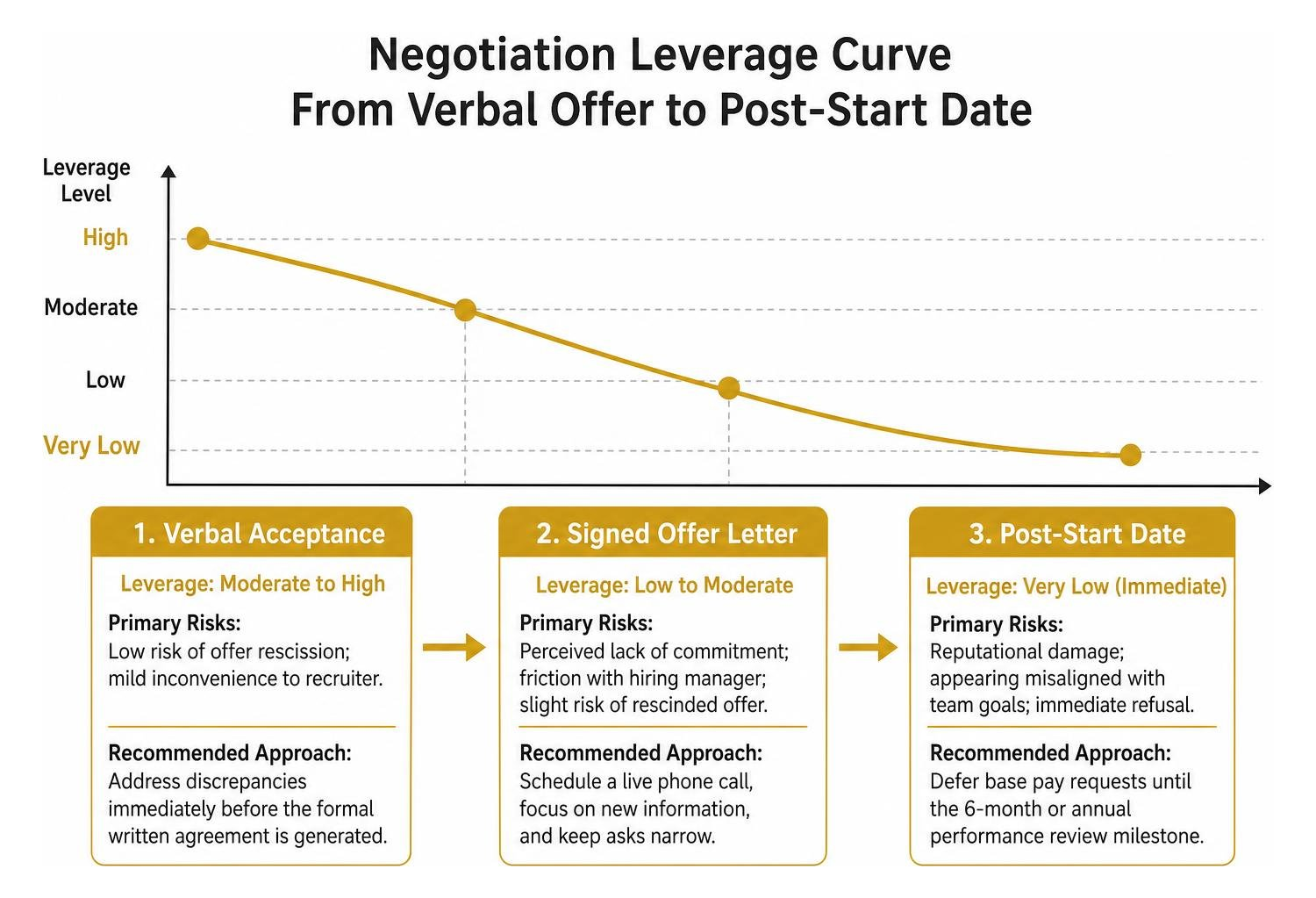
| Offer Stage | Leverage Level | Primary Risks | Recommended Approach |
|---|---|---|---|
| Verbal Acceptance | Moderate to High | Low risk of offer rescission; mild inconvenience to recruiter. | Address discrepancies immediately before the formal written agreement is generated. |
| Signed Offer Letter | Low to Moderate | Perceived lack of commitment; friction with hiring manager; slight risk of rescinded offer. | Schedule a live phone call, focus on new information, and keep asks narrow. |
| Post-Start Date | Very Low (Immediate) | Reputational damage; appearing misaligned with team goals; immediate refusal. | Defer base pay requests until the 6-month or annual performance review milestone. |
If you have only given verbal consent, you still have room to negotiate. As noted in insights on the art of securing your dream job, verbal offers are exploratory frameworks until finalized in ink.
Once the document is signed, your leverage drops noticeably. If you have already begun working, reopening your starting compensation immediately is ill-advised; your best path forward is delivering high-impact work and leveraging our proven job search strategies during structured performance milestones.
Legitimate Grounds and Critical Risks of Reopening Negotiations
Reopening an accepted offer is not an everyday tactic. To protect your professional standing, you must distinguish between valid, real-world justifications and simple buyer’s remorse.

When and How Can I Negotiate After Accepting Offer Letter Documents?
Hiring managers understand that business conditions and personal circumstances change. You have legitimate grounds to request an adjustment under specific conditions:
- Expanded Job Scope: You discover during pre-onboarding that the role entails managing unexpected territories, larger teams, or technical systems not discussed during interviews.
- Benefits or Equity Discrepancies: The formal benefits package reveals significant out-of-pocket healthcare premiums, unexpected vesting cliffs, or missing bonus guarantees that alter total compensation.
- Relocation Cost Spikes: Documented moving estimates, regional housing shifts, or real estate spikes substantially exceed original projections.
- Late-Arriving Competing Offers: A higher, verifiable offer from another firm arrives within days of your signature, giving you clear market data.
When these situations happen, approach the recruiter collaboratively. Rather than presenting demands, present facts. This preserves relationships and reinforces your personal branding as a transparent, analytical professional.
The Cost of Missteps and the Compounding Effect of Compensation
Failing to negotiate your initial offer upfront can carry a steep price. Research highlights how initial compensation gaps create an aggressive compounding deficit across a career:
As detailed in industry research on compounding career earnings, starting just $10,000 lower can cost an executive over $90,000 across five years when factoring in percentage-based annual merit increases, target bonus percentages, and equity refreshes.
However, attempting a clumsy renegotiation after signing can be far more costly if it leads to offer withdrawal. Avoid the typical pitfalls outlined in our guide on 13 big mistakes job seekers make. When you reopen discussions, anchor your points in clear data rather than personal financial needs like mortgages or credit card bills.
Step-by-Step Guide to Renegotiating After Acceptance (With Scripts)
If you must reopen negotiations after signing, execution matters. How you communicate is just as critical as what you ask for.
The 4-Step Strategic Conversation Framework
We coach candidates to navigate high-stakes discussions using a structured framework built on established Harvard PON salary negotiation principles.
Always initiate this conversation via phone or video conference. Email lacks tone, nuance, and warmth, leaving room for misinterpretation. Use email solely to schedule the call.
Exact Scripts and Email Templates for Post-Acceptance Conversations
1. The Scheduling Email (Setting Up the Call)
Subject: Quick check-in regarding Vice President of Product onboarding / Alex Morgan
Hi Sarah,
I am looking forward to joining the team next month and getting started on the platform migration initiative.
As I have been reviewing our final onboarding materials and timeline, a few new logistical details came up that I would appreciate your brief guidance on. Do you have 10 minutes for a quick call this afternoon or tomorrow morning?
Best regards,
Alex Morgan
2. Phone Script: Significant Role Scope Expansion
“Hi Sarah, thank you for jumping on the phone. I want to reiterate how excited I am to lead the product engineering team next month.
As we discussed yesterday, the scope of this role has evolved to include overseeing the European division and technical infrastructure, which involves significant additional travel and technical ownership. Because this expands beyond the initial parameters we outlined, would the team have flexibility to adjust the base compensation to $215,000 to match the updated scope?
My commitment to driving results for this team is absolute, and I appreciate your partnership in looking into this.”
3. Phone Script: Late-Arriving Competing Offer
“Hi David, thank you for taking the time to speak with me. I am fully committed to joining Acme Innovations and am eager to start on the 15th.
In the spirit of total transparency, an executive interview process I concluded prior to our agreement resulted in a formal offer yesterday at $195,000 with accelerated equity.
Acme Innovations remains my top choice because of our upcoming product roadmap. Is there any flexibility within your sign-on bonus or first-year equity pool to help narrow this gap? I wanted to bring this to you directly so we can resolve it and focus entirely on onboarding.”
For comprehensive preparation on framing these high-stakes discussions, explore our personalized interview coaching and preparation and our structured executive career transition strategy.
Non-Salary Levers to Negotiate When Base Pay Is Locked
When an organization locks base salary due to rigid internal pay equity bands or HR constraints, alternative compensation levers offer valuable ways to bridge the gap.

High-Impact Alternative Compensation Levers
- Sign-On Bonuses: Unlike recurring base pay, signing bonuses draw from one-time acquisition budgets. They allow recruiters to bridge a compensation deficit without disrupting internal team equity.
- Equity Grants & Accelerated Vesting: Requesting additional Restricted Stock Units (RSUs), stock options, or a shorter initial vesting cliff can yield substantial returns.
- Professional Development & Executive Coaching Budgets: Securing a guaranteed annual stipend for specialized certifications or coaching adds tangible long-term value.
- Guaranteed Performance Milestone Reviews: Agree in writing to evaluate your compensation at 6 months rather than the standard 12-month annual cycle based on agreed-upon KPIs.
- Flexible Work & Commute Stipends: Commute allowances, remote work arrangements, or tailored relocation assistance can quickly offset living expenses.
Navigating Employer Refusal Without Burning Bridges
If the hiring manager states that the offer is completely final and cannot be modified, your response will set the tone for your tenure.
Never react with frustration. Reaffirm your commitment gracefully:
“I completely understand and respect the budget constraints. I appreciate you looking into this for me. I am thrilled to join the team on our agreed start date and look forward to delivering exceptional value right out of the gate.”
This preserves goodwill, showcases your emotional intelligence, and sets the stage for an exceptional performance review. Review our insights on staying competitive in today’s job market to ensure your career remains positioned for ongoing growth.
Frequently Asked Questions About Post-Acceptance Salary Negotiation
Will an employer rescind my offer if I ask to negotiate after signing?
While uncommon, the risk of offer rescission exists if a candidate issues an ultimatum or appears adversarial. Employers rarely pull offers over polite, data-driven inquiries; rescissions generally occur when a candidate demands changes aggressively, signaling future friction.
How quickly should I reach out if I realize I need to renegotiate?
Reach out within 24 to 48 hours of discovering the new information. The earlier you initiate the conversation before your official start date, the easier it is for recruiters to adjust administrative workflows and budget allocations.
Can I negotiate a signing bonus after accepting my base salary?
Yes. A one-time signing bonus is frequently the easiest concession for an employer to make because it does not alter recurring salary bands or affect internal team parity.
Conclusion: Making Informed Career Moves
Reopening negotiations after accepting an offer letter is a delicate maneuver. While at-will employment gives you the legal room to discuss terms, your professional reputation and baseline trust are your most valuable career assets. By grounding every request in objective data, focusing on collaborative solutions, and maintaining a solution-oriented tone, you can protect both your financial market value and your workplace relationships.
At MyExpertCoach, we bring over 38 years of executive search and HR leadership experience to help senior leaders navigate complex compensation negotiations, career pivots, and executive branding. Explore our comprehensive career and executive coaching services or contact us today to partner on your next career move.