
table of contents
Handle a Counteroffer Without Derailing Your Career

If you ask a manager for a counter offer – or receive one after resigning – do not decide based on the raise alone. First, compare both roles against the reasons you wanted to leave, your long-term growth path, and whether your employer will put every promise in writing.
A counteroffer can be useful when it corrects a clear pay gap and includes real changes to your role, scope, or advancement plan. But it can also label you as a flight risk, leave the original problems untouched, and delay a career move you already knew was right. Research cited in career guidance shows that about 46% of employees who receive counteroffers still leave within a year, while only 29% remain longer than 12 months.
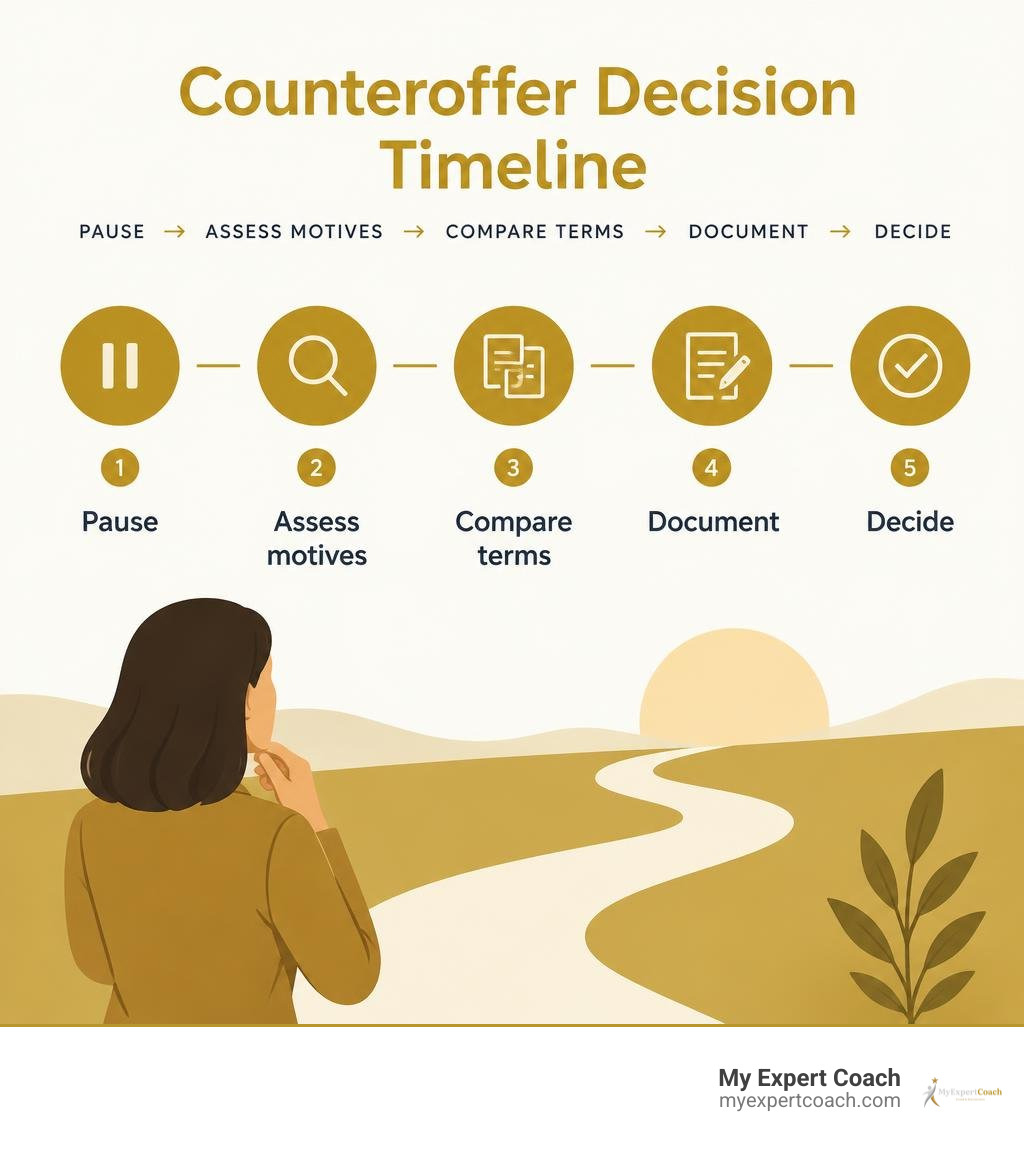
Before you respond, pause, ask for time, and evaluate the full package – pay, leadership, workload, flexibility, title, and future opportunity. A higher salary is valuable, but it is not a substitute for trust or meaningful career progress.
I am Sandy Spencer, a career coach, former HR and executive recruiting professional, and strategist with more than 38 years of experience helping leaders evaluate high-stakes decisions like an ask a manager counter offer. The next sections will help you spot the risks, identify rare cases where staying makes sense, and respond with confidence.
What Is a Counteroffer and Why Employers Make Them
A counteroffer occurs when an employee tenders their resignation, and their current employer presents an enticing alternative package to convince them to stay. This package often includes a salary increase, a title bump, expanded perks, or vague commitments about future projects. When you ask a manager for a counter offer, or receive one unprompted, understanding the underlying motivations is critical.
While it is flattering when a company suddenly discovers room in the budget to keep you, understanding their underlying motivations is critical. In our 25+ years of insider HR and recruiting experience, we find that counteroffers rarely stem from sudden, benevolent appreciation. Instead, they are typically calculated damage control.
Employers make counteroffers primarily to mitigate business disruption:
- Recruitment Costs: Sourcing, vetting, and onboarding a senior replacement can cost up to 1.5 to 2 times that employee’s annual salary, according to workforce benchmarks from the Society for Human Resource Management.
- Productivity Gaps: Leaving suddenly creates an operational void. Ongoing deliverables stall, and remaining teammates get overburdened.
- Panic Response: Managers are often evaluated on team stability. A sudden resignation reflects poorly on their leadership or puts critical quarterly goals at risk.
- Buying Time: Counteroffers allow companies to keep critical institutional knowledge in-house just long enough to orchestrate a controlled handover or find a backfill on their own schedule.

Many professionals assume that accepting a counteroffer is a seamless win. However, falling for the immediate ego stroke is one of the 13 big mistakes job seekers make when managing their career transitions. Employers use counteroffers as a tactical stopgap, not an enduring solution.
The Counteroffer Perspective: Why Staying Backfires
When an employer makes a counteroffer, the workplace dynamic changes permanently. Money alone rarely addresses the fundamental reasons that drove you to seek outside opportunities.
Once you hand in your notice, your employer knows your loyalty has fractured. You become viewed as an operational flight risk. This perception carries several hidden costs:
- Eroded Trust: Your manager may wonder if you have one foot out the door whenever you take a personal day or express frustration with a project.
- Stifled Future Compensation: The sudden 15% to 20% bump you receive today often eats into your standard raise pool for the next several annual review cycles. You may simply be receiving next year’s money early.
- Unresolved Environmental Issues: A higher base salary does not fix toxic leadership, unreasonable workloads, lack of executive direction, or a misaligned corporate culture.
- Target for Restructuring: If budget cuts or layoffs occur, employees who have previously signaled an intent to leave are frequently placed at the top of the vulnerability list.
Analyzing Counteroffer Retention Statistics
The numerical reality of accepting a counteroffer tells a clear story. Retention after accepting an employer’s retention package drops precipitously over the subsequent twelve months.

According to industry retention data:
- 46% of employees who are counter-offered leave anyway within the following 12 months.
- 4% accept the counteroffer but leave in under three months due to immediate buyer’s remorse.
- 21% remain between three and twelve months before finalizing their exit.
- Only 29% stay longer than a full year.
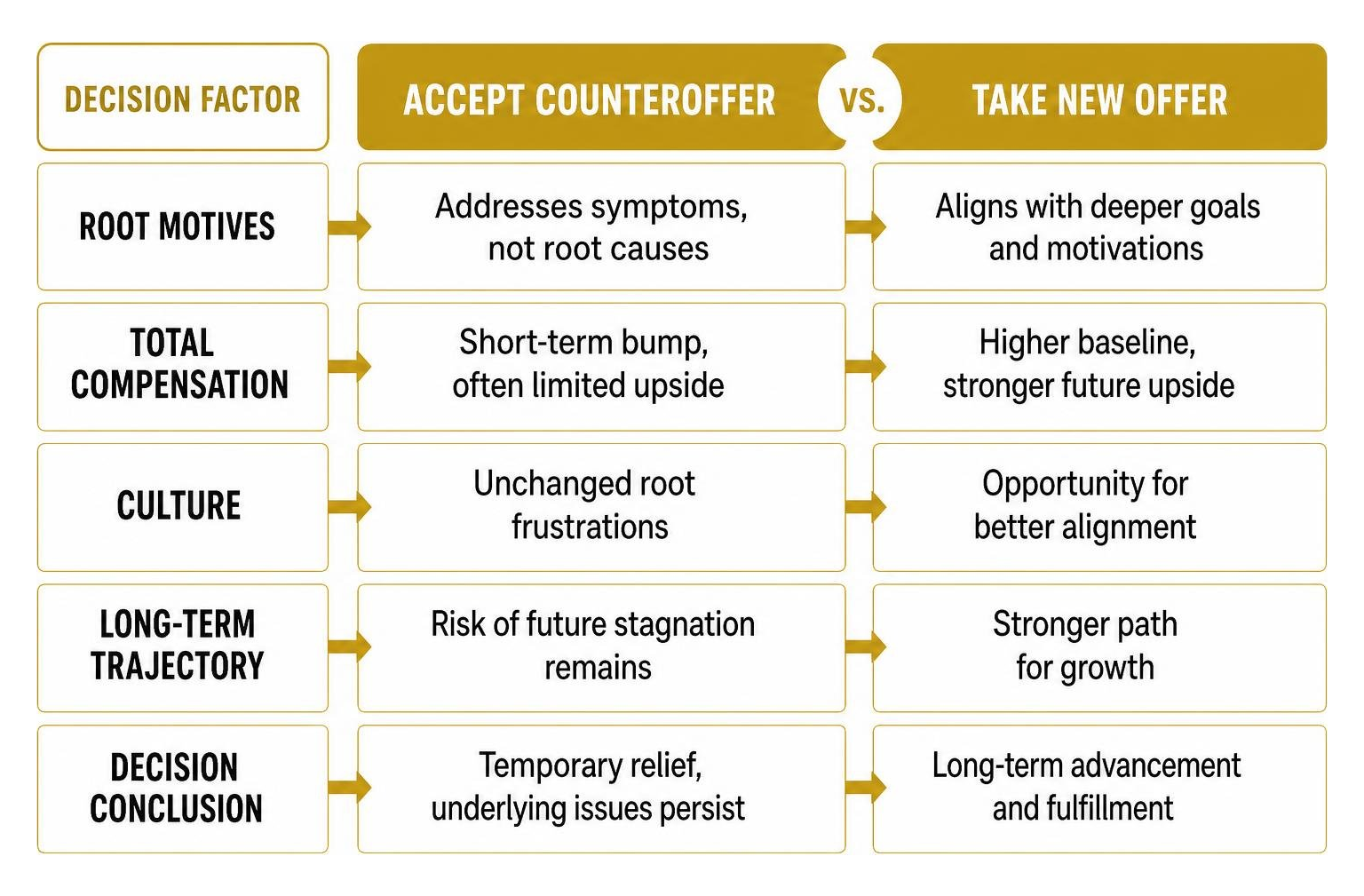
| Outcome Factor | Staying via Counteroffer | Moving to the New Role |
|---|---|---|
| Trust Dynamic | Damaged; viewed as a flight risk | Fresh slate; high initial trust |
| Compensation Trajectory | Often stalls future merit increases | Sets a higher baseline for future jumps |
| Workplace Culture | Unchanged root frustrations | Opportunity for better alignment |
| Long-Term Retention | 71% depart within 12 months | Standard onboarding tenure trajectory |
| Career Momentum | Often static despite new title | Immediate acquisition of new skills and networks |
Hidden Strings, Rescinded Promises, and Broken Agreements
Counteroffers frequently carry invisible asterisks. In some instances, organizations attempt to lock employees into punitive arrangements. Companies have been known to attach retention agreements requiring staff to repay salary increases or bonuses if they depart within a year.
Other risks include broken promises regarding scope and promotion. You might be offered a promotion to match an external offer, only to find the title withheld indefinitely while you are expected to take on expanded duties immediately. Corporate restructuring or managerial changes can quickly void unwritten promises.
If a company had the capacity to pay you market rate, support your development, and promote you all along, ask yourself why it required a resignation threat to make it happen.
Rare Exceptions Where Accepting a Counteroffer Makes Sense
While accepting a counteroffer is generally inadvisable, professional life is rarely absolute. There are specific, narrow scenarios where staying can serve your strategic interests:
- The Issue Was Purely Compensation Benchmarking: If you love your leadership, team, work-life balance, and growth trajectory, and the only problem was that corporate pay scales had lagged behind the broader market, a counteroffer can reset your salary to parity.
- Standard Industry Practice (e.g., Academia): In tenure-track academia and specific research environments, outside offers are the established, structural mechanism used to trigger institutional salary reviews.
- Formalized Scope Expansion with Written Backing: If your manager presents a restructured role that directly addresses past stagnation—complete with executive sign-off, clear KPIs, immediate title changes, and formal documentation—staying may bridge you to your next executive goal.

To navigate these unique situations, you must maintain actionable job search strategies so you are never operating from a position of desperation.
How to Evaluate and Handle an Outside Offer Professionally
When an external offer is on the table and your current company begins crafting a counterproposal, step back to analyze both paths objectively. Treat this as an executive business decision rather than an emotional confrontation.
Key Questions to Ask Before Responding
Before accepting or rejecting any offer, ask yourself these diagnostic questions:
- Why did I initiate my search in the first place? (If the primary drivers were burnout, lack of leadership support, or poor culture, extra money will not solve them.)
- Will this counteroffer change my day-to-day reality?
- How will my relationship with my boss and peers change once they know I planned to leave?
- Is the external company offering a stronger long-term platform for skill development and networking?
Mastering these evaluation stages is central to our interview coaching and preparation sessions, where we guide executives through high-stakes career crossroads. If you choose to negotiate an external offer rather than entertain an internal counter, keep communications collaborative and value-focused.
Handling Requests to Share Your External Offer Letter
A common pressure tactic from current employers is demanding to see a physical copy of your new job offer before they assemble a counterproposal.
You are under no legal or professional obligation to disclose an external offer letter to your current employer. Sharing it presents distinct risks:
- It surrenders your bargaining privacy.
- It reveals your prospective employer, inviting inappropriate back-channel inquiries.
- It frames your compensation strictly as a “match” rather than an evaluation of your actual worth to the organization.
If pressed, establish clear boundaries politely:
“I prefer to keep the specific written documentation confidential out of respect for the hiring company. However, I can confirm that the package includes a base salary of $X, along with expanded leadership scope and equity incentives.”
If you choose to share proof to satisfy a rigid corporate HR compensation policy, redact the hiring company’s name, logos, benefits details, and supervisor information.
How to Decline a Counteroffer with Poise
Declining a counteroffer professionally ensures you protect your professional reputation and maintain valuable executive connections.
Follow these best practices to decline cleanly:
- Express Appreciation: Thank your manager for their efforts to assemble the retention package.
- Keep the Focus on Long-Term Fit: Frame your departure around alignment with new challenges rather than flaws in your current team.
- Commit to an Orderly Transition: Offer to help document workflows, brief your replacement, and complete critical handoffs.
“Thank you for putting this package together and for your advocacy on my behalf. After careful consideration, I have decided to proceed with the outside opportunity. It aligns closely with the specific industry direction I am targeting for my next career phase. My priority over the next two weeks is ensuring a smooth transition for the entire team.”
Deploying clear communication strategies alongside these 5 ways to instantly improve your job search results ensures you maintain a stellar professional network wherever your career takes you.
Frequently Asked Questions About Counteroffers
Can I Leverage an Outside Offer Just to Get a Raise at My Current Job?
Using an outside offer solely as a negotiating lever is an extremely risky gamble. Employers can easily call your bluff. If your manager congratulates you on the new role and accepts your resignation on the spot, you must be prepared to walk out the door.
Furthermore, even if the employer matches the salary, the maneuver can breed managerial resentment and place your long-term security in jeopardy.
What Should I Do If My Employer Rescinds Their Counteroffer?
Employers occasionally assemble a verbal counteroffer in a panic, only for senior leadership or HR to reject the budget allocation later. An employer that pulls a counteroffer has signaled clear institutional instability and unreliability.
If this occurs, do not attempt to plead or renegotiate. Transition immediately to the new organization with complete focus. If you struggle with imposter syndrome or anxiety during sudden shifts, understanding how to beat the negative thoughts ruining your job search will help you stay grounded and decisive.
How Long Do Employees Typically Stay After Accepting a Counteroffer?
Statistically, fewer than 3 in 10 employees (29%) remain at their company for longer than a year after accepting a counteroffer. The overwhelming majority depart within 12 months because the financial incentive fails to fix broken workplace dynamics, unmanageable workloads, or limited progression pathways.
Failing to target the right environment is often the main reason you wont find a job that delivers genuine, sustained career satisfaction.
Conclusion
Counteroffers are seductive because they appeal to our natural desire for safety, comfort, and immediate financial validation. However, sustainable career advancement requires looking past short-term stopgaps and evaluating your broader professional trajectory.
By identifying the underlying motivations behind an employer’s counterproposal, asking the right diagnostic questions, and documenting all commitments, you can navigate these negotiations from a position of authority.
When you are ready to master high-stakes compensation discussions, elevate your executive presence, and secure opportunities aligned with your true market value, explore our comprehensive services at My Expert Coach. We provide bespoke, non-template executive coaching designed to help senior leaders build resilient, high-impact careers on their own terms. Learn more about our team and background on our about page, or explore ongoing workplace strategies across our blog.