table of contents
Essential Elements Every Executive Bio Must Include
When recruiters, venture partners, or conference organizers read your executive summary, they look for clarity, authority, and immediate relevance. A strong bio is not a compressed résumé; it is a strategic narrative designed to position your leadership brand.
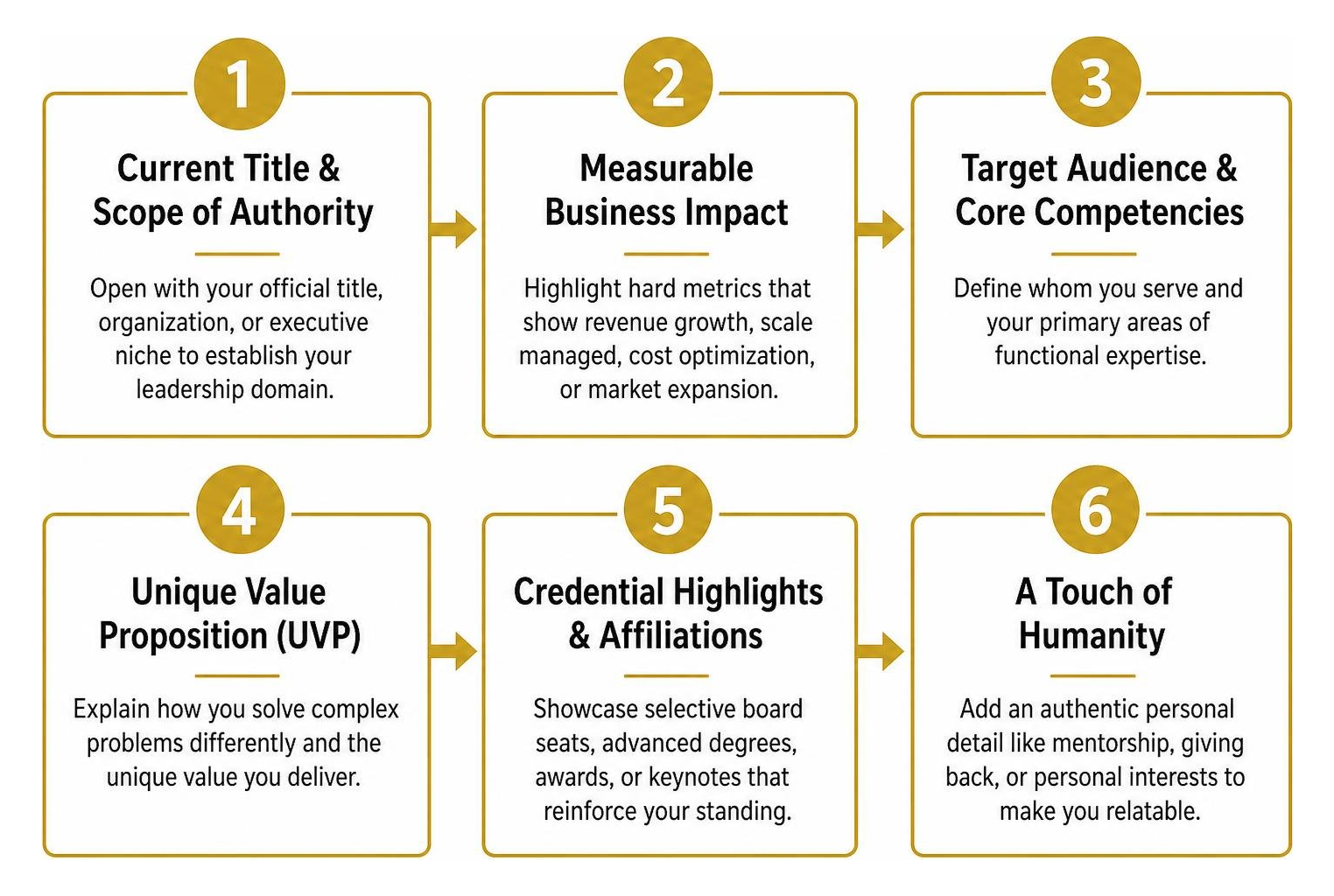
To craft a compelling bio that immediately establishes your credibility, ensure these core components are clearly communicated:
- Current Title & Scope of Authority: Open with your official title, organization, or executive niche, establishing your primary domain of leadership immediately.
- Measurable Business Impact: Replace broad claims with hard metrics. Highlight revenue growth, scale of operational management, cost optimization, or market expansion.
- Target Audience & Core Competencies: Clearly articulate whom you serve and your primary areas of functional expertise (e.g., enterprise SaaS transformation, cross-border M&A, organizational restructuring).
- Unique Value Proposition (UVP): Explain how you solve complex problems differently than your peers.
- Credential Highlights & Affiliations: Mention selective board seats, advanced degrees, industry awards, or keynotes that reinforce your standing.
- A Touch of Humanity: Conclude with an authentic personal detail—such as mentorship initiatives, philanthropic commitments, or personal interests—that makes you relatable and memorable.
Investing in intentional personal branding ensures that these elements work together seamlessly, transforming your background into a coherent executive story.
The Best Short Professional Bio Template Free Layouts for Job Seekers
Different executive platforms demand tailored bio architectures. Having multiple ready-to-use versions prevents scrambling when opportunities arise.
Below are three adaptable, high-impact layouts you can customize immediately for your career needs.
First-Person Short Professional Bio Template Free for LinkedIn Profiles
The first-person voice (“I”) creates an engaging, direct connection with executive recruiters and professional peers. LinkedIn members who complete and keyword-optimize their profiles are up to 40 times more likely to receive career opportunities.
Customized Example:
“As a Chief Technology Officer, I specialize in helping high-growth fintech enterprises modernize legacy architectures and accelerate cloud transformation. Over the past 15 years, I have built global engineering teams and led platform migrations that improved system reliability by 99.9% while cutting infrastructure costs by $12M. I am passionate about engineering culture and ethical AI governance. When I am not reviewing system architecture, you can find me mentoring first-generation STEM undergraduates.”
Refining your profile alongside targeted executive assets is essential. Explore our structured approach to resume and LinkedIn optimization to ensure complete alignment across your public materials.
Third-Person Short Professional Bio Template Free for Board and Speaker Pages
Third-person phrasing (“He/She/They”) provides an objective, authoritative tone suitable for company leadership pages, governance prospectuses, press kits, and keynote speaker introductions.
Customized Example:
“Elena Vance is a Global Supply Chain Executive with more than 18 years of experience building resilient procurement frameworks for Fortune 500 manufacturing leaders. Currently serving as Vice President of Global Logistics at Nexus Dynamics, Vance oversees a $450M operational budget across 14 international hubs and recently spearheaded an automation initiative that reduced delivery lead times by 28%. Recognized for her expertise in predictive supply network modeling, Vance serves on the advisory board of the Global Logistics Council and holds an MBA from Northwestern University.”
Using structured frameworks helps ensure your narrative maintains the right balance of executive authority, strategic metrics, and distinct leadership positioning.
Micro-Bio Framework for Event Summaries and Author Bylines
Micro-bios demand maximum impact within strict character constraints, such as 160-character social media profiles, panel programs, and guest publication bylines.
Customized Examples:
- Pipe Format (142 chars): VP of Product @ MedTech Labs | Enterprise Health AI | Scaled 3 SaaS platforms to $50M+ ARR | Angel investor & marathon runner.
- Narrative Format (153 chars): Fractional CFO partnering with Series B-D startups to accelerate enterprise value. Steered 6 successful exits totaling $1.2B. Board Member @ TechForward.
Platform-Specific Length and Point of View Guidelines
A single bio format cannot serve every channel. Publishing an informal first-person narrative in a formal board prospectus undermines executive presence, while dropping a dry third-person bio into a networking direct message creates unnecessary friction.
| Platform / Channel | Recommended Length | Point of View | Primary Objective | Key Optimization Focus |
|---|---|---|---|---|
| LinkedIn Profile Summary | 150–250 words (up to 2,600 char limit) | First Person (I) | Professional networking, recruiter discovery | High-intent search keywords, conversational leadership voice |
| Company Executive Page | 100–200 words | Third Person (He/She/They) | Investor relations, institutional trust | Formal scope of authority, strategic credentials, P&L responsibility |
| Conference Speaker Sheet | 50–100 words | Third Person (He/She/They) | Audience engagement, speaker credibility | Core presentation topic, notable achievements, audience takeaways |
| Board / Governance Dossier | 150–250 words | Third Person (He/She/They) | Fiduciary vetting, committee appointments | Governance history, risk management expertise, strategic leadership |
| Event Directory / Author Byline | 140–160 characters | First or Third Person | Instant brand recognition | Punchy value statement, pipe separators, single call to action |
Search engines index public LinkedIn profiles and leadership pages. Incorporating relevant functional keywords—such as enterprise risk mitigation, digital transformation, M&A integration, and SaaS product strategy—ensures your profile surfaces when executive recruiters execute targeted searches.
When adapting your bio for each platform, consider how the reader will encounter it. A recruiter scanning LinkedIn wants immediate evidence of leadership scope and measurable results. A conference organizer reviewing speaker submissions needs a concise credential summary that supports your proposed session. A board nominating committee looks for governance experience, fiduciary judgment, and strategic oversight. Tailoring your point of view and length to these distinct contexts strengthens your executive presence and increases the likelihood that your bio will be read in full.
Common Bio Writing Pitfalls and How to Avoid Them

Even experienced leaders occasionally fall into formatting and messaging traps that dilute their market presence. Review your drafted bio against these frequent missteps:
- Relying on Generic Buzzwords: Phrases like “visionary thought leader,” “results-driven problem solver,” or “dynamic team player” offer little value. Replace hollow adjectives with verifiable operational facts.
- Omitting Concrete Metrics: Stating that you “dramatically increased market share” is far less compelling than specifying that you “grew regional market share from 12% to 34% over a 24-month period.”
- Mixing Grammatical Perspectives: Avoid drifting between first-person reflections and third-person assertions within the same paragraph. Choose one viewpoint per platform and maintain consistency.
- Formatting as an Unbroken Wall of Text: Long, dense paragraphs cause digital readers to bounce. Use concise 2–3 sentence paragraphs or strategic bullet points for readability.
- Neglecting the Reader’s Context: A bio should demonstrate how your experience solves problems for your target organization, investor, or audience—not merely catalog past history.
- Using Passive Voice Excessively: Passive constructions such as “was responsible for” or “was tasked with” weaken executive authority. Prefer active verbs that show ownership, such as “led,” “built,” “negotiated,” or “transformed.”
- Leaving Outdated Credentials in Place: A bio that still lists a role you left three years ago or omits a recent board appointment signals inattention. Audit your bio regularly and remove dated achievements that no longer support your current positioning.
To explore deeper tactical guidance on executive communication, visit the career advisory articles on our blog.
Frequently Asked Questions About Short Professional Bios
How often should you update your short professional bio?
You should audit your professional bio at least twice a year. In addition to scheduled biannual reviews, update your bio immediately upon achieving major career milestones, such as securing a promotion, being appointed to a corporate or advisory board, earning an executive credential, or receiving significant industry recognition. Keeping your files current prevents rushed updates when high-visibility media or executive search opportunities arise.
What is the main difference between a professional bio and a social media bio?
The difference lies in character constraints, credential depth, and audience intent. A social media bio is typically limited to 150–160 characters and serves as a rapid identity tag designed for broad following. A professional bio is a structured leadership asset—ranging from 50 to 250 words—that outlines your operating scope, measurable business impact, governance experience, and professional value proposition for executive recruiters, partners, and event organizers.
How can AI tools streamline your bio drafting process?
Artificial intelligence tools can accelerate your initial drafting phase by transforming raw résumé bullet points into structured narrative drafts across multiple tones. You can use generative models to adjust length constraints or test different points of view. However, AI-generated outputs often default to generic adjectives and predictable phrasing. Always review and refine the output with your authentic executive voice, verified performance metrics, and proprietary leadership philosophy.
Should you include personal interests in an executive bio?
A brief personal detail can make your bio more memorable, but it should be relevant and strategically chosen. Mentioning mentorship initiatives, board service, or philanthropic commitments reinforces leadership character. Personal hobbies are acceptable when they humanize you without distracting from your executive authority. The key is balance: lead with professional credibility, then close with one authentic detail that invites connection.
Conclusion
A concise, high-converting professional bio is an essential asset in modern executive positioning. By utilizing structured frameworks, tailoring your voice across platforms, and anchoring your background with measurable business outcomes, you command attention across search engines, boardrooms, and recruiter databases.
At MyExpertCoach, we combine more than 25 years of insider recruiting and talent strategy expertise with custom, non-template executive materials. When you are ready to transition from standardized formats to an individualized market strategy, review our about background and discover our dedicated executive services.
Take control of your executive narrative today. Connect with us directly through our contact me portal to access bespoke career guidance, or explore our complete suite of executive job search strategies to position your career for sustained leadership growth.