table of contents
Career Consulting Helps You Turn Experience Into Opportunity

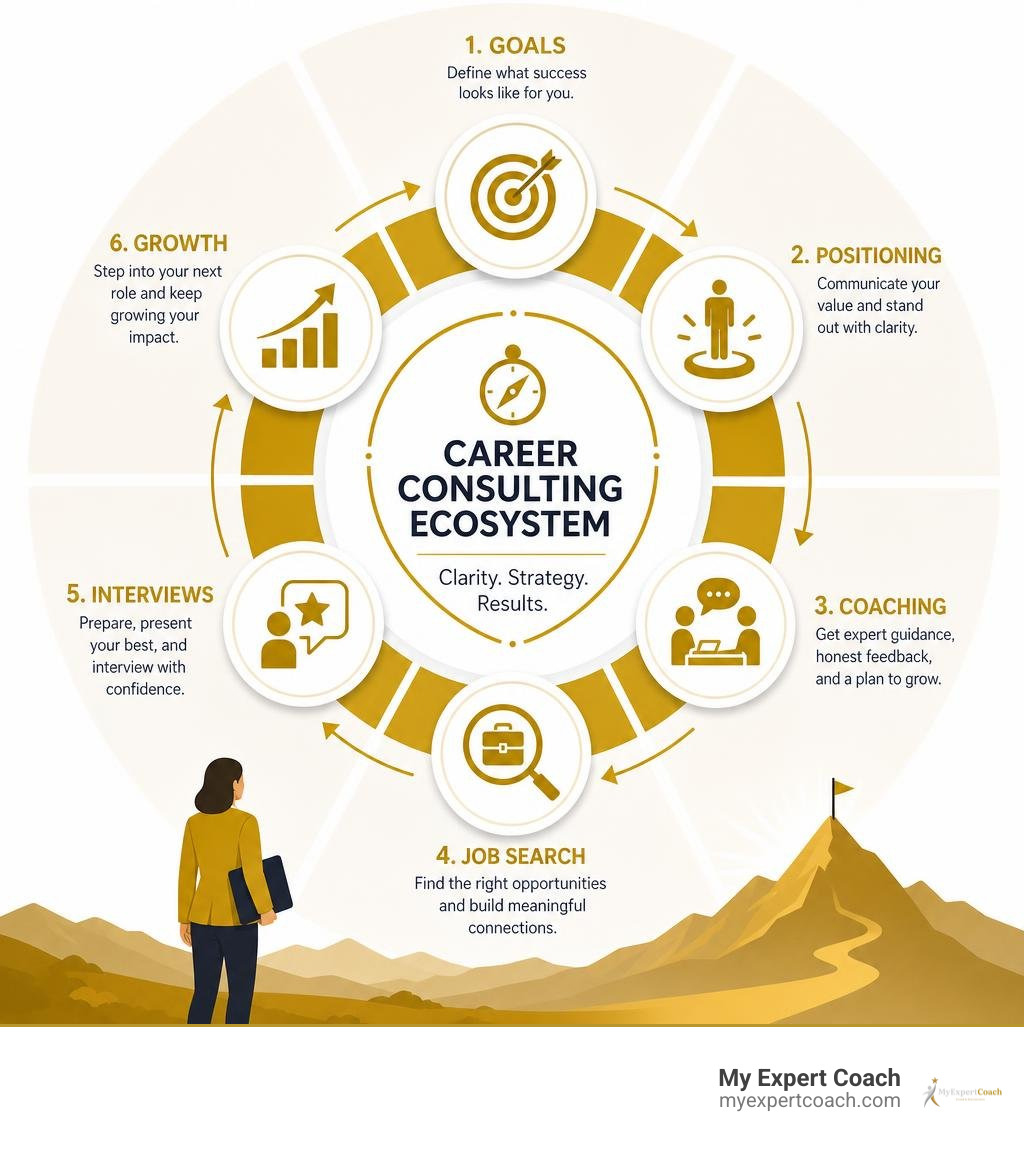
Career consulting helps you set a clear target, communicate the value of your experience, and take practical steps toward a stronger role. For senior leaders, that often means refining an executive resume and LinkedIn profile, preparing for high-stakes interviews, building negotiation confidence, and creating a focused job-search plan.
The best support is not one-size-fits-all. You might use a live virtual session for fast feedback and screen sharing, email-based guidance for thoughtful document review, or in-person and phone services when those formats fit your needs. The right option depends on your goals, schedule, and how much real-time discussion you need.
Career consulting also goes beyond finding openings. It can help you clarify direction when your next move feels unclear, reframe achievements around business outcomes, and challenge imposter-syndrome thinking that can hold accomplished professionals back. Instead of listing responsibilities, you learn to show the problems you solve and the results you create.
I am Sandy Spencer, a career strategist with more than 38 years of HR and executive recruiting experience, and I have helped advance over 10,000 careers. In this guide, I will explain how career consulting services work and how to use them to make your next move with greater clarity and confidence.
Delivery Formats in Modern Career Consulting

As the workplace landscape evolves in September 2026, the ways professionals access guidance have expanded significantly. Navigating career transitions requires choosing a delivery format that aligns with your learning style, schedule, and the depth of feedback you need. Whether you are aiming for the C-suite or exploring public sector opportunities, understanding the distinctions between service channels ensures you maximize your return on investment.
Virtual vs. Email Career Consulting
Choosing between virtual consultations and asynchronous email reviews comes down to the nature of the challenge you are solving.
Virtual career consulting offers live video conferencing, interactive screen sharing, and spontaneous dialogue. This format is unmatched for dynamic activities like mock interviews, live profile audits, and strategic mindset work. When a consultant shares their screen to dissect your career story line-by-line, you can ask questions immediately, clarify nuances, and test out value propositions on the spot.
In contrast, email-based career counseling is best suited for detailed document critiques, targeted proofreading, and structured, self-paced reflection. It allows you to formulate your thoughts deliberately without the pressure of live scheduling. However, email lacks the personal rapport, emotional resonance, and immediate collaborative problem-solving that live video calls provide.
| Format | Best Used For | Key Advantages | Potential Drawbacks |
|---|---|---|---|
| Virtual (Video) | Strategic planning, mock interviews, live profile reviews | Real-time feedback, screen sharing, deeper emotional rapport | Requires dedicated scheduling and stable technology |
| Asynchronous resume edits, cover letter reviews, written Q&A | Review at your own pace, written record, scheduling flexibility | Slower iteration cycles, risk of misinterpreting feedback | |
| Phone | Quick tactical check-ins, negotiation strategy, debriefs | Low barrier to entry, highly accessible on the go | No visual interaction or real-time document sharing |
| In-Person | On-site assessments, local networking, regional job centers | Hands-on local community access, physical testing | Geographic limitations, fixed travel time and schedules |
In-Person Centers and State Workforce Resources
Beyond private advisory practices, state-sponsored career resources provide essential baseline support for job seekers targeting public service or local industry placements. These publicly funded programs offer career counseling, skill assessments, and hiring event access at no direct cost to residents.
For example, state government services in Illinois offer career counseling across multiple modalities, including virtual appointments, email submissions, and toll-free phone guidance at (800) 526-0844. Additionally, regional recruitment centers operate in key hubs across the state:
- Chicago: Offers scheduled testing sessions typically held at 9:00 a.m. and 12:00 p.m.
- Springfield: Centralized hub coordinating statewide public sector career placement and testing.
- Champaign: Regional access point serving central communities and university transitions.
- Marion: Southern regional center supporting local agency recruitment.
- Rockford: Northern hub focusing on manufacturing, administration, and regional services.
Similarly, Nevada’s public workforce agency (EmployNV) provides both in-person and virtual career coaching, reachable by phone at (702) 822-4200.
When utilizing state-sponsored resources, preparation is vital. Bring a government-issued photo ID, an up-to-date master resume, relevant educational transcripts or certifications, and clear parameters regarding your target salary requirements and geographic commuting limits. This enables counselors to match your profile to open civil service classifications efficiently.
Strategic Frameworks for Career Growth and Executive Transition

Advancing to senior leadership requires more than submitting applications; it demands a strategic shift in how you evaluate your market value. Top-tier professionals approach their careers with the same analytical rigor they bring to business operations.
Applying the Jobs to Be Done Framework to Career Development
Originally popularized by Harvard Business School professor Clayton Christensen, the Jobs to Be Done (JTBD) framework explains that customers do not simply buy products; they “hire” them to make progress in a specific circumstance.
When applied to career growth, JTBD fundamentally reframes the hiring dynamic. Employers do not hire a candidate merely to fill a generic job description or check off arbitrary years of experience. They hire an executive to solve an urgent business problem, mitigate operational risk, or capture a market opportunity.
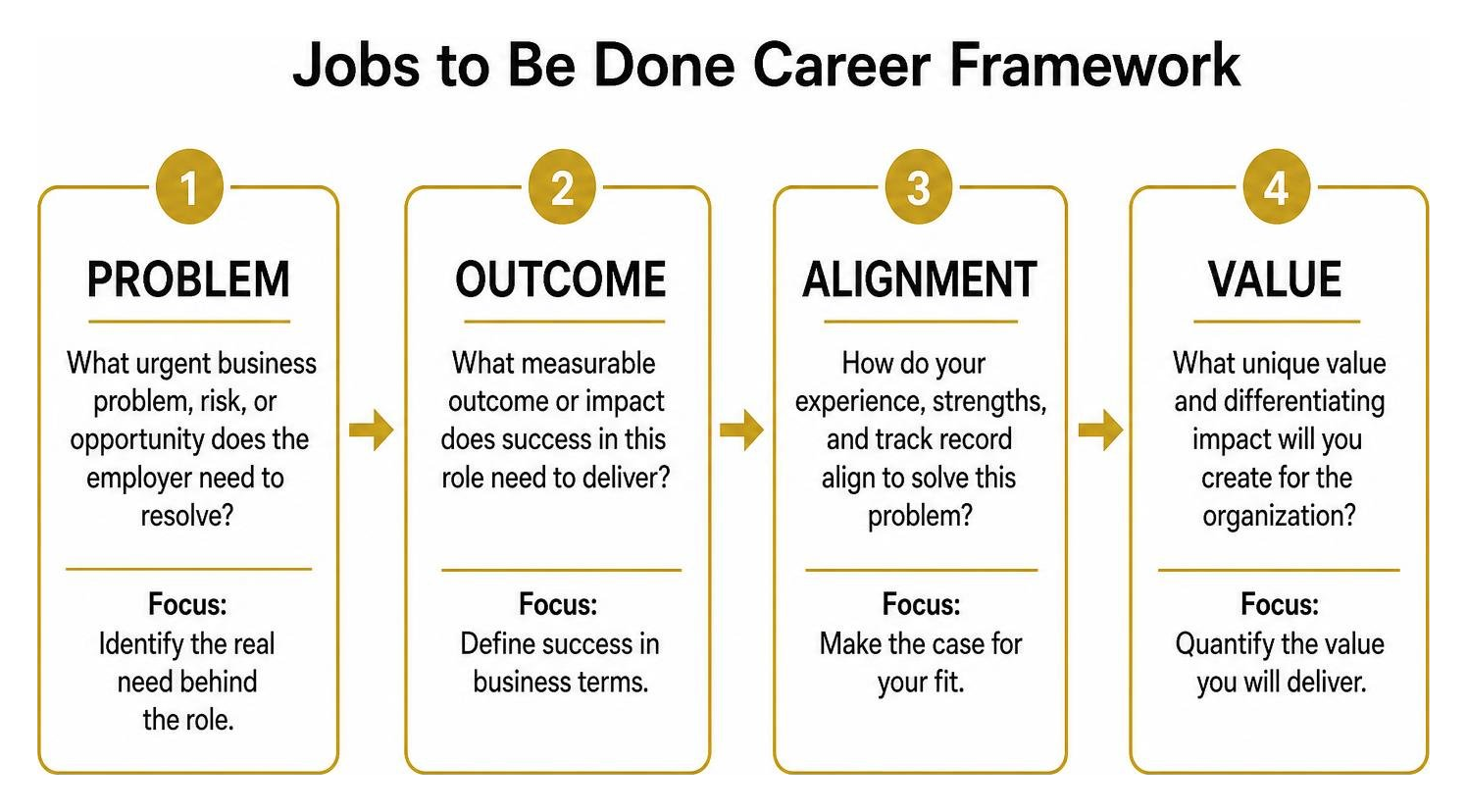
Applying JTBD shifts your narrative from task-based descriptions to outcome-driven value:
- Task Framing (Traditional): “Managed a cross-functional team of 15 product engineers and ran weekly sprint planning meetings.”
- Outcome Framing (JTBD): “Hired to eliminate product launch bottlenecks, cutting time-to-market by 35% and unlocking $4.2M in annual recurring revenue across three enterprise product lines.”
Positioning your career assets around these core outcomes elevates your personal branding and transforms your resume from an administrative history into a compelling business case.
Overcoming Imposter Syndrome and Mindset Blocks
Even the most accomplished leaders occasionally battle internal doubts. Imposter syndrome frequently surfaces during pivotal inflection points: preparing for a board-level presentation, negotiating an executive compensation package, or targeting a significant step up in scope.
High achievers often attribute their track record to luck, timing, or external help rather than their innate capabilities. Left unaddressed, this mindset can lead to overworking, underpricing your value in salary negotiations, or hesitation when pursuing stretch roles.
In career advisory work, overcoming these psychological hurdles starts by replacing emotional assumptions with objective data. Auditing your measurable career achievements provides undeniable evidence of your operational impact. Learning how to beat the negative thoughts ruining your job search allows you to separate self-criticism from reality, rebuilding executive presence and quiet confidence ahead of demanding interview cycles.
Essential Tools and Programs for Career Acceleration
Accelerating your career trajectory requires structured methodology, robust marketing materials, and sustained accountability.
Specialized Career Consulting for Senior Leaders
Executive-level hiring operates under an entirely different set of rules than early- or mid-career recruiting. Search committees, private equity partners, and corporate boards look for strategic vision, cultural alignment, risk management capabilities, and quantifiable ROI.
Our tailored advisory work focuses on building bespoke, non-template marketing suites that showcase your executive footprint:
- Executive Career Transition Strategy: Defining target market sectors, identifying decision-makers, and activating the hidden job market through structured executive networking.
- Executive Resume and LinkedIn Optimization: Crafting outcome-centric executive profiles that immediately communicate board-level value and pass through both human evaluation and executive talent search filters.
- Comprehensive Interview Coaching and Preparation: Mastering behavioral responses, navigating strategic case presentations, and controlling narrative pacing in high-stakes C-suite panel interviews.
Ongoing Development Programs and Structured Challenges
Sustainable professional growth requires consistent, disciplined action. Many leaders benefit from guided developmental frameworks that break down the complex transition process into manageable milestones.
Structured programs—such as a 90-day job change challenge—deliver focused email modules every few days. These curricula provide actionable exercises covering network mapping, value-proposition sharpening, and outreach tracking. Paired with self-paced reflection and accountability check-ins, these programs help candidates avoid burnout and maintain positive momentum.
Adopting straightforward habits, like reviewing 5 ways to instantly improve your job search results, provides immediate tactical wins while you execute your broader strategic plan.
Frequently Asked Questions about Career Advisory Services
How do I prepare for a state government career counseling session?
To get the most out of a state government career advisory appointment, assemble an intake package in advance. This should include an up-to-date master resume, copies of relevant degrees and licenses, a valid government photo ID, and a clear list of target geographic regions and acceptable salary bands. Having these materials ready allows the counselor to cross-reference your background against open civil service classifications immediately.
What are the main advantages of virtual career consulting over email counseling?
Virtual consulting provides immediate, real-time dialogue and visual collaboration via screen sharing. It allows for dynamic role-playing during mock interviews, real-time line editing of resumes, and rapid clarification of complex strategic questions. It also fosters deeper interpersonal rapport, which is critical when navigating mindset blocks and confidence hurdles.
How does the Jobs to Be Done framework apply to a job search?
The Jobs to Be Done framework shifts your positioning from a list of past duties to the specific outcomes you achieve for an organization. Instead of marketing yourself as a manager who performs tasks, you position yourself as a strategic solution to an employer’s core operational challenges, revenue goals, or growth constraints.
Conclusion
A successful career transition requires a clear roadmap, sharp self-positioning, and disciplined execution. By understanding the available consulting formats, applying strategic frameworks like Jobs to Be Done, and confronting mindset hurdles head-on, you can take full control of your professional path.
At My Expert Coach, we bring more than 25 years of insider HR and recruiting expertise to every engagement. Having advanced over 10,000 careers, we partner with senior leaders to craft bespoke, non-template executive materials and market-tested transition plans.
Ready to transform your trajectory? Partner with us to master modern job search strategies and secure the executive leadership role you deserve.