
table of contents
How to Make Mentoring Executives and Directors Work
Start with the decision or transition you need help with. For mentoring executives and directors, choose someone who has faced a similar leadership or board challenge. Agree on what you can discuss, how often you will meet, and what must stay confidential. Use each meeting to test your judgment, not to hand over the decision.
That is what sets this work apart from standard coaching: a mentor can draw on direct experience of board dynamics, governance, and senior leadership. The best fit depends on the role you hold and the decisions ahead.
I’m Sandy Spencer, a career coach and strategist with more than 38 years of experience in HR and executive recruiting. That background shapes my perspective on mentoring executives and directors, especially as senior leaders prepare for their next role.
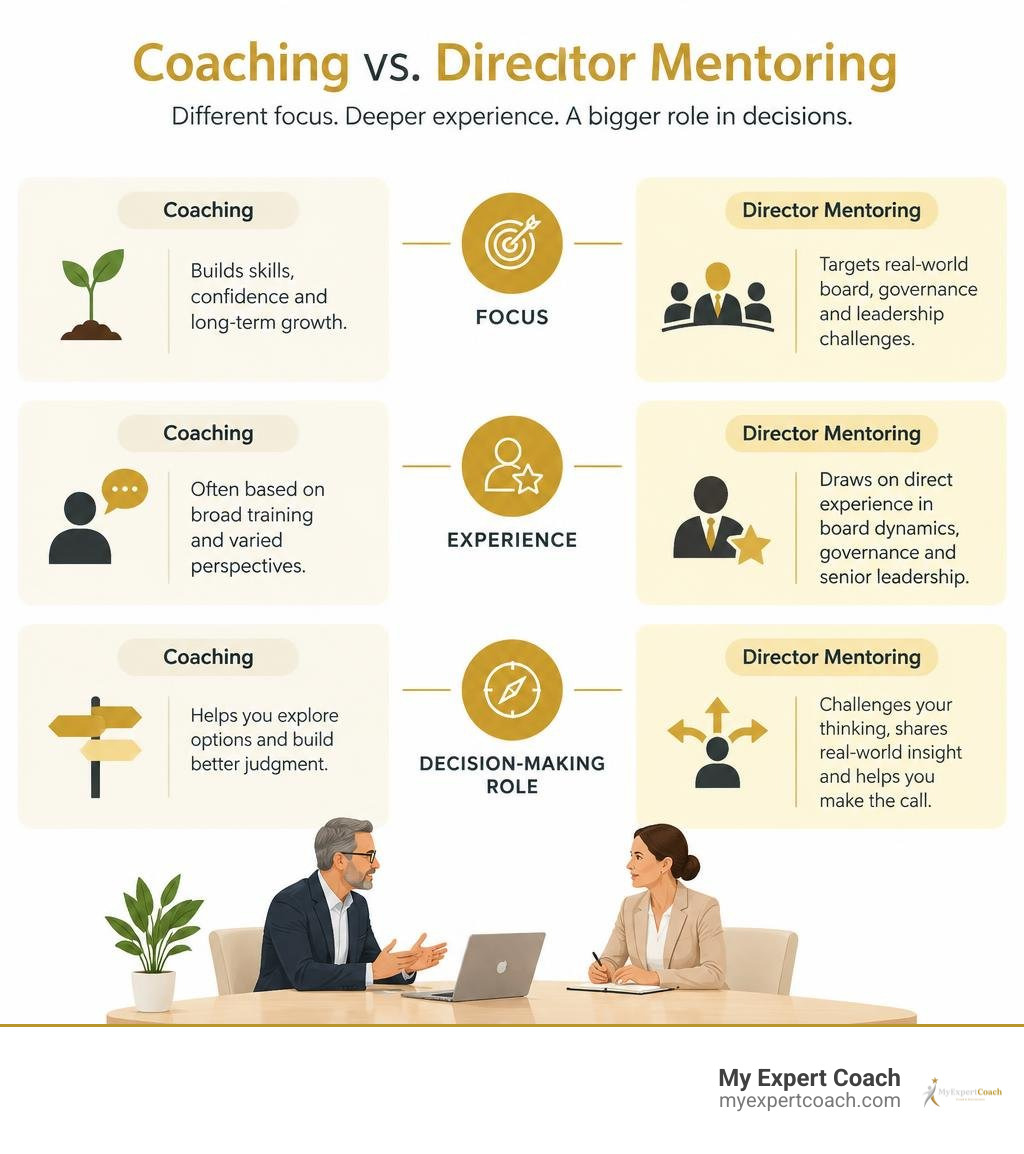
Core Differences: Mentoring Executives and Directors vs. Standard Coaching
When senior leaders reach the C-suite or step into the boardroom, standard leadership development tools often reach their limits. Many professionals wonder where standard executive coaching ends and executive-director mentoring begins. While both practices create confidential environments for growth, their scope, mechanics, and governance context differ significantly.
| Dimension | Standard Executive Coaching | Executive & Director Mentoring |
|---|---|---|
| Primary Method | Nondirective inquiry, active listening, and behavioral frameworks | Lived governance experience, peer advisory, and strategic counsel |
| Subject Matter | Leadership style, emotional intelligence, and team management | Board dynamics, fiduciary duty, stakeholder politics, and risk |
| Relationship Dynamic | Facilitator-to-client partnership | Experienced peer-to-peer advisory and strategic sounding board |
| Governance Context | Operational and internal management focus | Boardroom governance, committee oversight, and CEO-board relations |
| Outcome Focus | Behavioral change and individual competency | Governance judgment, career-defining decisions, and risk mitigation |
Scholarly research underscores that director-level guidance requires specialized development frameworks. As detailed in foundational research on mentoring executives and directors, mentoring at the top of an organization operates across complex intellectual, emotional, and business contexts simultaneously (Megginson & Clutterbuck, 2007).
Foundational Distinctions: Inquiry vs. Lived Governance Experience
Standard executive leadership coaching relies heavily on open-ended inquiry. A coach does not need to have managed a hostile takeover, navigated an audit committee inquiry, or managed an activist shareholder to help an executive discover their own behavioral blind spots.
Director and executive mentoring, by contrast, relies directly on lived governance experience. When a newly appointed Non-Executive Director (NED) or Chief Executive faces a board confrontation, they do not just need structured questioning. They need a peer who has sat around comparable boardroom tables, understood fiduciary liabilities, and resolved boardroom stalemates. A mentor provides strategic perspective by sharing practical wisdom, offering contextual frameworks, and stress-testing governance judgment.
The Personal Reflective Space (PRS) Model in Boardroom Advisory
Traditional top-down corporate leadership often viewed the executive as the unfaltering “captain of the ship.” Modern governance models have evolved toward caring, collaborative leadership that balances robust enterprise performance with genuine empathy and stakeholder stewardship.
To navigate this complexity, executive mentors frequently use the Personal Reflective Space (PRS) model. This framework establishes a psychological sanctuary outside corporate hierarchies where leaders can step back from daily fires. In this space, the mentor helps the director integrate:
- Intellectual context: Dissecting macroeconomic shifts, regulatory pressures, and disruptive technologies.
- Emotional intelligence: Managing boardroom power dynamics, interpersonal friction, and personal isolation.
- Business strategy: Stress-testing strategic capital allocations, risk appetites, and enterprise-wide transformations.
Why Top-Level Leaders Require Advisory Mentorship
The corporate summit is notoriously demanding. As operating environments grow more volatile, the margin for error at the C-suite and board levels has narrowed significantly.

A 2012 Harvard Business Review study revealed that 50% of CEOs experience profound feelings of loneliness, and 61% report that this isolation directly hinders their executive performance. When leaders feel they have no safe internal outlet to voice uncertainty, decision quality inevitably declines.
Recent data shows the severe cost of unsupported transitions: in 2023, more than 15% of CEO appointments across the world’s largest enterprises failed within their first two years—a sharp increase from the historical average of 9.6% recorded since 2019. Furthermore, 71% of surveyed CEOs noted that formal mentoring should have been better incorporated into their onboarding and transition processes.
Easing Isolation at the Top and Accelerating Decision-Making
Executives cannot openly share doubts about enterprise strategy with subordinates without destabilizing team confidence. Nor can they freely workshop preliminary uncertainties with their board chairs without inviting scrutiny over their competence.
An external, seasoned mentor acts as a strategic sounding board. Harvard Business Review data indicates that after receiving executive mentorship:
- 69% of CEOs reported improved decision-making capabilities.
- 84% of CEOs credited their mentors with helping them avoid costly strategic errors.
Mentors help leaders identify blind spots, test high-stakes assumptions, and rapidly regain composure during periods of enterprise crisis.
Best Practices for Mentoring Executives and Directors in Complex Transitions
Stepping from operational C-suite roles (such as managing a business unit) into enterprise-wide governance or non-executive directorship is one of the most jarring professional shifts. Navigating an executive career transition strategy requires shifting from direct operational execution to high-level strategic influence.
Leading governance frameworks emphasize structured approaches to board effectiveness and director development. When executives move into board roles, mentors help them master these transition practices:
- Shifting from Doing to Questioning: Moving away from operational management to asking probing, high-impact governance questions.
- Mastering Committee Leadership: Navigating the specialized duties of audit, risk, and remuneration committees.
- Establishing Executive Presence: Building credibility without overstepping into management territory.
How to Structure and Manage a Board-Level Mentoring Program
Unstructured, ad-hoc mentoring conversations can easily devolve into casual chats without clear accountability. High-impact director mentoring requires deliberate design, clear boundaries, and structured engagements.
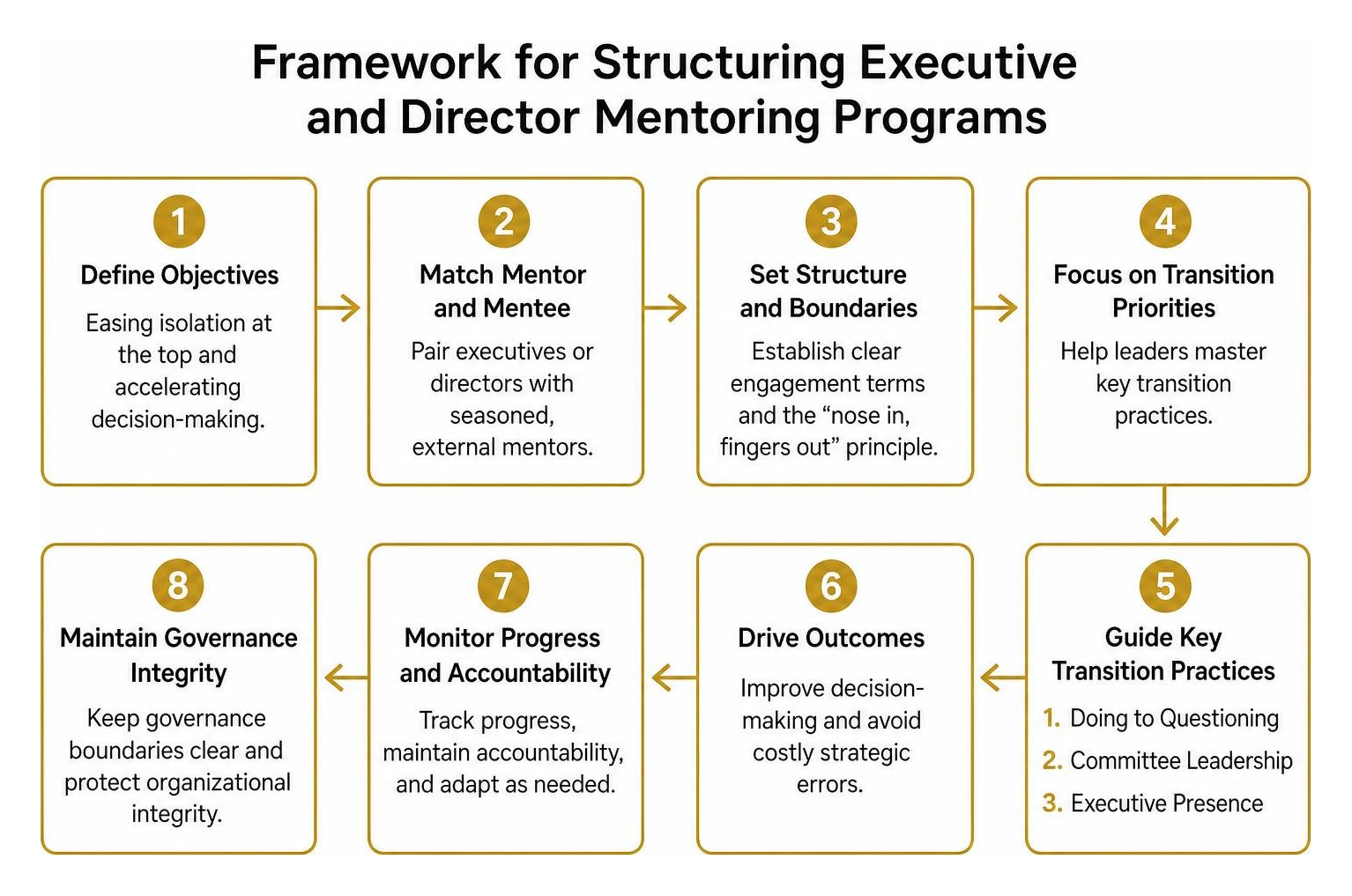
Establishing Governance Boundaries and the CEO-Director Dynamic
When active board members mentor internal executives, governance boundaries must remain crystal clear. The foundational rule of corporate board engagement is “nose in, fingers out.” Directors must provide strategic oversight, ask incisive questions, and offer advice without intervening in daily operations or undermining executive management.
To maintain organizational integrity:
- Mentoring internal executives should always be initiated with the CEO’s full awareness and support.
- Mentors must serve as sounding boards without second-guessing or overriding the CEO’s operational authority.
- If conflicts of interest arise, they must be disclosed immediately to the board chair.
Structuring Mentoring Executives and Directors for Maximum Impact
Whether implementing an internal board development initiative or engaging external advisors through comprehensive career consulting services, programs should follow a structured lifecycle:
- Strategic Matching and Intake: Pair mentees with mentors based on sector expertise, governance challenges, and complementary leadership styles, ensuring strict conflict-of-interest checks.
- Cadence and Duration: Engagements typically run for 6 to 12 months. Most executive pairs meet monthly for 60 to 90 minutes, with ad-hoc check-ins around major board meetings, AGMs, or critical transactions.
- Absolute Confidentiality: Conversations must remain strictly confidential between mentor and mentee. If a mentee fears that their vulnerabilities will be reported back to the full board, candid dialogue disappears.
Strategic Applications: Succession Planning and Board Diversity
Executive mentoring is a strategic tool for enterprise risk management, executive pipeline stability, and board composition.
Preparing High-Potential Talent for C-Suite and Boardroom Succession
A company’s pipeline is only as strong as its leaders’ readiness for unexpected external challenges. Recent executive surveys show that CEOs’ confidence in their leadership teams’ ability to confront external macro threats dropped by 5.6 percentage points over a six-month period.
Mentoring closes this capability gap by preparing senior leaders for executive career opportunities. Rather than focusing solely on P&L management, mentors teach executives how to:
- Articulate their boardroom value proposition.
- Cultivate an authentic executive persona using structured executive personal branding.
- Understand public policy, institutional investor dynamics, and shareholder engagement.
National institutions demonstrate this structured approach. For example, the American Kinesiology Association executive leadership mentoring framework pairs aspiring institutional leaders with seasoned executives to cover strategic budgeting, search firm navigation, and board relations.
Driving Board Diversity and Inclusion Initiatives
Mentorship programs play a crucial role in diversifying modern boardrooms. As of June 2025, women held 39.3% of ASX 100 director seats and 38.1% of ASX 200 boards. While gender parity targets have made progress, broader cultural diversity and representation across corporate boards still require dedicated talent pipelines.
Specialized initiatives illustrate how targeted mentorship opens boardroom pathways:
- The AICD Chairs Mentoring program connects emerging female and First Nations directors with ASX 200 Chairs, supporting 40 to 50 mentoring pairs annually.
- Cohort-based initiatives, such as the BoardAgender Aspiring Women Directors mentoring guidelines, pair C-suite executives and senior advisors with active chairs, using selective cohort admissions to ensure focused governance readiness.
Measuring Impact, ROI, and Future Governance Trends
Because executive mentoring focuses on high-level strategy rather than front-line tasks, measuring its return on investment (ROI) requires qualitative and quantitative benchmarks.

Qualitative and Quantitative Metrics for Boardroom Advisory
Organizations and individual leaders can evaluate mentoring programs through key performance indicators:
- Transition Velocity: How quickly a new CEO or director reaches full decision-making effectiveness (reducing early appointment failures).
- Decision Quality and Error Mitigation: Measurable reductions in strategic missteps during major transactions or crises.
- Annual Board Evaluations: Feedback from the board chair regarding the director’s contributions and effectiveness during meetings.
- Executive Retention: Improved retention of high-potential C-suite leaders within succession pipelines.
The Evolution of Hybrid, Virtual, and Cross-Border Mentorship
Corporate governance faces fast-moving challenges, from artificial intelligence integration and cybersecurity oversight to complex geopolitical supply chain risks. As boards navigate these shifts, executive mentoring models continue to evolve:
- Hybrid and Virtual Advisory: Digital platforms now connect directors across borders, enabling leaders to seek specialized counsel from international governance experts.
- Asynchronous Sounding Boards: Secure, encrypted channels allow executives to quickly stress-test urgent communications or board papers with mentors between formal sessions.
- Digital Ethics and AI Literacy: Specialized mentoring arrangements pair traditional chairs with tech-fluent leaders to help boards oversee emerging digital risks.
Frequently Asked Questions About Executive and Director Mentorship
How does director mentoring differ from non-executive director induction?
Board induction is an informational onboarding process that introduces a new director to an organization’s specific policies, financial statements, risk registers, and executive teams. Director mentoring is an ongoing, developmental relationship focused on honing governance judgment, mastering interpersonal boardroom dynamics, and sharpening strategic oversight.
Who typically funds executive and director mentoring programs?
Funding arrangements vary by organization and career stage. Enterprise-sponsored programs and board development budgets frequently fund mentorship for onboarding CEOs, committee chairs, and high-potential executives. Independent directors seeking personal advancement often privately engage external advisory mentors.
What is the “nose in, fingers out” rule in board mentorship?
The “nose in, fingers out” principle defines the boundary between board oversight and operational management. In a mentoring context, it means a director mentor guides an executive on strategic thinking and governance perspectives (“nose in”) without meddling in daily operational decisions or issuing direct management orders (“fingers out”).
Conclusion
Mentoring executives and directors provides the strategic clarity, lived governance experience, and confidential support that leaders need to navigate today’s complex corporate landscape. Whether preparing for your first board seat, stepping into the C-suite, or chairing a key committee, partnering with a seasoned advisory mentor helps you avoid costly errors and lead with confidence.
At MyExpertCoach, we bring over 25 years of executive talent insight, having guided more than 10,000 careers. When you are ready to position yourself for top-tier leadership opportunities, explore our bespoke executive resume and LinkedIn optimization services to articulate your boardroom value and accelerate your career.
References
David Megginson, David Clutterbuck. “Mentoring Executives and Directors.” 2007. DOI 10.4324/9780080511429.