table of contents
The Core Foundations of Personal Branding
Starting a personal brand begins with four deliberate steps: clarify your core positioning and values, establish an owned digital home base, choose one primary social platform where your audience already spends professional attention, and publish value-driven insights consistently. This sequence turns your experience into a recognizable professional identity rather than a scattered online presence.
At its core, a personal brand is not a curated facade or an exercise in self-promotion. It is simply the deliberate management of stakeholder perception. Amazon founder Jeff Bezos famously noted that your brand is what people say about you when you are not in the room. In executive circles, we take that definition one step further: your brand is what stakeholders depend on you for, the specific problems they trust you to solve, and the distinct value you bring to high-stakes decisions.
Establishing this trust creates direct economic value. Hiring research indicates that 85% of hiring managers consider a clear professional identity an influential factor in their hiring choices. Furthermore, professionals who cultivate a recognized identity earn, on average, 25% more than their unbranded peers. When you articulate your expertise clearly, you stop competing as a fungible commodity and start operating as a differentiated asset.
For leaders seeking career resilience, building career antifragility with personal branding ensures that your professional equity belongs to you rather than being tied entirely to a single employer or title.
Why Personal Branding Matters in 2026
The professional landscape of 2026 moves faster than ever. Technical and managerial competencies experience rapid turnover, with the average half-life of professional skills shrinking to roughly 4.5 years. A well-maintained presence signals adaptability, continuous learning, and active thought leadership in your sector.
Corporate screening processes have fundamentally shifted as well. Approximately 47% of employers state they will not interview candidates whom they cannot evaluate online. Before an executive search committee extends an invitation or a prospective client signs an advisory agreement, they conduct digital due diligence.
Take a moment to step into their shoes. If you haven’t taken the time to google yourself lately, you may be surprised by what prospective partners or recruiters see—or fail to see. A dormant search footprint costs you opportunities before conversations even begin.
Clarifying Your Positioning, Core Values, and Narrative
Building a sustainable presence begins with an inward discovery phase rather than outward broadcast. We use structured exercises with our clients to surface the recurring themes across their career milestones:
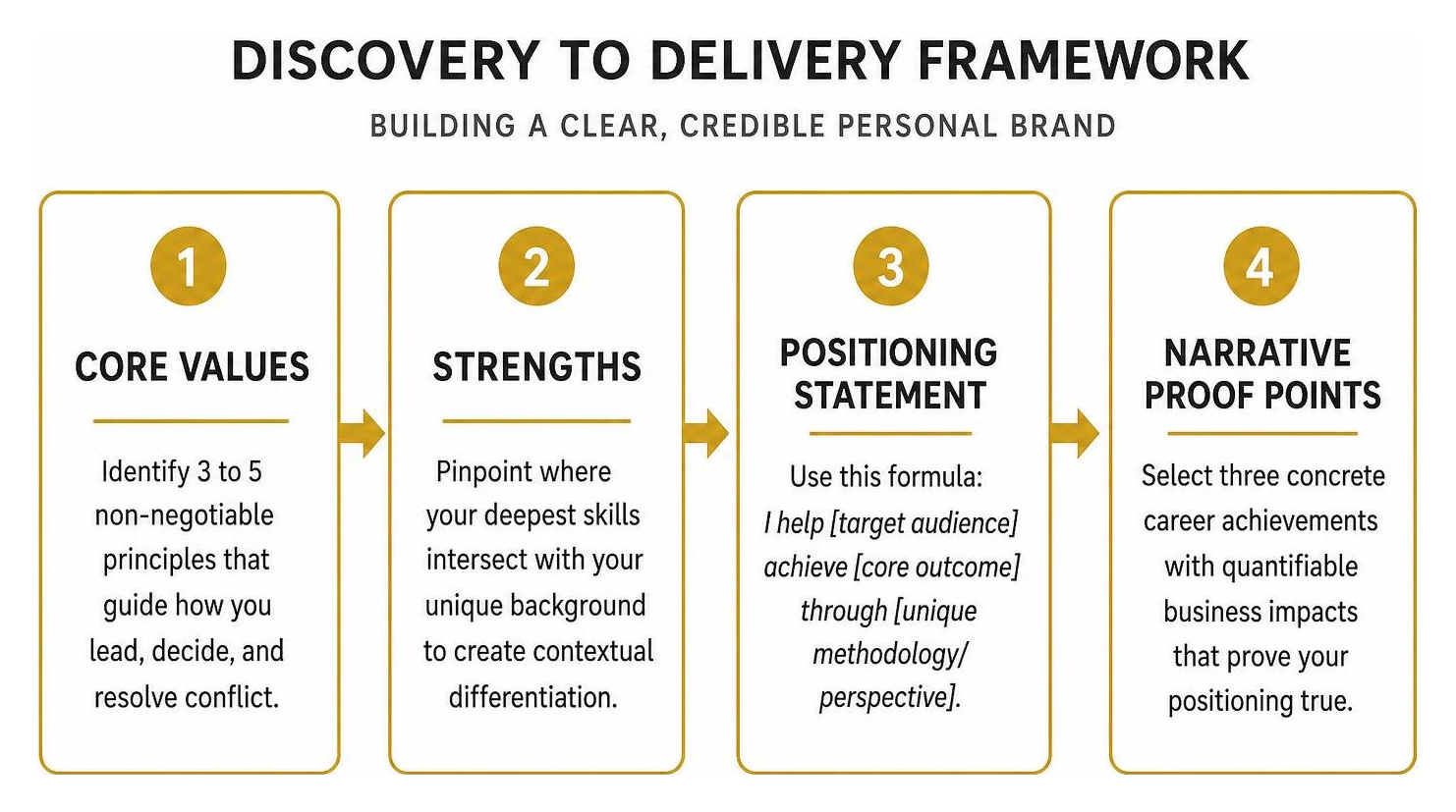
- Core Values Elicitation: Identify 3 to 5 non-negotiable principles that dictate how you lead, make decisions, and resolve conflict.
- Contextual Differentiation: Pinpoint the intersection between your deepest skills and your unique professional background. Being distinct is rarely about inventing a brand-new concept; it is about bringing your specific perspective to existing industry challenges.
- The Positioning Formula: Draft a concise positioning anchor using this proven structure:
I help [target audience] achieve [core outcome] through [unique methodology/perspective]. - Narrative Proof Points: Select three concrete career achievements with quantifiable business impacts that prove your positioning statement true.
If you find it challenging to distill decades of complex experience into a crisp narrative, working through dedicated career consulting services can help uncover blind spots and extract the core themes of your career history.
Establishing Your Digital Home Base and Primary Channel
A common misstep professionals make is spreading their energy across multiple channels simultaneously. Trying to maintain profiles on five different networks dilutes your attention, produces shallow content, and makes it impossible to gather clear feedback on your messaging.
Adopting a test-market approach is far more effective. By concentrating your efforts, you create the platform gravity necessary to convert casual readers into loyal advocates. As strategist Ben Oberman highlights when discussing why concentrating on one platform to build authority works, focusing on a single distribution engine allows you to master native nuances, build genuine relationships, and validate your messaging before scaling outward.
Building an Owned Digital Presence
While social platforms provide reach, you do not own them. Algorithm shifts or account issues can wipe out years of audience building overnight. That is why your overarching strategy must direct rented audience attention toward an owned digital asset.
Your owned ecosystem consists of two primary elements:
- An Executive Portfolio Site: A clean, accessible hub that features your positioning statement, featured case studies, board or advisory experience, media mentions, and contact access. When evaluating whether an owned personal website fits your goals, consider whether your target clients or executive search firms require a centralized destination to verify your background.
- An Email Newsletter: A direct distribution channel that lands right in your audience’s inbox, free from platform gatekeepers.
Choosing and Mastering Your Primary Social Platform
Select one social platform that matches where your target audience spends their professional attention and where the native format aligns with your natural communication strengths.
Before publishing content, optimize your profile to function as a landing page. Use a clear, professional headshot, write a descriptive headline focused on your value proposition rather than just your job title, and make it simple for peers to connect with you. If you need a refresher on the basics, review finding and sharing your LinkedIn profile link to ensure your public touchpoints are configured smoothly.
| Platform | Primary Audience | Core Formats | Conversion Speed to High-Ticket Leads |
|---|---|---|---|
| B2B Leaders, Founders, Recruiters, Board Members | Text posts, Document Carousels, Long-form Articles | Fast (30–90 days via direct outreach & executive alignment) | |
| X (Twitter) | Tech Founders, VCs, Media, Developers | Short insights, Threads, Curated commentary | Moderate (Requires high volume and active community building) |
| YouTube | Broad Consumers, Deep-dive Learners, B2B Researchers | Long-form video, Tactical breakdowns, Interviews | Slow to build, exceptionally high long-term trust |
| Substack / Medium | Dedicated Readers, Industry Specialists, Academics | In-depth essays, Analysis, Niche industry reports | Moderate (Compounds steadily via newsletter referrals) |
Developing an Authority Content and Networking Strategy
Creating authority requires depth over sheer volume. To build a reputation that stands the test of time, adopt the 80/20 Value Split:
- 80% Value-Driven Insights: Actionable frameworks, detailed post-mortems of industry challenges, breakdowns of executive leadership lessons, and strategic commentary on market shifts.
- 20% Contextual & Personal Perspectives: Transparent reflections on career pivots, core values in practice, behind-the-scenes decision-making, and professional milestones.
Organize your publishing schedule around three to four core content pillars that reflect your strengths. If your focus is operational turnarounds, your pillars might be Change Management, Unit Economics, Cross-Functional Leadership, and Culture Modernization.
Creating High-Impact Content and AI-Assisted Workflows
Consistency is often where busy executives struggle most. You can streamline this process by using artificial intelligence as a thinking partner without sacrificing your authentic perspective. Leading brand strategists like Joe Gannon demonstrate how structured AI workflows can help creators and corporate executives quickly outline ideas and capture their voice without sounding like a generic algorithm.
Use AI to:
- Brainstorm alternative angles and hooks based on your original ideas.
- Transcribe spoken voice memos into structured drafts.
- Repurpose a single comprehensive article into short social takeaways, newsletter blurbs, and discussion prompts.
Never outsource your core opinions or judgment to automated tools. Your unique point of view is what readers connect with, and maintaining that voice is what builds authentic trust.
Enhancing Your Visual Identity with Personal Branding Photography
Visual consistency reinforces professional credibility. When people encounter your content across different touchpoints, a cohesive visual identity speeds up brand recognition.
- Professional Photography: Invest in a dedicated personal branding photoshoot. Move beyond stiff corporate headshots. Capture environmental portraits that show you in your natural working elements—collaborating, presenting, or working in your environment.
- Palette and Typography: Choose two brand colors and a consistent typography style for your featured images, newsletter banners, and slide decks.
- Budget-Friendly Templates: If you are building your assets independently, simple design tools like Canva let you create a standard set of clean, repeatable templates to maintain brand consistency.
Networking and Community Engagement Tactics
Publishing content is only half the equation; relationship building is where real career momentum happens. Founder and brand advocate Erica Rankin highlights that vulnerability, active community interaction, and direct conversations are what turn passive followers into genuine advocates.
Apply the Give-First Principle:
- Engage Strategically: Identify 10 to 15 peers and thought leaders in your space. Spend ten minutes each day leaving thoughtful, value-additive perspectives on their posts before publishing your own.
- Manage Ego: Professional visibility can occasionally attract debate or dissent. Keep interactions focused on facts and solutions, and leave defensiveness behind. Prioritizing long-term relationship health over being right preserves your professional standing.
- Direct Messaging Etiquette: Reach out without an immediate sales pitch. Thank others for insightful perspectives, ask thoughtful follow-up questions, and offer relevant introductions or resources whenever you can.
Monetization Models and Your 90-Day Roadmap
A well-defined presence opens doors to diverse income streams and high-impact career opportunities. When you build trust at scale, monetization transitions from cold pitching to inbound selection.
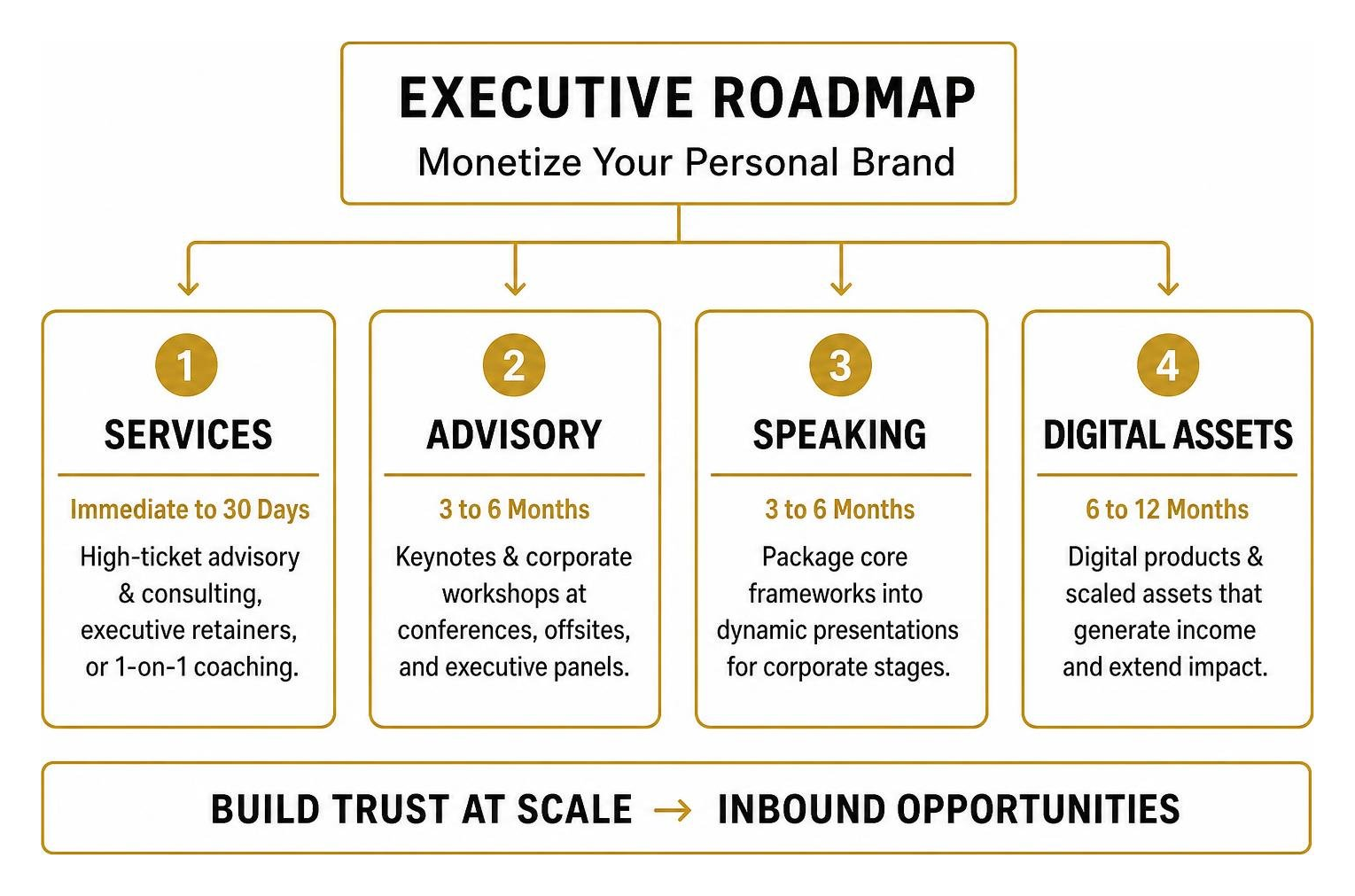
- Tier 1: High-Ticket Advisory & Consulting (Immediate to 30 Days)
Offer strategic consulting, executive advisory retainers, or 1-on-1 career coaching. This path requires minimal audience size because trust carries the transaction. - Tier 2: Keynotes & Corporate Workshops (3 to 6 Months)
Package your core frameworks into dynamic presentations for industry conferences, corporate offsites, and executive panels. - Tier 3: Digital Products & Scaled Assets (6 to 12 Months)
Create specialized frameworks, video workshops, or cohort programs that allow you to decouple your earnings from direct hourly output.
The 90-Day Personal Brand Launch Plan
Launching your brand does not need to be an overwhelming endeavor. Following a structured roadmap, similar to the blueprint outlined by spunk.codes in their personal branding guide, allows you to move systematically from initial strategy to measurable market momentum:
- Days 1–7 (Foundation Phase):
Audit your existing digital footprint. Finalize your core positioning statement and update your primary profile with professional imagery and aligned copy. - Days 8–30 (Content Engine Activation):
Choose your 3 core content pillars. Write and schedule 3 value-driven posts per week. Engage daily with 5 industry leaders in your sector. - Days 31–60 (Momentum & Community Growth):
Launch an owned newsletter asset. Test varied content formats—such as carousels, detailed teardowns, or personal case studies—to see what resonates most with your audience. Initiate direct outreach to 3 peers weekly. - Days 61–90 (Acceleration & Conversion):
Introduce your signature point of view or proprietary framework. Begin directing your audience toward clear next steps, whether that means booking advisory calls, downloading an executive resource, or subscribing to your newsletter.
Avoiding Critical Mistakes in Brand Building
Avoid these common pitfalls that can stall your progress:
- Platform Dilution: Resisting the urge to master one channel before attempting to launch across four others.
- Transactional Networking: Reaching out to connections only when you need a favor, referral, or job opportunity.
- Lack of Deep Positioning: Sharing broad, generic motivational quotes instead of nuanced, real-world industry perspectives.
- Inconsistent Publishing: Posting multiple times a day for two weeks, burning out, and disappearing for three months.
- Premature Monetization: Pitching high-ticket offers to your network before delivering consistent, demonstrable value.
Frequently Asked Questions About Building Your Brand
How long does it realistically take to see results?
Expect to see initial engagement, warm network messages, and introductory conversations within the first 60 to 90 days of consistent publishing. Securing high-ticket advisory clients, inbound executive recruiting reach-outs, and speaking invitations generally accelerates between months 6 and 12 as your ideas compound across your industry.
Can you build a strong brand without showing your face?
Yes. While personal headshots accelerate human connection, many respected authorities build their reputation entirely through rigorous written analysis, curated industry data, proprietary frameworks, and technical whitepapers. In these instances, the clarity and depth of your intellectual output serve as the brand.
How do you balance authenticity with professional polish?
Authenticity does not require oversharing every personal detail of your life. It means maintaining honesty about your core values, your real-world professional experiences, and the strategic rationale behind your decisions. Practice strategic vulnerability: share past challenges and setbacks only after you have processed them and extracted actionable lessons for your audience.
Conclusion
Building your public presence is one of the highest-leverage investments you can make in your professional journey. It turns your hard-earned experience into an asset that works for you around the clock, drawing the right partnerships, clients, and leadership opportunities directly to your door.
You do not need to overhaul your entire career overnight. Pick your core focus, optimize your primary channels, and start sharing your perspective with the people who matter most in your space.
If you are ready to position your leadership background for maximum impact, explore our tailored resume and LinkedIn optimization services to turn your executive presence into a magnet for exceptional career opportunities.
[…] your LinkedIn profile serves as an interactive portfolio. Build a cohesive presence by applying our executive personal branding guide and completing a comprehensive LinkedIn profile […]