
table of contents
Why You Should Counter Your Initial Severance Offer
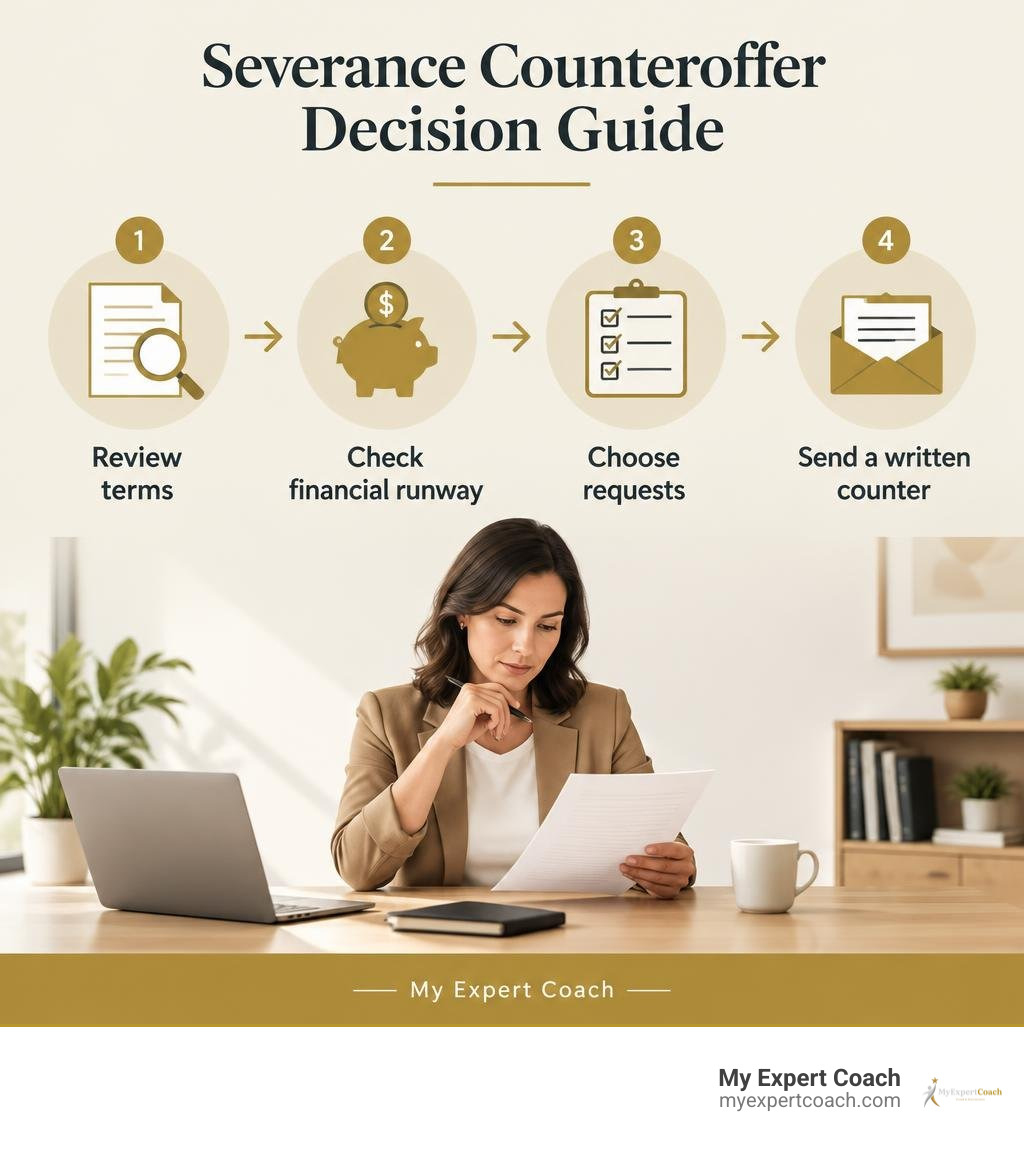
Yes, you can counter a severance package. Before you sign, review the full agreement and choose the changes that matter most: more pay, continued health coverage, bonus or equity treatment, or fewer limits on your next job. Send a short, polite email with specific requests and a reason for each. Check your deadline first, and ask for more review time if you need it.
An initial offer may not be the final one. But the right counter depends on what you are being asked to sign and how long your savings can cover your essential costs.
I am Sandy Spencer, a career coach with 38 years of experience in HR and executive recruiting, and I help leaders answer the question, “can you counter offer a severance package?” My work helping more than 10,000 professionals advance their careers informs the practical steps that follow.
Can You Counter Offer a Severance Package? Understanding Your Baseline Rights and Leverage

Many professionals assume that an exit package is non-negotiable. In reality, a severance package is a formal business contract, not a parting gift. An employer offers severance in exchange for your signature on a legal liability waiver. When negotiating a severance package, you are engaging in a bilateral commercial transaction where your agreement to waive legal claims holds tangible monetary value.
Employers expect some degree of pushback, particularly from senior leaders and tenured staff. In standard layoffs, baseline formulas often provide 1 to 2 weeks of base pay per year of service. However, national exit benchmarks show an average payout across all severance packages of approximately 19.3 weeks of pay. Because an initial document reflects the employer’s opening position, you have the right to review the terms, evaluate your leverage, and submit a structured counteroffer.
Evaluating Your Core Negotiation Leverage
Your bargaining strength depends on tangible contributions and legal factors:
- Tenure and Performance History: Sustained years of service, revenue generated, key client relationships, or proprietary operational knowledge provide justification for a larger package.
- WARN Act Compliance: The Worker Adjustment and Retraining Notification (WARN) Act mandates a 60-day advance notice for mass layoffs affecting 50 or more employees. If your company missed statutory notice windows, you have clear leverage.
- Potential Legal Vulnerabilities: Unpaid bonuses, overtime discrepancies, recent protected HR complaints, or potential discrimination risks increase the cost of defense for the employer, making an amicable settlement attractive.
What You Are Actually Trading: The Release of Claims
When you sign a severance agreement, you sign a comprehensive Release of Claims. This document waives your right to sue the company for wrongful termination, unpaid wages, or age, race, and gender discrimination.
For an employer, an unexecuted release represents open financial and reputational risk. Buying your signature permanently eliminates that exposure. The table below outlines how various leverage factors influence your negotiating position:
| Leverage Category | Specific Asset / Claim | Negotiation Impact |
|---|---|---|
| Tenure & Value | 5+ years of service, client accounts, institutional knowledge | Justifies increasing cash severance from 1–2 weeks to 3–4 weeks per year. |
| Statutory / Compliance | WARN Act notice gaps, unpaid earned commissions or accrued PTO | Requires employers to cure statutory shortfalls before enforcing release terms. |
| Legal / Protected Status | Age (over 40), unresolved HR filings, retaliatory timing | Provides strong leverage to secure additional months of salary continuation and legal fee coverage. |
| Restrictive Covenants | Broad non-compete clauses, non-solicitation restrictions | Creates trade-offs to narrow geographic or industry limits in exchange for signing. |
What to Negotiate: High-Impact Items Beyond Cash Severance
Focusing solely on cash pay leaves significant value on the table. A comprehensive exit proposal addresses total compensation, including insurance coverage, vesting schedules, and post-employment mobility.
| Seniority Level | Standard Initial Baseline | Realistic Counteroffer Target | Key Non-Cash Focus Areas |
|---|---|---|---|
| Mid-Level Contributor | 1–2 weeks per year of service | 2–3 weeks per year (or +4 to +8 weeks total) | 3–6 months COBRA subsidy, neutral reference, outplacement ($5k–$15k) |
| Senior Manager / Director | 2–3 weeks per year + standard benefits | 3–4 weeks per year + full quarter bridge | 6 months COBRA, prorated bonus, narrowed non-compete terms |
| Executive / C-Suite | 3–6 months flat base pay | 6–12 months base pay + bonus continuation | Accelerated equity vesting, extended exercise windows, $15k–$50k outplacement |
Cash Pay, Bonuses, and Severance Multiples
Cash is the primary anchor of any exit agreement. If an offer sits at the standard 1 to 2 weeks per year of service, a realistic counter aims for 3 to 4 weeks per year, especially for longer-tenured team members.
Ensure your counter accounts for earned, prorated annual bonuses and unpaid commissions. Standard salary negotiation principles apply here: frame requests using objective milestones and documented performance rather than personal financial needs.
Healthcare Continuation, COBRA Subsidies, and Non-Cash Terms
Paying out-of-pocket COBRA health premiums can cost upwards of $1,500 to $2,500 per month for family plans. Requesting an employer-paid COBRA subsidy is often easier for HR to approve because the expense is categorized under group health benefits rather than direct departmental payroll.

In addition to health insurance, evaluate long-term equity. High-impact non-cash asks include:
- Equity Acceleration: Pushing forward unvested stock options or restricted stock units (RSUs) across an upcoming vesting cliff.
- Extended Option Exercise Windows: Extending the standard 90-day post-termination exercise window to 12–24 months.
- Professional Transition Support: Securing outplacement services valued between $5,000 and $15,000 for mid-level managers, or $15,000 to $50,000 for executives.
Restrictive Covenants and Mutual Non-Disparagement
Agreements often contain one-sided non-disparagement clauses and restrictive non-compete agreements. Standard counter items to protect your future career include:
- Mutual Non-Disparagement: Ensuring the company agrees not to make disparaging statements about you, rather than just binding you to silence.
- Agreed Reference Language: Securing a written letter of reference or a formal commitment to confirm only neutral employment details (dates of employment, title, and confirmation of good standing).
- Narrowed Non-Compete Clauses: Removing or reducing restrictive non-competes to ensure you can freely secure work within your specialized field.
Calculating Your Financial Runway Before Countering

Before sending a counteroffer, evaluate your true runway to determine how aggressively you can negotiate. As outlined in guides on evaluating severance runway, your safety net consists of more than just your lump-sum payout.
Severance Runway Math: Negotiate vs. Accept
Calculate your operational runway in weeks using this formula:
$$\text{Real Runway (Weeks)} = \frac{\text{Net Cash Reserves} + \text{Net Severance Offer} + \text{Anticipated Unemployment Insurance}}{\text{Essential Monthly Expenses} \div 4.33}$$
Use your runway figure to guide your counter strategy:
- 8+ Weeks of Runway: Strong position. You can present a multi-item counter (cash, equity, COBRA subsidies) without immediate financial pressure.
- 4 to 7 Weeks of Runway: Moderate position. Focus your counter on 1 or 2 high-impact items (such as cash weeks and health subsidies) to keep turnaround times brief.
- 3 or Fewer Weeks of Runway: Thin position. Minimize negotiation cycles. Focus primarily on non-cash items, or accept the baseline to preserve near-term cash flow.
Can You Counter Offer a Severance Package When Given a Strict Deadline?
Employers typically provide a review window of 7 to 21 days (or 45 days in group layoffs under federal rules). If your deadline is approaching, you do not need to rush an unvetted signature.
Send a brief email to HR requesting an extension:
“Thank you for providing the exit documentation. To allow adequate time for a thorough financial and professional review, I respectfully request an extension of the signing deadline to [Date, 5–7 business days out]. Please confirm if this works for your team.”
Securing written extensions preserves your review rights, much like the steps taken when negotiating after offer acceptance.
Step-by-Step Guide to Structuring and Sending Your Counteroffer
A counteroffer must be clear, professional, and backed by a documented paper trail. We recommend submitting your proposal via email directly to your designated HR representative.
Structuring the Formal Written Counteroffer Letter
Use a clean, four-paragraph layout:
- Opening Acknowledgment: Thank HR for their partnership and confirm receipt of the original severance agreement dated [Date].
- Summary of Value: Restate your tenure, contributions, and commitment to executing a smooth operational handoff.
- Specific, Numbered Requests: Present each ask with a concise business rationale. Avoid combining multiple complex requests into long paragraphs.
- Closing and Next Steps: Reiterate your desire to reach an amicable conclusion, state your availability for a call, and request a written response within 48 to 72 hours.
For comprehensive templates, review resources like SimpleSeverance counteroffer scripts, structured counteroffer templates, and SeveranceCalc’s counter-offer guide.
Can You Counter Offer a Severance Package Without Risking Offer Rescission?
Legally, submitting a counterproposal acts as a rejection of the original contract. However, full offer rescissions are rare, occurring in roughly 2% to 5% of cases. When rescissions happen, they almost always stem from aggressive ultimatums, emotional language, or threats of litigation.
To protect yourself against handling counteroffer traps, maintain a collaborative tone. Signal flexibility by framing requests as adjustments needed to reach a mutually beneficial agreement.
Legal, Tax, and Unemployment Implications You Must Consider
OWBPA Timelines and When to Hire an Employment Attorney
Under the Older Workers Benefit Protection Act (OWBPA), employees age 40 and older receive specific federal statutory protections:
- Individual Terminations: At least 21 days to review the agreement before signing.
- Group Layoffs (2+ employees): At least 45 days to review, accompanied by demographic disclosure reports showing the job titles and ages of affected staff.
- Revocation Period: A mandatory 7-day revocation window post-signing, during which you can cancel the agreement.
Consult an employment attorney if you suspect discrimination or retaliation, or if you are managing complex executive equity plans. For broader legal perspectives on negotiating exit terms, consult LegalGuide.blog’s severance overview.
Severance Taxation and Unemployment Insurance Eligibility
Severance payouts are classified by the IRS as supplemental wages, which are subject to a flat 22% federal income tax withholding rate for payments up to $1 million, alongside standard state and FICA withholdings. If receiving a large lump sum at year-end pushes you into a higher tax bracket, you can negotiate to split the payment across two calendar tax years.
Severance payments also interact with state unemployment insurance (UI). Depending on state rules:
- Some jurisdictions allow you to receive severance and unemployment concurrently.
- Other states treat severance as disqualifying wages during the weeks it covers, delaying your first benefit payout until that period concludes.
Always file your unemployment claim immediately after your final working day, regardless of your severance arrangement.
Frequently Asked Questions About Severance Counteroffers
How much more severance pay can you realistically negotiate?
Most thoughtful severance counteroffers produce a 25% to 50% increase over the initial cash offer. Across corporate negotiations, 50% to 70% of professional counterproposals succeed in securing at least partial improvements in cash, extended COBRA coverage, or adjusted equity terms.
What happens if an employer rejects my severance counteroffer?
If an employer states that their opening terms represent their best and final offer, they will typically reiterate the original package rather than pulling it off the table. You can then accept the baseline terms or pivot to low-cost non-cash items, such as mutual non-disparagement or a laptop buyout.
Does receiving severance disqualify you from state unemployment benefits?
Not necessarily. While some states delay unemployment insurance payouts for the duration of the severance period, others permit concurrent filing. Check with your state’s unemployment office to determine whether your payout is classified as wage continuation or an exempt dismissal payment.
Conclusion
Negotiating an exit package is a standard business process. By understanding the commercial value of your Release of Claims, auditing your financial runway, and submitting a well-supported counterproposal, you can secure fair compensation and protect your career transition.
If you are navigating an executive exit and preparing for your next leadership role, our team provides personalized career advisory, interview strategy, and executive career coaching and resume services to help you move forward with confidence.