
table of contents
What Is a Realistic Life Coach Salary?
A useful U.S. life coach salary benchmark is Salary.com’s published range of $57,700 to $72,544 a year, with a $64,965 average based on 2025 data. For someone planning a coaching career in 2026, that is a starting point, not a promise: an independent coach’s income depends on paying clients, rates, and business costs.
I’m Sandy Spencer, a career coach with more than 38 years of experience in HR and executive recruiting. I’ll use that background to help you look past the headline life coach salary and understand what coaches may actually keep.

National and Regional Life Coach Salary Benchmarks
Understanding the economics of the coaching profession requires distinguishing between self-reported survey averages, corporate aggregate data, and take-home pay. The International Coaching Federation (ICF) 2025 Global Coaching Study provides a broad snapshot of the industry, reporting an average annual coaching income of $49,283 globally and $71,719 in the United States. Across all platforms and aggregators, typical reported ranges span from $38,219 to nearly $90,000 annually.
However, headline averages are heavily skewed by top earners. Data indicates that approximately 53% of life coaches worldwide generate less than $30,000 per year from coaching alone. This occurs because the vast majority of independent practitioners run part-time practices, averaging roughly 13.3 client-facing coaching hours per week.
Geographic location also plays a measurable role in pricing power and local corporate salary baselines.
| Market Tier / Benchmark Level | Typical Annual Earnings Range | Average Hourly Session Fee |
|---|---|---|
| National Average (Aggregator Baseline) | $57,700 – $72,544 | $150 – $250 |
| ICF Reported US Average (Full-Time) | $67,800 – $71,719 | $234 – $297 |
| High Cost-of-Living Metros (e.g., San Jose, CA) | $67,500 – $81,940 | $250 – $400+ |
| Global Coaching Industry Benchmark | $49,283 | $234 |
Regional demand and local purchasing power shape baseline rates. Metropolitan areas with dense corporate ecosystems and high costs of living consistently show higher compensation. For instance, coaches operating in high-demand California markets often see annual medians around $65,508 to $81,940, as detailed in reports on Life Coach Salary in Berkeley, CA. Yet, a higher gross income in an expensive metro does not immediately translate to superior take-home pay once state taxes, office overhead, and local operating costs are factored in.
Entry-Level vs. Experienced Life Coach Salary Trajectories
A coach’s earnings trajectory follows an upward curve driven almost entirely by client acquisition stability, referral velocity, and pricing structure maturity.
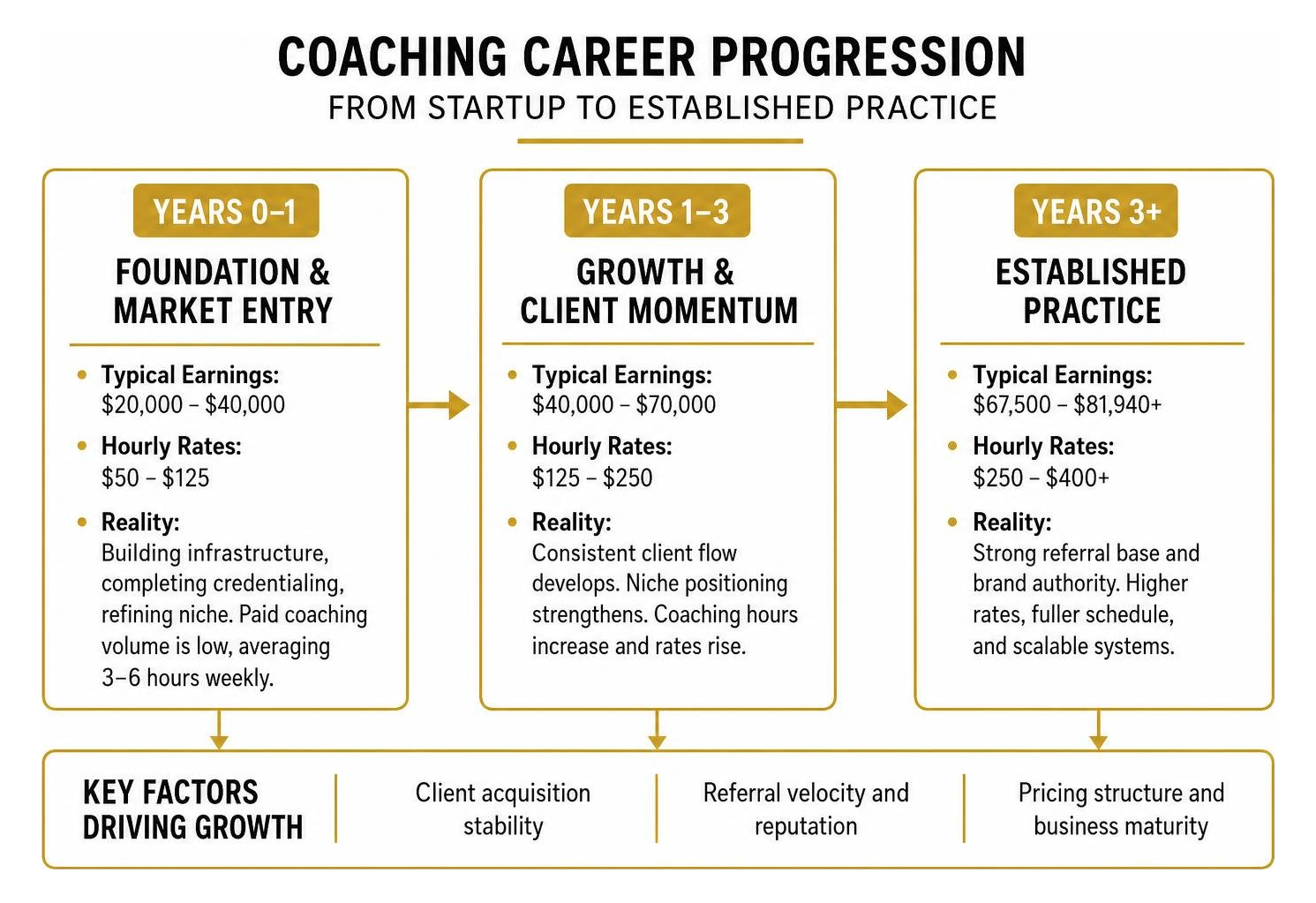
- Years 0–1 (Foundation & Market Entry):
- Typical Earnings: $20,000 – $40,000.
- Hourly Rates: $50 – $125.
- Reality: Most coaches spend the majority of their first 12 months building business infrastructure, completing credentialing, and refining their niche. Paid coaching volume is low, often averaging 3 to 6 hours weekly.
- Years 2–3 (Traction & Systemization):
- Typical Earnings: $45,000 – $75,000.
- Hourly Rates: $150 – $300.
- Reality: Client acquisition becomes more predictable. Coaches shift away from ad-hoc hourly billing into structured multi-session packages, improving client retention and cash flow stability.
- Years 4–5+ (Established & Scaled Practice):
- Typical Earnings: $80,000 – $150,000+.
- Hourly Rates: $250 – $500+.
- Reality: Seasoned coaches leverage word-of-mouth networks, long-term retainers, and leveraged delivery formats (group cohorts, digital assets) while spending less unbilled time on basic business development.
Corporate Coaching vs. Private Practice Compensation
The gap between working as an internal/employed coach versus running a private practice represents one of the most critical structural divides in the industry.
- Internal / Employed Coaches: Many corporations, healthcare networks, and digital coaching platforms hire coaches on full-time salaries or steady hourly subcontracts. These positions typically offer base salaries ranging between $55,000 and $85,000, accompanied by standard benefits, predictable hours, and zero client acquisition responsibilities. The trade-off is an earnings ceiling set by corporate pay bands.
- Private Practice Practitioners: Independent coaches capture 100% of the top-line fee, setting session rates anywhere from $150 to $500+. While an independent coach with 15 weekly clients paying $250 per hour could theoretically bill over $180,000 annually, they shoulder all marketing, software, legal, insurance, and self-employment taxes. For professionals exploring consulting and corporate coaching structures, reviewing the complete guide to career consulting services provides helpful context on enterprise engagements.
Niche Specialization and Related Profession Comparisons
A primary driver of earning variance across the industry is niche selection. Life coaching is an umbrella discipline; market value is determined by the financial and emotional stakes of the outcome being delivered.
When comparing coaching to adjacent helping professions, structural compensation differences emerge:
- Licensed Therapists (LCSW, LMFT, LPC): Typically earn between $60,000 and $95,000 annually. Therapists operate in heavily regulated environments, often bound by health insurance reimbursement schedules and diagnostic compliance, which creates steady demand but caps per-session rates.
- General Life Coaches: Operating without clinical constraints, generalist life coaches average $50,000 to $70,000, but frequently struggle with client acquisition because “improving your life” is an open-ended value proposition.
- Executive & Leadership Coaches: Command anywhere from $120,000 to $300,000+ annually. Because corporate organizations sponsor the engagements to retain executives or improve enterprise performance, budgets are substantially larger. Specialized executive leadership coaching operates on enterprise procurement budgets rather than discretionary household funds.
High-Income Specializations and Market Value
Within the coaching spectrum, certain niches routinely outperform general personal development:
- Executive & C-Suite Coaching: Engagements range from $300 to $1,000+ per hour, often structured as 6- to 12-month corporate retainers valued at $15,000 to $50,000 per executive.
- Career Transition & Compensation Strategy: Helping professionals pivot industries, secure senior promotions, or master complex salary negotiation generates measurable ROI, justifying package rates between $2,500 and $8,000.
- Health, Wellness & Executive Performance: High-earning professionals pay premiums ($200–$400/hour) for specialized protocols that optimize energy, longevity, and stress resilience.
- Relationship & Family Dynamics: Highly specialized relationship coaches frequently structure 3- to 6-month containers commanding $3,000 to $7,500.
Business Models, Pricing Structures, and the Reality of Net Income
How a coach monetizes their expertise dictates their actual financial return. Top-earning practitioners rarely rely on standalone single-session billing.
- Hourly Billing: Coaches charge $100–$300 per hour. While simple, it links revenue directly to physical time, creates income volatility from frequent cancellations, and leaves administrative hours uncompensated.
- Outcome-Based Packages: Practitioners package multi-month transformations (e.g., a 12-week intensive for $3,500). This model secures upfront commitments, improves client accountability, and stabilizes monthly revenue.
- Corporate Retainers: A monthly recurring fee ($2,000–$5,000/month) for ongoing advisory, ad-hoc check-ins, and strategic support.
- Leveraged Delivery: Adding group coaching cohorts, online training, or workshops allows a coach to serve multiple clients simultaneously, breaking the linear ceiling of time-for-money. When advising clients on corporate roles or entering contract work, knowing how much should I ask for salary new job helps professionals evaluate equivalent hourly values.
Factors That Dictate an Independent Life Coach Salary
Gross business revenue is not personal take-home pay. Independent practitioners must manage overhead and business realities:
- The Collection Gap: While a coach might set an official rate of $250 per hour, their actual collected revenue per worked hour is often closer to $90 to $120. This gap exists because for every billable hour, a coach typically spends 1 to 2 unbilled hours on marketing, discovery calls, invoicing, session prep, and administration.
- Credentialing and Training: Over 70% of coaching clients expect formal credentials. Quality programs accredited by bodies like the ICF require investments between $3,000 and $12,000+, alongside ongoing continuing education costs.
- Operating Overhead: Professional liability insurance, CRM systems, video hosting, scheduling software, website maintenance, and legal documentation easily total $3,000 to $8,000 annually.
- Taxes: Self-employed coaches must cover the 15.3% U.S. self-employment tax (Social Security and Medicare) in addition to federal, state, and local income taxes, requiring an estimated 25% to 35% tax reserve from net revenue.
Frequently Asked Questions About Life Coaching Earnings
How much do life coaches make per hour on average?
In North America, average charged session rates typically range from $150 to $300 per hour for established private coaches, with industry survey averages sitting around $234 to $297 per hour. However, when factoring in unbilled administrative time, marketing, and client prep, the actual collected revenue per working hour across the broader industry averages closer to $98 to $120 per hour.
How long does it take for a new coach to reach six figures?
Reaching $100,000 or more in gross annual coaching revenue typically requires 2 to 4 years of consistent practice. Achieving this benchmark requires shifting away from one-off hourly billing toward structured packages, building a reliable client acquisition pipeline, maintaining high client retention, and often incorporating corporate engagements or group offerings.
Why is there a significant difference between charged rates and collected income?
The difference stems from capacity constraints and non-billable operational workload. A coach charging $200 per session who coaches 10 hours a week does not earn $200 for a 40-hour workweek. The remaining 20 to 30 hours are dedicated to non-billable tasks such as lead generation, administrative work, business development, and client onboarding.
Conclusion: Maximizing Your Long-Term Earning Potential
A successful, sustainable career in coaching requires pairing deep empathy and active listening with disciplined business operations. While the average life coach salary reflects the part-time nature of many practices, dedicated professionals who specialize, package their services effectively, and target high-value outcomes can build rewarding, high-earning businesses.
Whether you are expanding an independent coaching practice or elevating your personal executive career, standing out in a crowded market requires sharp positioning and an exceptional professional narrative. Explore our proven strategies for optimizing executive resume and LinkedIn profiles to elevate your market visibility and command the compensation your expertise deserves.