
table of contents
Build an Executive Chef CV That Shows Your Business Impact
To build a strong executive chef CV, lead with the scale of the kitchens you have run, then show what improved under your leadership. Include a short professional summary, relevant skills, work history, certifications, and education. In each recent role, pair an action with a result: the size of your team, a change in food costs, faster service, or less waste. Match your wording to the job description, but only claim skills and results you can support.
The goal is to show more than great cooking. Employers hiring a senior chef also need to see how you lead people, protect quality, and manage a budget. Those details give you stronger evidence to discuss when pay comes up.
I’m Sandy Spencer, a career coach with more than 38 years of experience in HR and executive recruiting. I’ve helped senior leaders present their achievements clearly, and I’ll show you how to apply that approach to an executive chef cv.
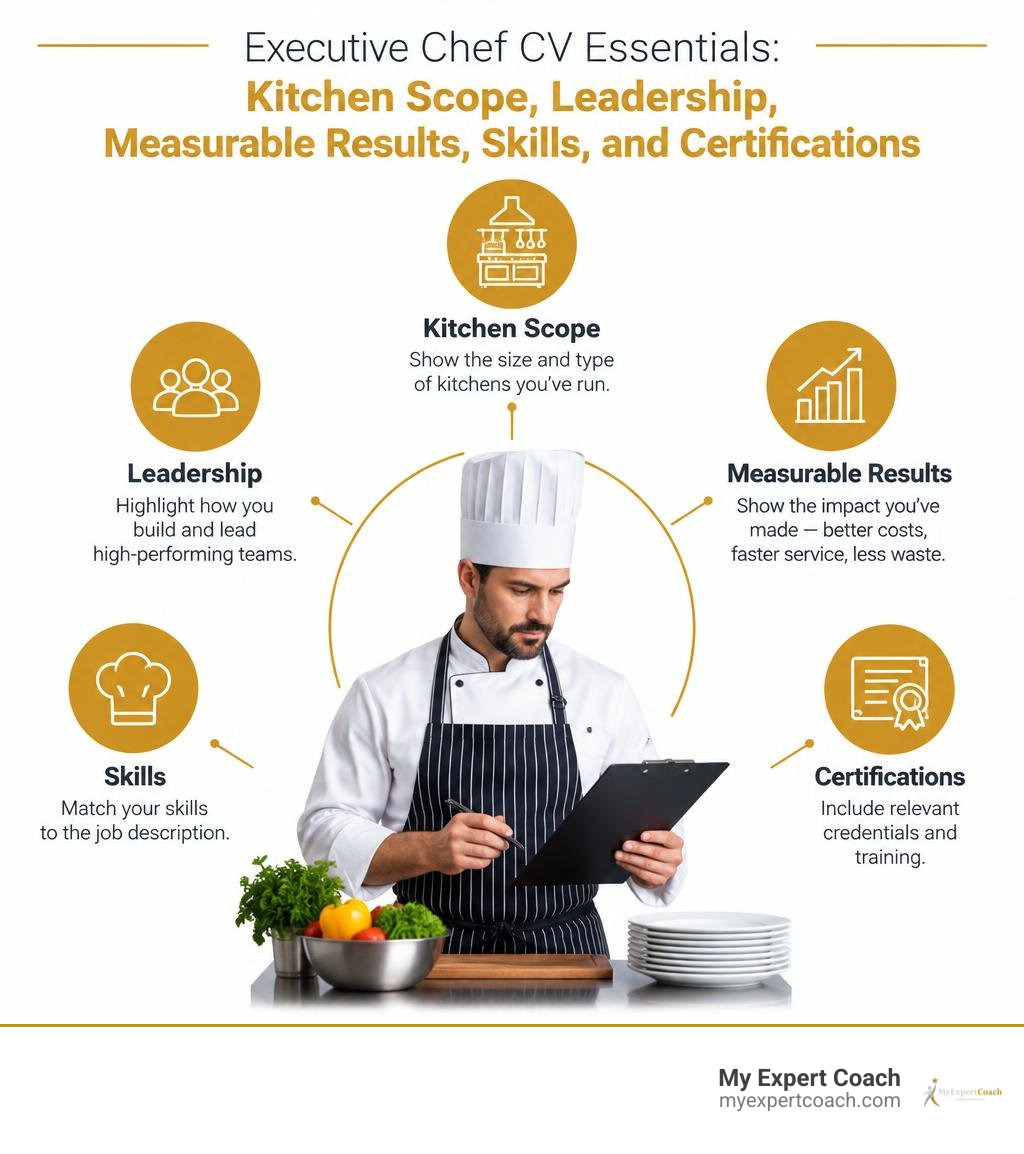
Essential Architecture of a High-Impact Executive Chef CV
Recruiters and hospitality owners review hundreds of profiles for every open leadership role, frequently spending fewer than ten seconds skimming a document before deciding whether to move forward. If your document reads like a simple line cook’s job description filled with generic responsibilities such as “prepared sauces” or “managed kitchen staff,” you miss the opportunity to command executive compensation.
To stand out, your document must demonstrate executive maturity. Applying the ultimate guide to executive resume best practices helps frame your background as a strategic business leader who happens to command the back of house.
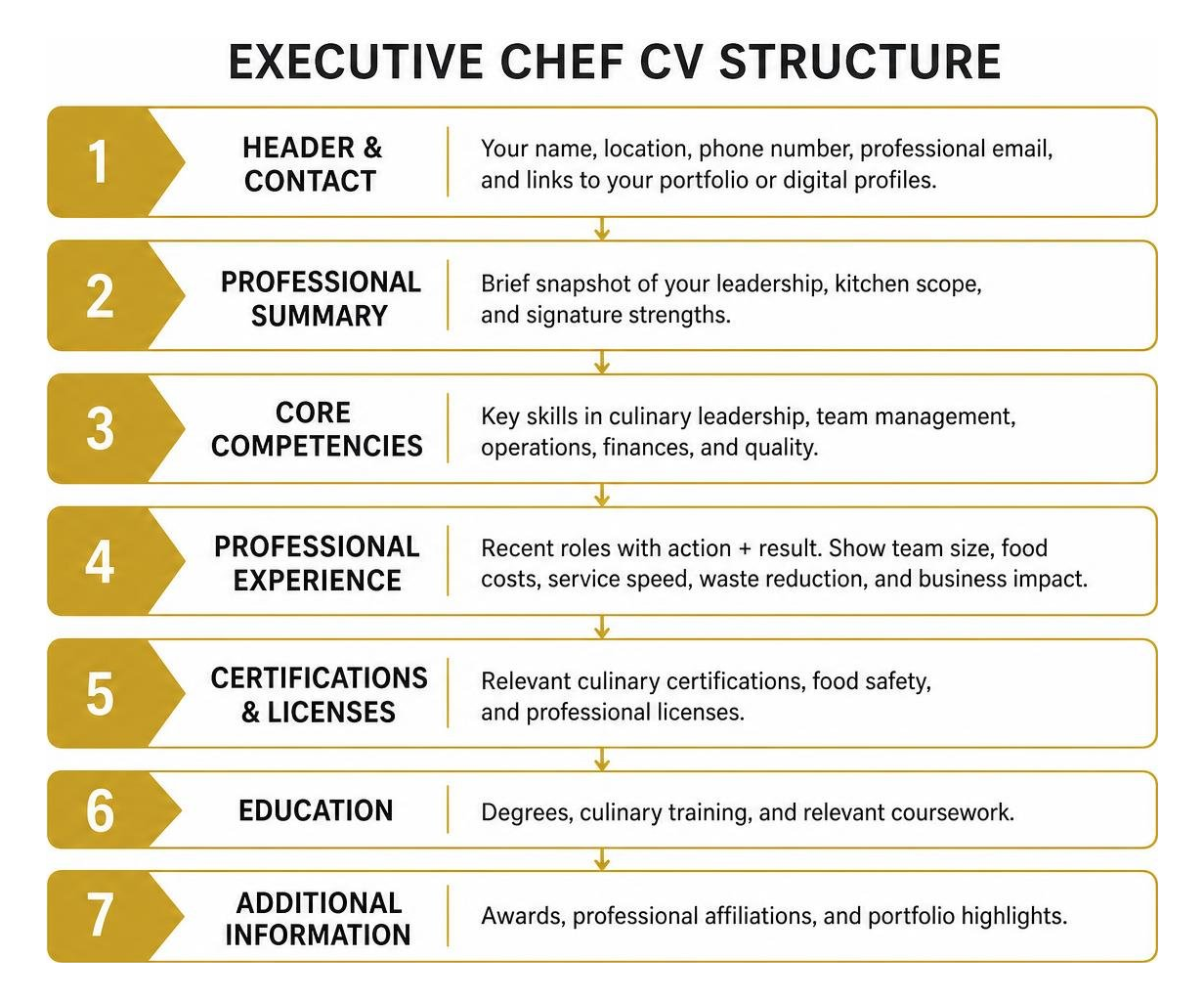
Core Sections to Structure Your Executive Chef CV
A modern executive CV requires clear, deliberate sections that allow hiring managers to quickly locate your property scope, financial impact, and culinary credentials:
- Header & Contact Information: Keep this clean. Include your full name, location, phone number, professional email, and links to your professional portfolio or digital profiles.
- Property Scope & Executive Summary: An immediate snapshot of your career scale—detailing covers per night, annual food and beverage spend, and outlet oversight.
- Core Competencies: A balanced matrix of creative mastery (e.g., menu engineering, tasting menus, farm-to-table sourcing) and executive operations (e.g., P&L management, labor scheduling, health compliance).
- Professional Experience: Reverse-chronological career history focusing on the last 8 to 12 years with quantified achievements.
- Certifications & Technical Accreditations: Industry credentials like ACF Certified Executive Chef (CEC), ServSafe Manager, and HACCP certifications.
- Education: Formal culinary arts diplomas, apprenticeships, or business degrees.
- Industry Recognition & Media: Awards, Michelin guide mentions, television appearances, or high-profile guest chef engagements, as shown in international leadership profiles like this CV CHEF YERIKA HOJA A4 CON NUMERO .
Balancing Creative Mastery and Financial Performance
A common pitfall for culinary directors is tilting too far toward menu descriptions while ignoring the balance sheet—or conversely, reading like a sterile accountant. Top back-of-house salaries go to leaders who combine culinary vision with fiscal discipline.
| Culinary Artistry & Standards | Executive Business Operations |
|---|---|
| Menu Engineering: Designing signature seasonal offerings | Profit Margins: Optimizing recipe costs to achieve a 28% food cost baseline |
| Culinary Innovation: Modernizing tasting concepts and plating | Revenue Expansion: Increasing overall outlet F&B sales by 15% |
| Team Mentorship: Training junior brigade members on classic techniques | Labor Optimization: Reducing overtime by 18% through cross-station scheduling |
| Quality Control: Maintaining presentation consistency across peak service | Waste Reduction: Lowering spoilage by 40% with automated inventory audits |
| Sourcing Excellence: Partnering with regional organic producers | Supplier Negotiations: Securing favorable vendor terms on multi-million dollar spends |
How to Quantify Back-of-House Achievements and Command Higher Pay
When negotiating compensation, data is your greatest leverage. Anyone can claim they “cut costs” or “improved quality,” but top earners prove their value with clear numbers. Incorporating proven executive resume tips 2026 ensures your metrics resonate with general managers, owners, and corporate hospitality directors.
Crafting Results-Driven Work Experience Bullet Points
Every bullet point under your professional history should use the Challenge-Action-Result (CAR) model. Start with a decisive action verb, define the scope, and conclude with the measurable outcome.
Instead of writing:
- Responsible for redesigning the spring menu and supervising cooks.
Transform it to:
- Redesigned seasonal spring menu across 3 outlets, driving a 25% menu profitability boost and lifting guest retention scores by 20%.
Instead of writing:
- Trained kitchen crew and managed prep shifts.
Transform it to:
- Supervised and trained a brigade of 15 kitchen staff, improving operational efficiency by 25% and reducing prep time by 20%.
Looking at structured resumes such as this RESUME – CHEF GEORGE PAPAPARASKEVAS illustrates how managing high-volume covers (up to 2,000 guests) across luxury resort environments translates into clear career progression.
Sourcing, Sustainability, and Waste Management Impact
Sustainability and food waste management are major drivers of kitchen profitability. Highlighting these initiatives demonstrates leadership foresight:
- Inventory Control Systems: Mention specific software platforms (such as BirchStreet, xtraCHEF, or Synergy) you implemented to track inventory, which can decrease food waste by up to 40% and save tens of thousands of dollars annually.
- Sourcing Partnerships: Quantify hyper-local sourcing programs (e.g., Sourced 38% of all produce within 200 miles, lowering transport costs while enhancing brand marketability).
- Health and Safety Streaks: Highlight regulatory excellence (e.g., Maintained an unbroken streak of 11 consecutive quarterly health inspections with 98%+ scores).
Crafting a Compelling Summary vs Resume Objective
An outdated resume objective tells an employer what you want from them. An executive summary shows the hiring team what you deliver to their bottom line. Understanding how to build personal branding allows you to craft a summary that establishes your unique culinary voice and business capabilities immediately.
Executive Summary Examples Across Culinary Sectors
Example 1: Luxury Hotel & Resort Culinary Director
Dynamic Executive Chef with 14 years of luxury hospitality leadership managing up to $9.5M in annual food and beverage operations across 3 dining outlets and high-volume banquet facilities (15,000+ annual covers). Expert in contemporary Mediterranean cuisine, brigade mentorship, and modern inventory systems. Successfully improved banquet contribution margins from 41% to 49% while maintaining a 5-star guest satisfaction standard.
Example 2: Independent Fine Dining & Tasting Concept
Creative and business-minded Executive Chef with background in Michelin-caliber fine dining. Adept at driving 100% farm-to-table seasonal menu development, zero-waste kitchen practices, and comprehensive cellar pairings. Boosted menu profitability by 25% through optimized portion controls, while achieving a 30% increase in guest retention.
Positioning Early-Career or Transitioning Chefs
When stepping up from Chef de Cuisine or Executive Sous Chef into your first head Executive Chef position, focus on transferable leadership achievements rather than entry-level culinary tasks. A successful executive career transitions demand strategy far beyond the standard resume. Focus on:
- Past budget oversight and food-cost contributions under the outgoing Executive Chef.
- Direct brigade management, scheduling, and onboarding accomplishments.
- Cross-functional collaboration with Front-of-House (FOH) managers and event sales directors.
Strategic ATS Optimization and Keywords for Senior Culinary Roles
Hospitality recruiters rely heavily on Applicant Tracking Systems (ATS) to filter candidate pools. If your document lacks industry-standard terms, it may never reach human eyes. Evaluating your materials through an ats resume optimizer free tool can confirm your credentials parse correctly.
High-Priority Keywords and Technical Proficiencies for Your Executive Chef CV
To ensure smooth ATS indexing, incorporate these core technical and managerial keywords naturally throughout your experience bullets and skills section:
- Culinary & Operations: Menu Development, Recipe Standardization, Plating & Food Presentation, Banquet Operations, Volume Catering, Tasting Menus, Kitchen Workflow Optimization.
- Financial & Business Strategy: Food & Labor Cost Control, P&L Accountability, Vendor Contract Negotiation, Gross Operating Profit (GOP), Revenue Optimization, Capital Expenditure (CapEx).
- Compliance & Safety: HACCP Standards, ServSafe Manager, ISO 22000, OSHA Regulations, Allergen Control, Health Department Inspections.
- Software & POS Tools: Micros POS, Toast, BirchStreet, xtraCHEF, Synergy Suite, MarketMan, MS Excel (advanced scheduling/costing).
Tailoring Your CV and Cover Letter to Specific Hospitality Job Descriptions
Never send a generic resume to a luxury property or private restaurant group. Tailor every submission to match the specific kitchen environment:
- For Resort & Multi-Outlet Properties: Emphasize banquet capacity, multi-kitchen brigade leadership, inventory automation, and banquet contribution margins.
- For Boutique Fine-Dining Venues: Highlight culinary vision, regional agricultural partnerships, tasting menu guest satisfaction, and media accolades.
- Reinforce Your Digital Footprint: Ensure your executive resume aligns seamlessly with your online presence by consulting our linkedin profile ultimate guide 2026.
Frequently Asked Questions About Executive Chef CVs
How long should an executive chef CV be?
An executive chef CV should generally be two pages. Senior culinary roles require detailed property scope, brigade sizes, revenue volumes, and multiple industry credentials. A single page rarely provides enough space to showcase extensive leadership experience, while three pages can dilute your strongest achievements.
Should an executive chef always include a cover letter?
Yes. A well-written cover letter provides a platform to communicate your culinary philosophy, leadership style, and alignment with the venue’s brand concept. It shows employers your strategic thinking before they review your operational history.
What certifications carry the most weight on an executive chef CV?
The most recognized credentials include the American Culinary Federation Certified Executive Chef (ACF CEC), ServSafe Manager, HACCP Lead Certification, and AHLEI Certified Hospitality Educator/Trainer. Demonstrating formal safety and kitchen leadership certifications reinforces your operational authority.
Conclusion
Stepping into a high-earning back-of-house role requires presenting yourself as both an exceptional culinary artist and a capable business operator. When you lead with measurable outcomes—from food cost reductions to brigade retention—you position yourself for stronger compensation packages and better career opportunities.
If you are ready to take your career to the next level, our team at MyExpertCoach is here to help. With more than 25 years of insider HR and executive recruiting experience, we build custom, non-template executive materials tailored to senior leaders. Explore our resume and linkedin services today to transform your culinary track record into a compelling executive presentation.