
table of contents
How Much Is Reasonable to Ask for a Raise?
To decide how much is reasonable to ask for a raise, start with the market rate for your role, then weigh your results and any added responsibilities. A 3% to 5% increase fits a routine annual review. A 10% to 15% request may be reasonable if you can show exceptional impact or a clear pay gap. A larger request needs stronger evidence, such as a major change in your role. In 2026, employers are budgeting about 3.5% for total pay increases, so a double-digit ask calls for a case beyond the usual merit review.
I’m Sandy Spencer, a career coach with 38 years of HR and executive recruiting experience who has helped advance more than 10,000 careers. I help senior leaders work out how much is reasonable to ask for a raise by connecting their achievements to their market value.
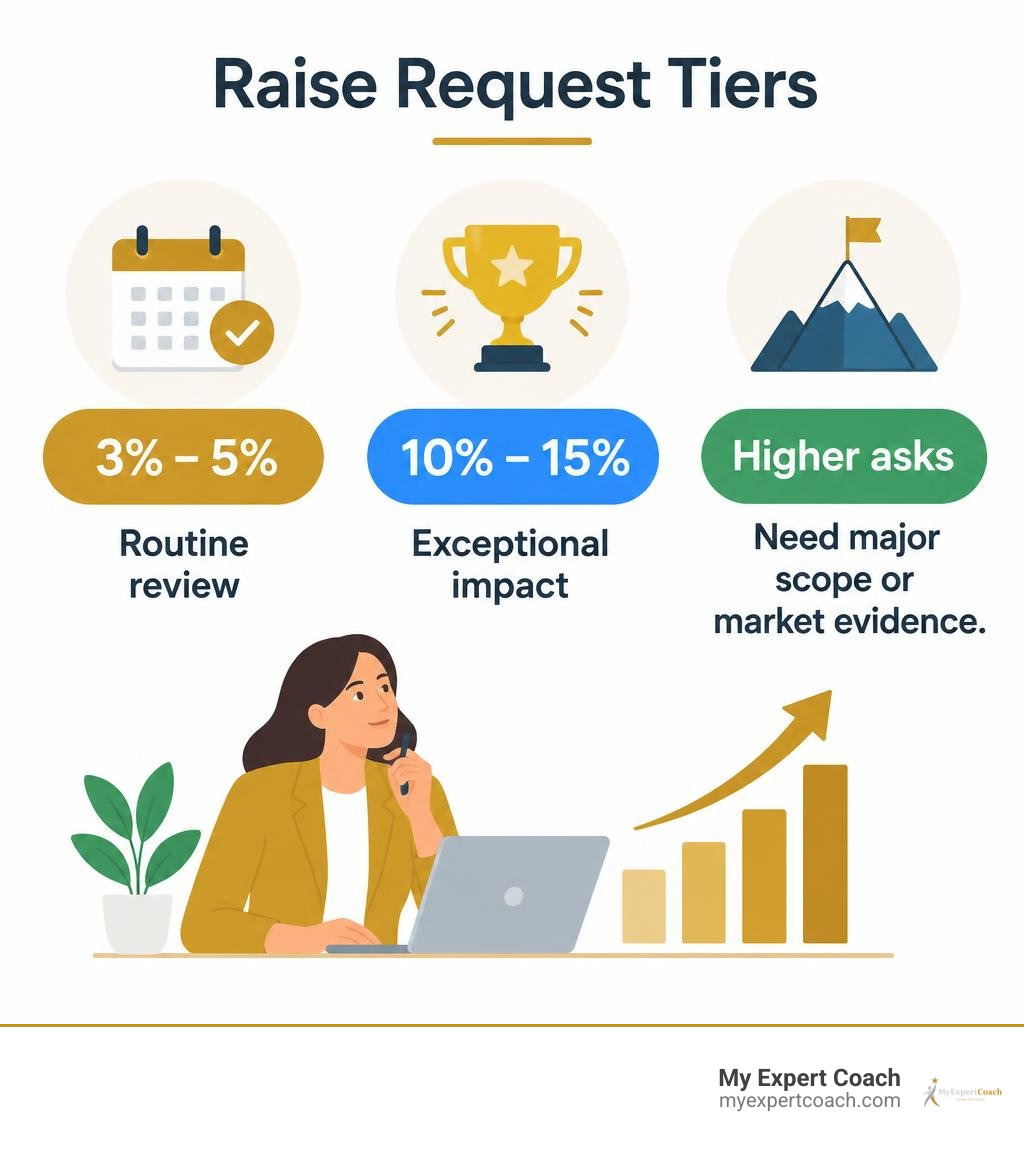
Average Pay Increase Benchmarks in 2025–2026
To understand what you can realistically request, you first need to look at the macroeconomic landscape. Compensation planning has shifted over the past few years. After the aggressive wage spikes of recent hiring booms, corporate salary increase budgets have normalized.
According to major workforce compensation surveys from firms like Mercer and Payscale:
- Average corporate pay increases dropped from 4.0% in 2023 to 3.6% in 2024.
- The median pay raise that U.S. companies gave to employees in 2025 was 3.5%.
- In 2026, employers are budgeting approximately 3.2% specifically for merit pools and roughly 3.5% for total pay increases.
- Average base pay growth reported on Glassdoor cooled to 3.3% year-over-year in early 2026, down from 5.2% in late 2025.
- Formal internal promotions yield an average increase of about 8.7%.
These figures represent what companies budget by default across broad employee populations. When individuals actively negotiate and present a documented business case, the numbers look quite different.
| Compensation Event | Average Employer Budget | Proactive Negotiation Target | Primary Driver |
|---|---|---|---|
| Standard Annual Merit | 3.0% – 3.5% | 4.0% – 6.0% | Inflation alignment, tenure, meeting role expectations |
| High Performer Merit | 4.0% – 6.0% | 7.0% – 10.0% | Exceeding core KPIs, taking on minor extra duties |
| Internal Promotion / Major Scope Increase | 8.0% – 9.0% | 10.0% – 20.0% | Title change, managing larger teams, higher budget control |
| External Job Transition | N/A | 10.0% – 20.0%+ | Market scarcity, specialized expertise, external hiring budgets |
While standard merit increases protect your baseline against inflation, securing substantial compensation growth requires deliberate positioning.
Benchmarking Pay: How Much Is Reasonable to Ask for a Raise?
Benchmarking your compensation requires looking beyond company-wide averages. To build a defensible target, evaluate your pay relative to your broader industry and geographic market.
Only 37% of workers ever ask for a pay raise, yet research indicates that approximately 70% of those who make a formal, structured request receive an increase. The hesitation usually stems from uncertainty around what figure is defensible. If you ask for too little, you leave substantial money on the table; if you ask for an arbitrary figure disconnected from market reality, you risk undermining your credibility.
Factors That Determine How Much Is Reasonable to Ask for a Raise
Several internal and external variables dictate the upper boundary of a reasonable request:
- Quantifiable Business Impact: Did your direct actions drive revenue, cut operational costs, or mitigate risk? An employee who generated $250,000 in bottom-line value has far more negotiation leverage than one whose contributions cannot be measured.
- Current Pay Relative to Market Percentiles: Are you currently compensated below the 50th percentile for your role? Bringing your pay up to the 60th–75th percentile is a standard, defensible business adjustment. You can verify regional compensation bands using a salary calculator by city to ensure your baseline reflects local economic conditions.
- Company Financial Health: A company experiencing record profitability has wider discretionary compensation bands than one operating under cost-cutting measures or hiring freezes.
- Scarcity of Your Skill Set: If replacing your specialized institutional knowledge or technical capability would require months of recruiting at a premium rate, your internal value increases significantly.
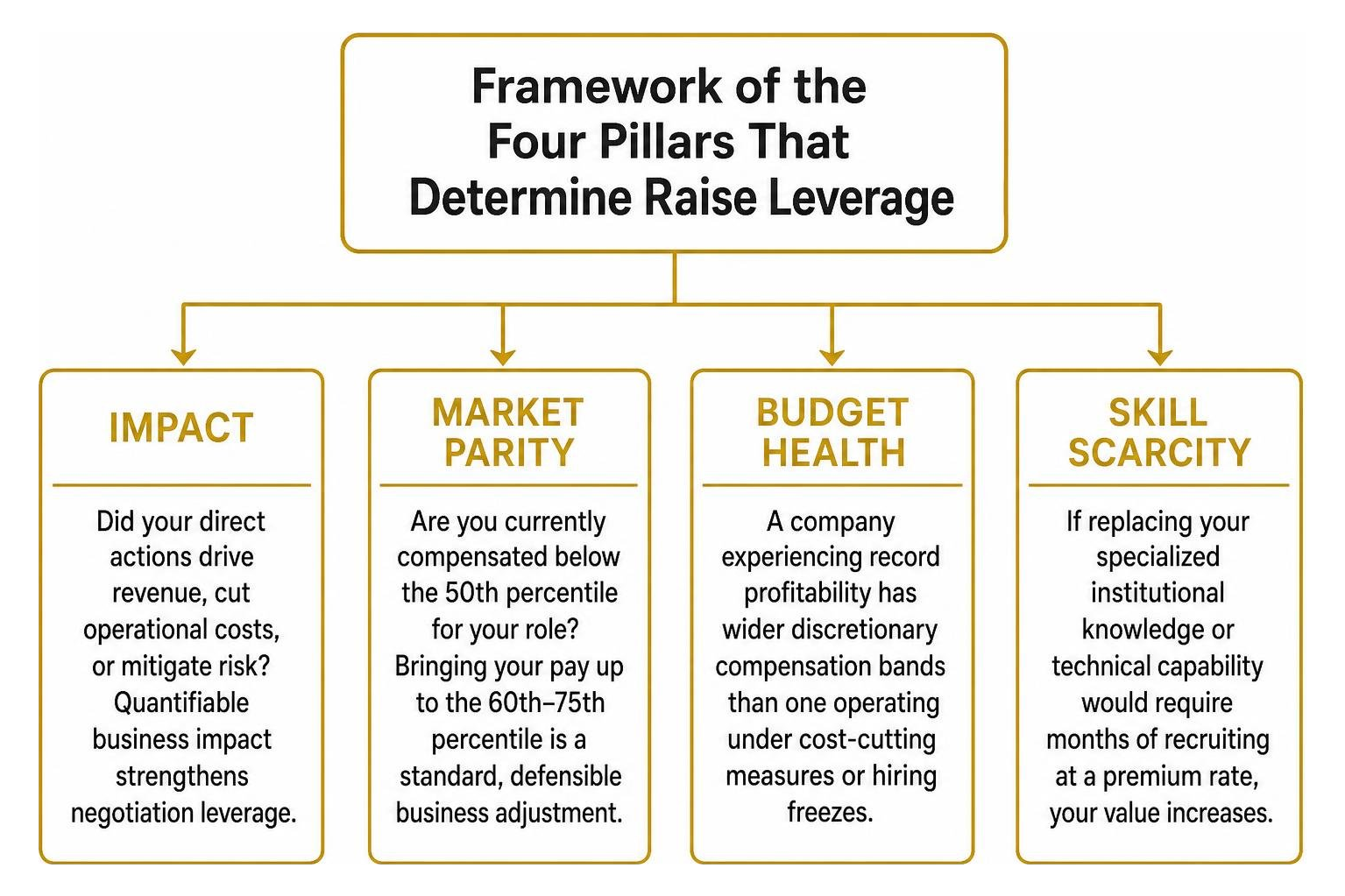
How Much Is Reasonable to Ask for a Raise Across Different Career Milestones
Your career situation determines the appropriate percentage bracket to target:
- The 3% to 5% Ask (Standard Merit): Appropriate when your performance meets all expectations, the role scope has remained unchanged, and you want to maintain pace with baseline cost-of-living increases.
- The 5% to 10% Ask (Consistent High Performer): Justified when you consistently exceed performance metrics, mentor colleagues, or have taken on incremental projects without a formal title change.
- The 10% to 15% Ask (Market Discrepancy or Expanded Impact): Appropriate if external salary data proves you are paid below the market median, or if you have driven significant revenue growth or cost savings over the past 12 months.
- The 15% to 25% Ask (Major Scope Shift or Substantial Underpayment): Warranted when your role has fundamentally changed—such as absorbing a departing manager’s duties, directly managing a new team, or delivering an enterprise-level milestone.

How to Calculate Your Target Salary and Build the Business Case
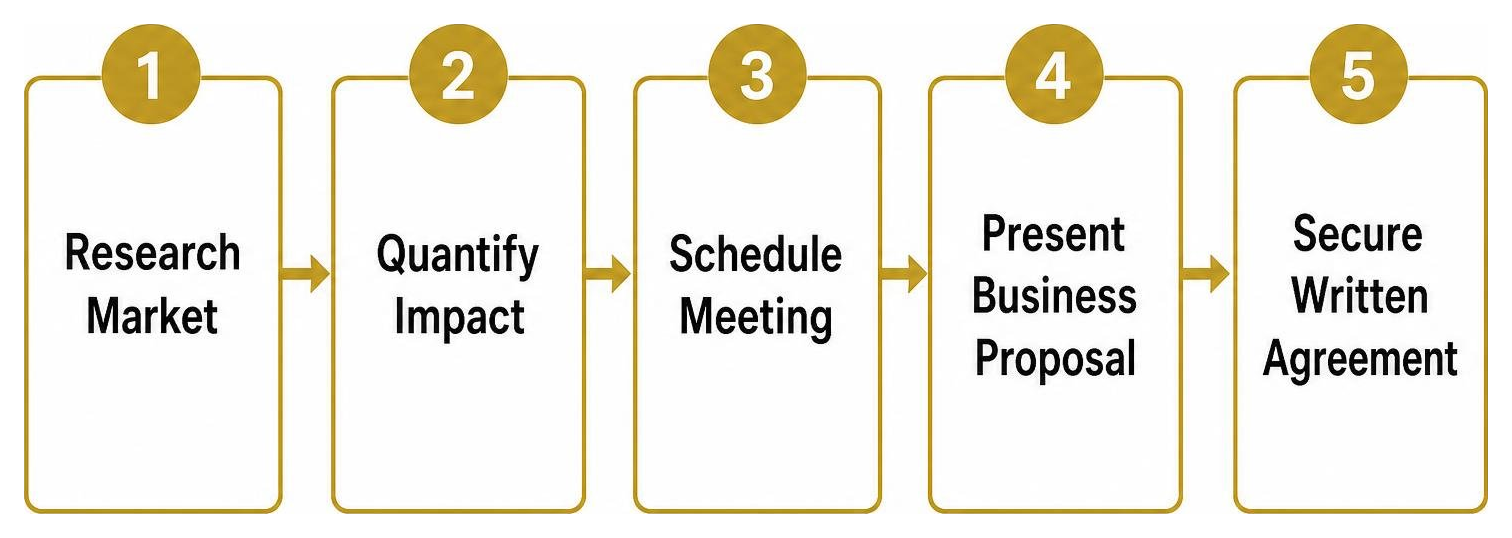
Never enter a salary conversation with an arbitrary number or an emotional appeal. We always advise executives and professionals to structure their requests around a clear calculation and an evidence-backed proposal. Mastering the mechanics of structured salary negotiation turns what could be an uncomfortable meeting into an objective business conversation.
To calculate your target salary:
- Establish your current base salary.
- Identify the market median (50th percentile) and upper quartile (75th percentile) for your title, experience level, and geographic metro area.
- Quantify the dollar value of your extra contributions over the past year.
- Add a slight margin of 2% to 3% above your walk-away target to leave room for collaborative negotiation. For example, if you aim for an 8% increase, anchoring your ask at 10% to 11% allows both parties to reach an agreeable outcome.
Documenting High-Impact Achievements
Your manager needs concrete data to defend your raise to HR and upper leadership. Build an executive “brag sheet” highlighting:
- Revenue Attribution: New accounts won, deals closed, or pipeline expanded.
- Cost Savings & Optimization: Vendor contracts renegotiated, processes automated, or hours saved across the team.
- Risk Mitigation: Compliance milestones met, system downtime prevented, or security vulnerabilities addressed.
- Leadership & Culture: Training new team members, leading cross-functional task forces, or filling leadership gaps during transitions.
Framing the Request as an Executive Proposal
Deliver your request in person or via video conference, supported by a concise written summary. Here is an effective framework to open the discussion:
“Over the past year, my core focus has been delivering on [Key Initiative A] and driving [Specific Outcome B], which resulted in [Quantifiable Result, e.g., a 15% increase in team output / $80,000 in operational savings]. In addition, I have taken on [Expanded Responsibility C].
Based on these contributions and current market benchmarks for our role in this region—which sit between [Market Low] and [Market High]—I would like to discuss adjusting my base salary to [Specific Dollar Figure, e.g., $135,000], representing a [X%] increase. How can we work together to make this adjustment happen?”
Strategic Timing: When to Request Your Pay Increase
Even a well-prepared business case can fall flat if delivered at the wrong time. Asking for a raise during an annual performance review is common, but it is often too late in the corporate calendar.

Aligning with Corporate Budget Cycles
Most organizations finalize their annual merit and compensation budgets two to four months before performance reviews take place. If your annual review happens in December or January, department budgets were likely locked in August or September.
- 3 to 4 Months Prior to Review: Begin having strategic conversations with your manager about your performance trajectory and compensation expectations. This gives your manager time to include your adjustment in the department’s upcoming budget proposal.
- Immediately Following a Major Milestone: Requesting a compensation review right after closing a major contract, launching a key product, or leading a successful audit provides maximum leverage while your impact is top of mind.
- The 6-Month Mark for Role Expansions: If you were promoted or absorbed new responsibilities without an immediate salary bump, schedule a formal review six months in to review the expanded scope.
Leveraging Competing Opportunities and Role Expansions
If you receive an external inquiry or a competing job offer, proceed with caution. While outside interest proves market parity, using another offer aggressively can damage trust.
If you decide to ask for a raise with another offer in hand, frame it collaboratively rather than as an ultimatum:
“I love working with this team and believe in where the company is headed. Recently, I was approached by another firm offering a compensation package of [Amount] for a role with similar responsibilities. My clear preference is to stay here, and I would love to see if we can bring my compensation closer to this market level.”
What to Do When Your Salary Increase Is Denied or Capped
A initial “no” or “not right now” does not mean your negotiation is over. It simply marks the start of the next phase.
Negotiating Non-Salary Benefits and Total Rewards
When cash compensation is strictly capped by HR policies or enterprise-wide budget freezes, pivot the conversation to non-salary components of your total rewards package:
- Variable Compensation & Spot Bonuses: Milestone-based performance bonuses or retention incentives that draw from different budget pools.
- Equity and Long-Term Incentives: Additional stock options, Restricted Stock Units (RSUs), or profit-sharing percentages.
- Additional Paid Time Off (PTO): An extra week of vacation carries substantial personal value with zero direct payroll cash cost to the department.
- Professional Development Budgets: Dedicated funding for executive certifications, industry conferences, or specialized coaching.
- Title Adjustments: A title upgrade (e.g., from Director to Senior Director) provides immediate market recognition and positions you for higher compensation bands in the future.
Knowing When to Seek External Opportunities
If your organization consistently freezes compensation while expanding your workload, you may be facing structural salary compression. Internal annual raises typically average 3% to 5%, whereas professionals who change employers frequently secure a 10% to 20% increase in base compensation.
If your current employer cannot match your market rate, it may be time to evaluate external roles. If you receive an outside offer, make sure to secure better pay without falling into the dangerous counteroffer trap. When entering the job market, thoroughly research how much should I ask for salary at a new job so you anchor your initial compensation discussions effectively from day one.
Frequently Asked Questions
Is asking for a 10% to 15% raise considered too high?
A 10% to 15% raise request is entirely reasonable if supported by verifiable data. This bracket is appropriate when you have taken on new responsibilities, demonstrated significant business impact, or if your current salary has fallen well below market medians. Present clear documentation of your contributions and external salary benchmarks to show why the number is justified.
How soon into a new position can you request a salary increase?
The standard guideline is to wait at least 12 months, or until your first annual performance review cycle. However, you can reasonably open a compensation conversation at the 6-month mark if your actual duties have expanded significantly beyond the original job description, or if you were brought in on a probationary rate with agreed-upon performance milestones.
Can you be penalized or fired for requesting a raise?
In professional environments, an employee will not be fired or demoted simply for politely and professionally asking for a raise backed by market data. Retaliation of that nature is extremely rare and reflects poor leadership. As long as you present your case respectfully, focus on your contributions rather than personal financial needs, and avoid hostile ultimatums, opening a salary discussion is a normal part of career development.
Conclusion
Knowing how much to ask for in a raise requires balancing macroeconomic realities with your documented value. In 2026, standard corporate merit pools may hover around 3.5%, but your personal career trajectory does not have to be limited by default budgets. By benchmarking your market percentile, quantifying your revenue impact, and timing your request ahead of internal budget cycles, you can approach salary negotiations with clarity and confidence.
At MyExpertCoach, our team brings more than 25 years of inside HR and executive recruiting expertise to help leaders negotiate their compensation and navigate career transitions. If you want to position yourself for higher compensation bands, refine your professional narrative, and unlock new executive opportunities, explore our executive resume and LinkedIn optimization services to ensure your market profile reflects your true value.