table of contents
How to Build a LinkedIn Profile for Freshers That Gets Noticed
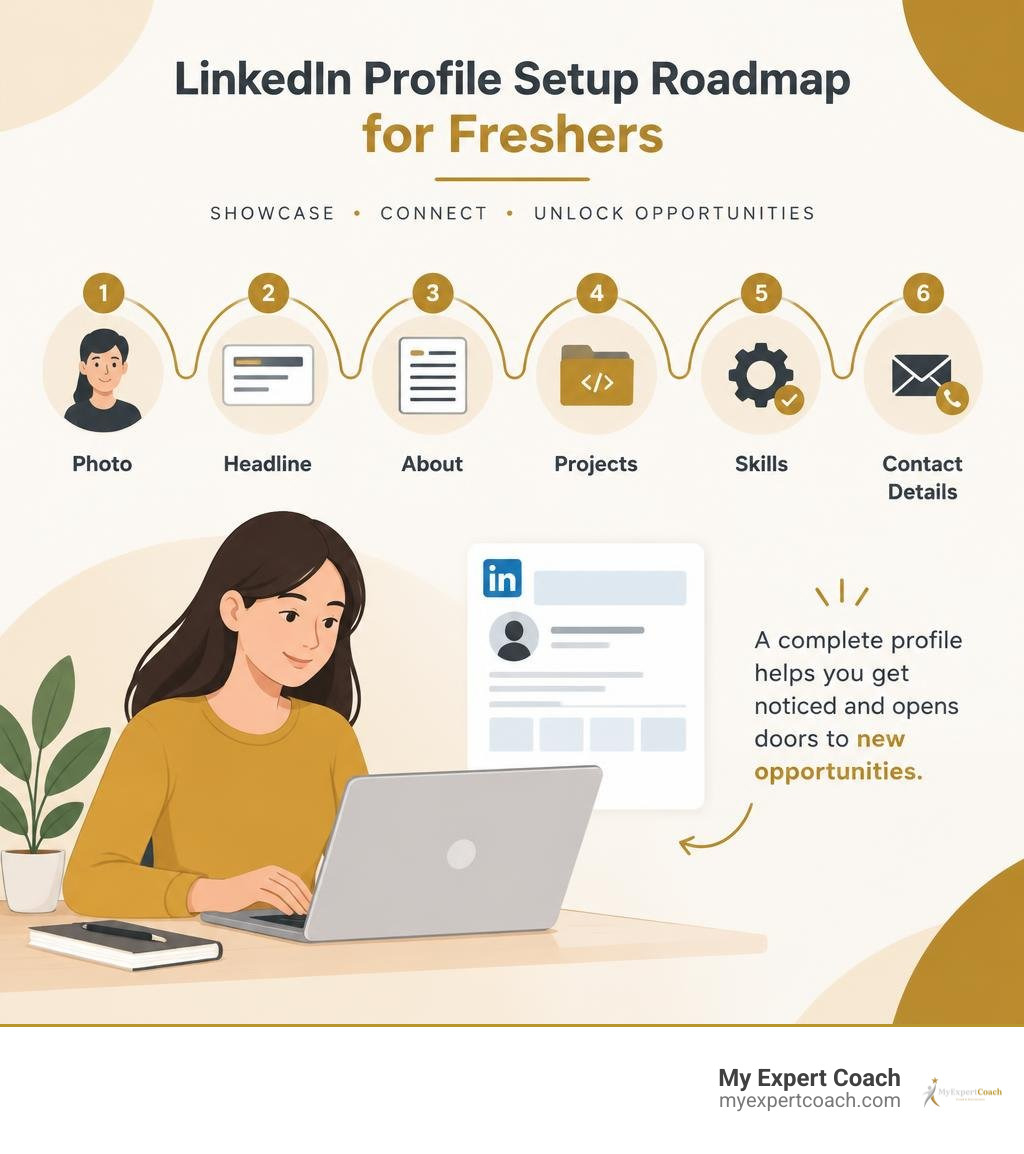
To build a linkedin profile for freshers that helps recruiters understand what you can do, start with a clear photo and a headline naming the role you want. Add a short About section, then show proof of your skills through projects, internships, coursework, or volunteer work. Use terms from relevant job postings in your headline, About section, and Skills list, but only for skills you have.
You do not need a full-time job to make a strong first impression. A complete profile helps people see your career direction, your work, and how to contact you.
I’m Sandy Spencer, a career coach with over 38 years of experience in HR and executive recruiting who has helped advance more than 10,000 careers. I’ll bring that recruiter perspective to each step of building a linkedin profile for freshers, starting with why those details matter.
Why LinkedIn Profile Optimization Matters for Recent Graduates
Graduating from college is a massive milestone, but waiting for employers to stumble upon your resume through standard job boards is often an uphill battle. In 2026, the modern job market relies heavily on inbound sourcing. Over 87% of recruiters use LinkedIn to search and screen candidates, and roughly 9 out of 10 talent acquisition professionals actively source candidates directly through the platform. Furthermore, 75% of hiring managers inspect a candidate’s online presence before deciding whether to extend an interview invitation.
When talent scouts look for entry-level candidates, they do not read every profile manually. Instead, they rely on complex search algorithms and recruiter filters that scan for specific keywords, education backgrounds, locations, and demonstrated competencies. If your profile is blank or missing key technical terms, you become invisible to the very people hiring for your dream roles. Complete profiles are 40% more likely to attract recruiters because the platform’s algorithm prioritizes fully completed accounts in search results.
Building an optimized presence is essentially establishing your baseline personal branding. It allows you to control the narrative of your skills, academic rigor, and potential before you even step into an interview room. Moreover, nearly 60% of LinkedIn users access the platform via mobile devices, meaning your profile must be structured for immediate clarity, scannability, and high visual impact on screens of all sizes. Following a structured step-by-step profile creation guide ensures you check every technical box from day one.
Essential Building Blocks of a Winning LinkedIn Profile for Freshers
A successful profile does not merely mimic your resume; it acts as an interactive digital portfolio that introduces who you are, what you care about, and where you want to go.
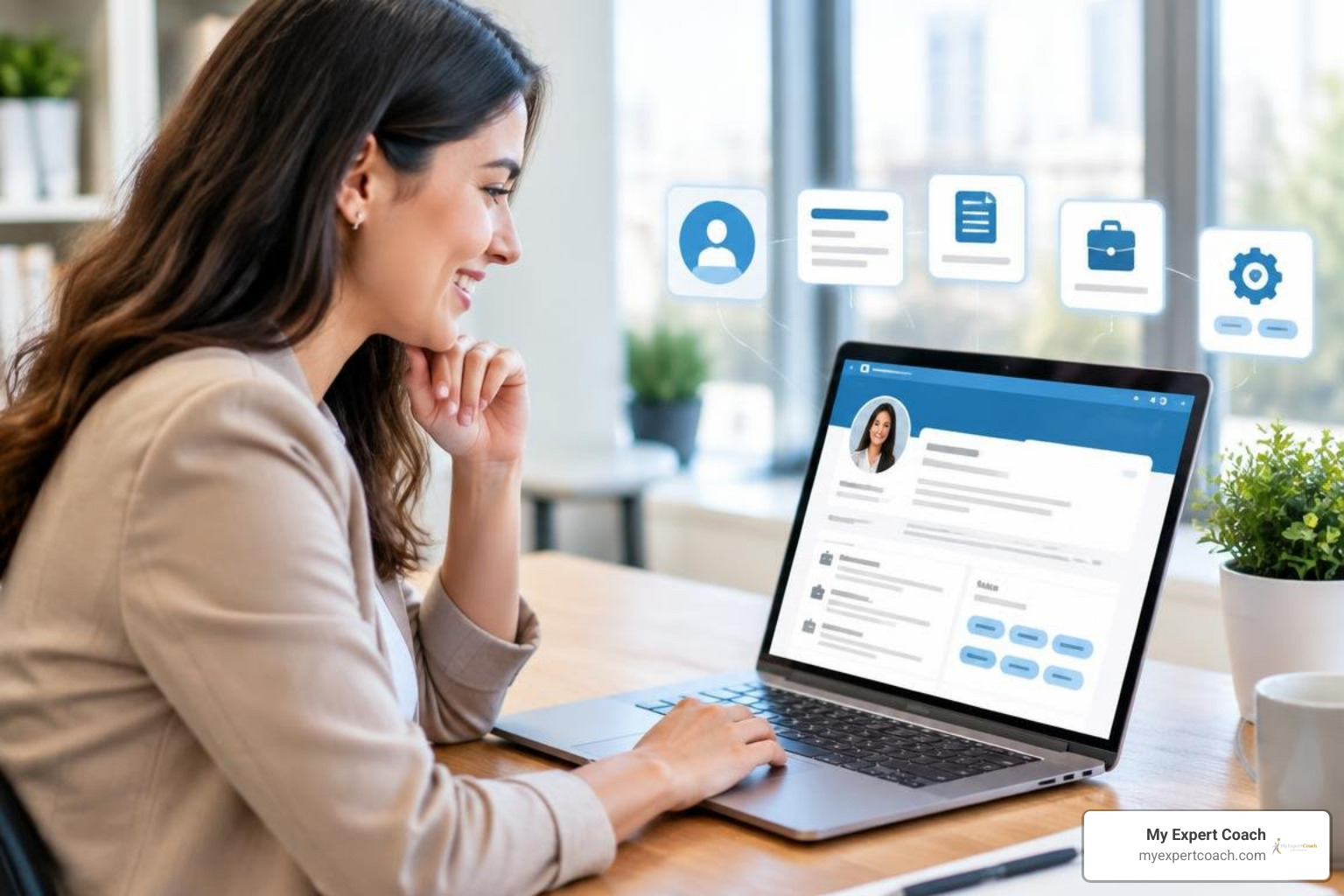
To build maximum credibility quickly, focus on these essential core sections:
- Custom Vanity URL: By default, LinkedIn assigns you a URL containing random numbers and letters. Clean this up immediately. Customizing and sharing your profile link makes your profile easy to remember, clean on a resume header, and simple to send to hiring managers.
- Visual Assets: A high-quality headshot and a complementary banner image set the tone for your professionalism.
- Targeted Headline: A 220-character hook that defines your target role, key technical proficiencies, and value proposition.
- Narrative About Section: A personalized summary highlighting your background, motivations, major wins, and clear career aspirations.
- Structured Experience & Projects: A dynamic showcase of internships, capstone projects, academic research, part-time work, and student leadership.
- Strategic Skills & Certifications: A curated list of at least 10–15 core capabilities aligned with entry-level job descriptions.
Let us explore how to execute each of these critical elements effectively.
Professional Headshots and Banner Selection
Your profile photo is your digital handshake. Research shows that profiles with a photo receive up to 21 times more profile views and up to 36 times more messages than photo-less accounts. Specifically, profiles featuring clean, professional photos receive 14 times more views.
You do not need to hire an expensive commercial photographer. A modern smartphone camera can produce outstanding results when you follow these best practices:
- Lighting and Focus: Use soft, natural front lighting (such as facing an open window). Avoid harsh overhead fluorescent lights or deep shadows.
- Framing: Your face and shoulders should fill roughly 60% of the frame. Keep your expression warm, approachable, and confident.
- Background: Choose a simple, uncluttered background—a solid neutral wall or a softly blurred outdoor background works perfectly.
- Attire: Dress in business casual or industry-appropriate clothing. Avoid casual selfies, party pictures, cropped group shots, or graduation cap filters that obscure your face.
Do not leave your background banner as the default gray geometric pattern. Use tools like Canva to design a simple banner that reflects your discipline—such as clean typography stating your field, an image representing code, data visualization graphics, or a neutral brand aesthetic.
Crafting an Impactful Headline on a LinkedIn Profile for Freshers
Your headline is one of the highest-weighted fields in LinkedIn’s internal search algorithm. Unfortunately, many new graduates write generic phrases like “Student at University” or “Recent Graduate Looking for Opportunities.” These phrases waste prime digital real estate because recruiters rarely type “looking for opportunities” into their search bars.
Instead, structure your headline around your target role, hard skills, and current readiness:
Headline Examples for Entry-Level Candidates
- Software Development: Aspiring Software Engineer | Java, Python, SQL, React | B.S. in Computer Science | Open to Entry-Level Roles
- Data Analytics: Entry-Level Data Analyst | SQL, Power BI, Python, Excel | Turning Raw Data into Business Insights
- Digital Marketing: Marketing Graduate | Content Strategy, SEO, Google Analytics & Paid Social | Passionate about Brand Growth
- Finance & Accounting: Finance Graduate | Financial Modeling, Valuation & Risk Analysis | Seeking Financial Analyst Opportunities
Remember to activate the “Open to Work” feature in your settings. You can choose whether to display the public green photo frame or keep it visible exclusively to LinkedIn Recruiter users.
Writing a Standout About Section and Summary
Your “About” section is your chance to showcase your personality. Nearly 87% of recruiters look for personality in a candidate’s summary, making this the only place on your profile where you can speak directly to the reader in your authentic, first-person voice (“I”, “my”).
While LinkedIn provides up to 2,600 characters, the most effective entry-level summaries are concise (around 150 to 300 words), well-formatted, and easy to skim. You can draw inspiration from established summary frameworks and templates as well as university career centers offering academic profile writing tips.
A high-converting summary follows a proven four-part structure:
- The Hook & Introduction: Introduce your academic background, core passion, and specialized area of interest.
- Core Competencies & Hands-On Work: Mention the primary tools, methodologies, and projects you have mastered.
- Key Accomplishment or Project Highlight: Briefly describe a capstone project, internship win, or academic achievement with measurable impact.
- Call to Action (CTA): Tell the reader what roles you are pursuing and provide your professional email address for direct outreach.
Example Summary for an Entry-Level Candidate
“I am a recent Computer Science graduate passionate about building intuitive, high-performance web applications and data pipelines. During my academic career, I focused on full-stack development, object-oriented programming, and cloud technologies.
Recently, I developed a full-stack e-commerce web application utilizing React, Node.js, and PostgreSQL, which improved mock transaction speeds by 25% and supported seamless multi-user authentication. Beyond coursework, I served as a Peer Tutor for Data Structures and Algorithms, helping over 40 underclassmen master foundational programming concepts.
Key Skills & Tools: Python, Java, JavaScript, React, SQL, Git, REST APIs, Agile Principles.
I am actively seeking entry-level software engineering and junior developer opportunities. Feel free to connect with me here on LinkedIn or contact me at [email protected].”
Showcasing Experience, Projects, and Education Without a Full-Time History
The most common concern for freshers is: “How do I complete the Experience section if I have never held a corporate job?”
Recruiters hiring for entry-level positions do not expect a decade of corporate tenure. They look for evidence of problem-solving ability, self-motivation, technical aptitude, and teamwork. You can populate your profile using:
- Academic Capstone Projects & Major Coursework
- Summer Internships & Co-op Placements
- Student Organizations & Club Leadership Roles
- Part-Time Jobs & Campus Work-Study Roles
- Volunteer Initiatives & Hackathons
When describing these experiences, use action verbs and quantify your results whenever possible. For example, rather than saying “Responsible for building a database,” write “Designed and implemented a relational PostgreSQL database for an inventory management system, reducing data query retrieval times by 30%.”
| Profile Section | How Freshers Can Leverage It | Example Entry |
|---|---|---|
| Academic Projects | Highlight complex class assignments, capstone work, or thesis research. | Led a 4-person team to build an IoT monitoring system; achieved 95%+ biometric accuracy. |
| Internships / Co-ops | Demonstrate real-world execution, team collaboration, and tooling adoption. | Analyzed weekly user retention metrics using Excel and SQL; presented findings to senior leaders. |
| Leadership & Clubs | Showcase soft skills, organizational capability, budgeting, and communication. | Elected Treasurer of Finance Society; managed a $15,000 annual event budget across 6 campus workshops. |
| Volunteer Work | Illustrate proactive community involvement and transferable organizational skills. | Coordinated social media campaigns for local non-profit, lifting community event attendance by 20%. |
In your Education section, list your degree, major, university, and graduation year. Include relevant coursework, academic honors (such as Dean’s List), and study abroad experiences that highlight your dedication.
Maximizing Recruiter Discoverability with Skills and Endorsements
The Skills section serves as search engine metadata for your profile. LinkedIn allows you to add up to 50 skills, and profiles featuring relevant skills receive up to 13 times more views from hiring teams.
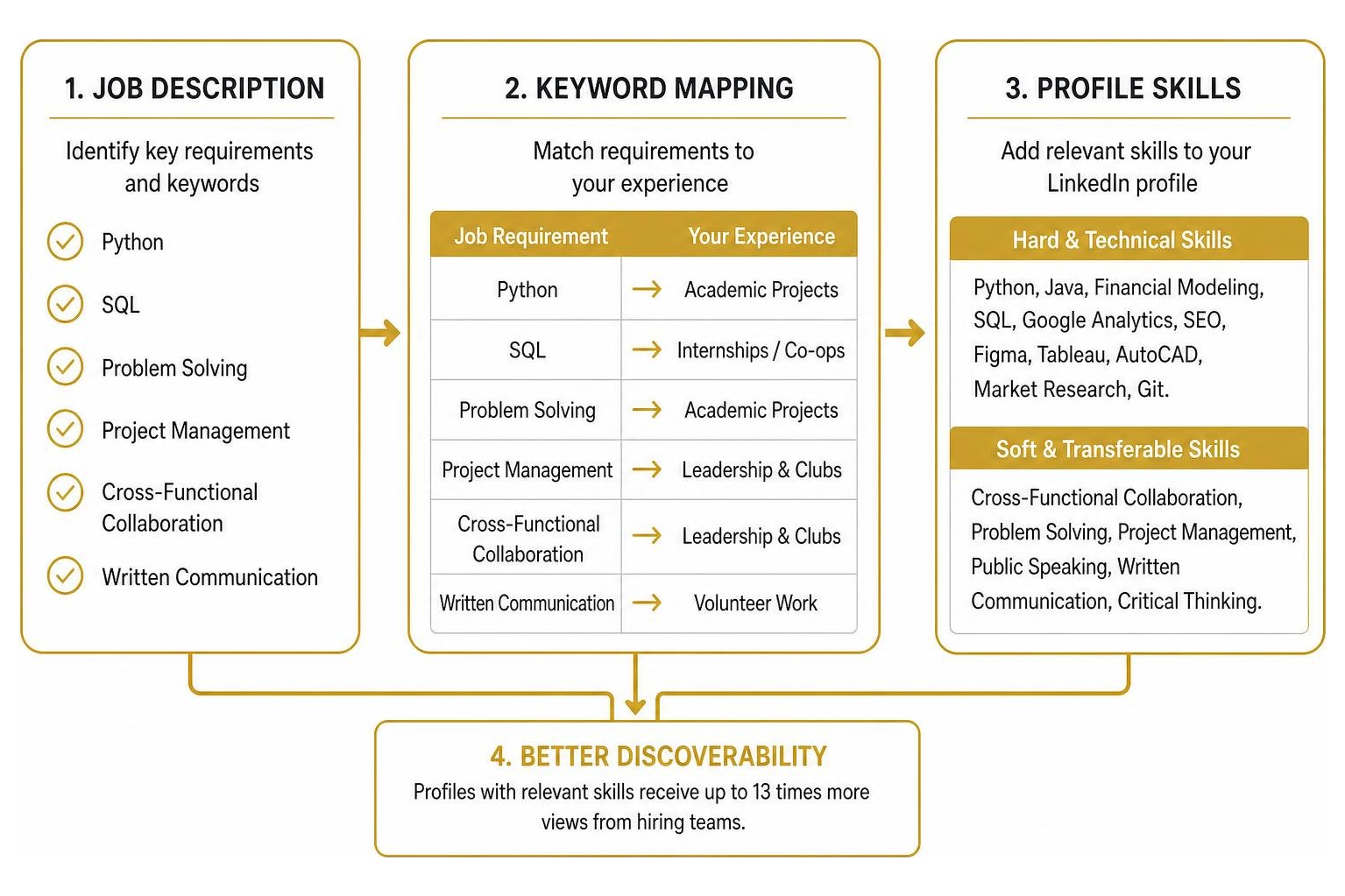
To build a balanced, searchable profile, incorporate a mix of hard technical capabilities and transferable soft skills:
- Hard & Technical Skills: Python, Java, Financial Modeling, SQL, Google Analytics, SEO, Figma, Tableau, AutoCAD, Market Research, Git.
- Soft & Transferable Skills: Cross-Functional Collaboration, Problem Solving, Project Management, Public Speaking, Written Communication, Critical Thinking.
Review our complete LinkedIn profile optimization guide for an in-depth breakdown of how keyword weighting influences profile indexing. Once you have added your skills, request endorsements from classmates, team project partners, and professors to build instant social proof.
Key SEO Strategies to Optimize a LinkedIn Profile for Freshers
Recruiters search LinkedIn using Boolean strings and exact keyword matching (such as “Data Analyst” AND “SQL” AND “Tableau”). In fact, 98% of recruiters use keyword searches as their primary method for identifying candidate pools.
To optimize your search visibility without sounding robotic:
- Analyze Target Job Descriptions: Collect 5–10 entry-level job descriptions that interest you. Highlight recurring tools, software names, and methodology keywords.
- Strategic Keyword Placement: Naturally integrate these target terms across your Headline, About section, Experience bullets, Projects, and Skills list.
- Avoid Keyword Stuffing: Do not dump raw lists of disconnected keywords into your summary. Always weave terms into readable, professional sentences.
Proactive Networking and Job Search Strategies for Entry-Level Talent
Having an optimized profile is essential, but active networking accelerates your results. Referred candidates are four times more likely to get hired than cold applicants, making relationship-building a high-return activity.

1. Reconnect with University Alumni
Alumni from your alma mater are often your most receptive networking partners. Use the LinkedIn University page search tool to filter alumni by company, location, or industry.
Connection Note Template:
“Hi [Name], I noticed you graduated from [University] and are now working as a [Job Title] at [Company]. As a recent [Major] graduate from [University] looking to enter [Industry], I admire your career trajectory. I would love to connect and follow your journey!”
2. Request Informational Interviews
Reach out to professionals working in roles you aspire to hold. Ask for a brief 15-minute conversation to learn about their career path and industry insights rather than immediately asking for a job. For fresh perspectives on landing opportunities, check out these innovative job hunting approaches.
3. Share Your Learning Journey Publicly
Post updates once or twice a week about what you are studying, an interesting project milestone you completed, or an industry article that caught your attention. Sharing your work regularly demonstrates initiative and keeps your profile visible across your network’s feeds.
Pitfalls to Avoid: Common LinkedIn Mistakes for Beginners
Even ambitious candidates often make simple missteps that lower their profile ranking or deter recruiters.
Be sure to avoid these frequent errors:
- Using a Desperate Headline: Avoid phrases like “Unemployed and desperately seeking any role.” Focus on your skills and the value you bring to a prospective team.
- Leaving Sections Incomplete: Skipping your About section, leaving your photo blank, or omitting your education weakens your credibility and drops your profile ranking.
- Copy-Pasting Resume Bullets Verbatim: LinkedIn is an interactive platform. Use engaging, human language alongside clear formatting and white space.
- Overusing Cliché Buzzwords: Terms like “go-getter,” “synergistic,” and “hardworking” take up space without proving competence. Demonstrate your qualities through measurable outcomes instead.
- Forgetting Contact Information: Make sure your primary email address is visible to connections so interested recruiters can reach out directly.
Reviewing these proven ways to boost job search outcomes can help you audit your overall outreach strategy before sending out applications.
Frequently Asked Questions About LinkedIn Profiles for Freshers
How do I list experience on LinkedIn if I have never had a corporate job?
You do not need full-time corporate employment to fill out the Experience and Projects sections. List academic capstone projects, lab research, freelance work, student government leadership, fraternity/sorority executive roles, campus work-study jobs, and volunteer initiatives. Treat each significant project like a job entry by adding a clear title, describing your specific responsibilities, and detailing the outcomes achieved.
How often should freshers update their LinkedIn profile?
Update your profile immediately whenever you finish a new project, earn a certification, complete an internship, or acquire a technical skill. In addition, conduct a quarterly review to refresh your headline, refine your summary, and update your target keywords based on current industry job postings.
Is LinkedIn Premium necessary for college students and freshers?
For the vast majority of freshers, the free tier of LinkedIn offers everything needed to build a polished profile, grow a targeted network, and apply for positions. While LinkedIn Premium provides extra InMail credits and deeper applicant insights, you can achieve excellent job search results on the free plan by building a keyword-optimized profile and sending personalized connection requests.
Conclusion
Your college degree represents years of hard work, discipline, and skill acquisition. However, your degree alone cannot generate career momentum if hiring teams are unable to find you. Transforming your profile into a professional, searchable digital asset bridges the gap between your academic achievements and your first full-time role.
Take the process step by step: upload a clean headshot, craft a keyword-focused headline, write an engaging first-person summary, and highlight your projects with measurable outcomes. By maintaining an active presence and connecting with alumni and industry peers, you will position yourself for long-term career growth.
If you are ready to take your career presentation to the highest level, explore our expert resume and LinkedIn optimization services. At MyExpertCoach, we combine over 25 years of insider recruiting expertise to build customized, high-converting career marketing assets that help you stand out to top employers from day one.