
table of contents
Can You Negotiate Salary for a City Job?
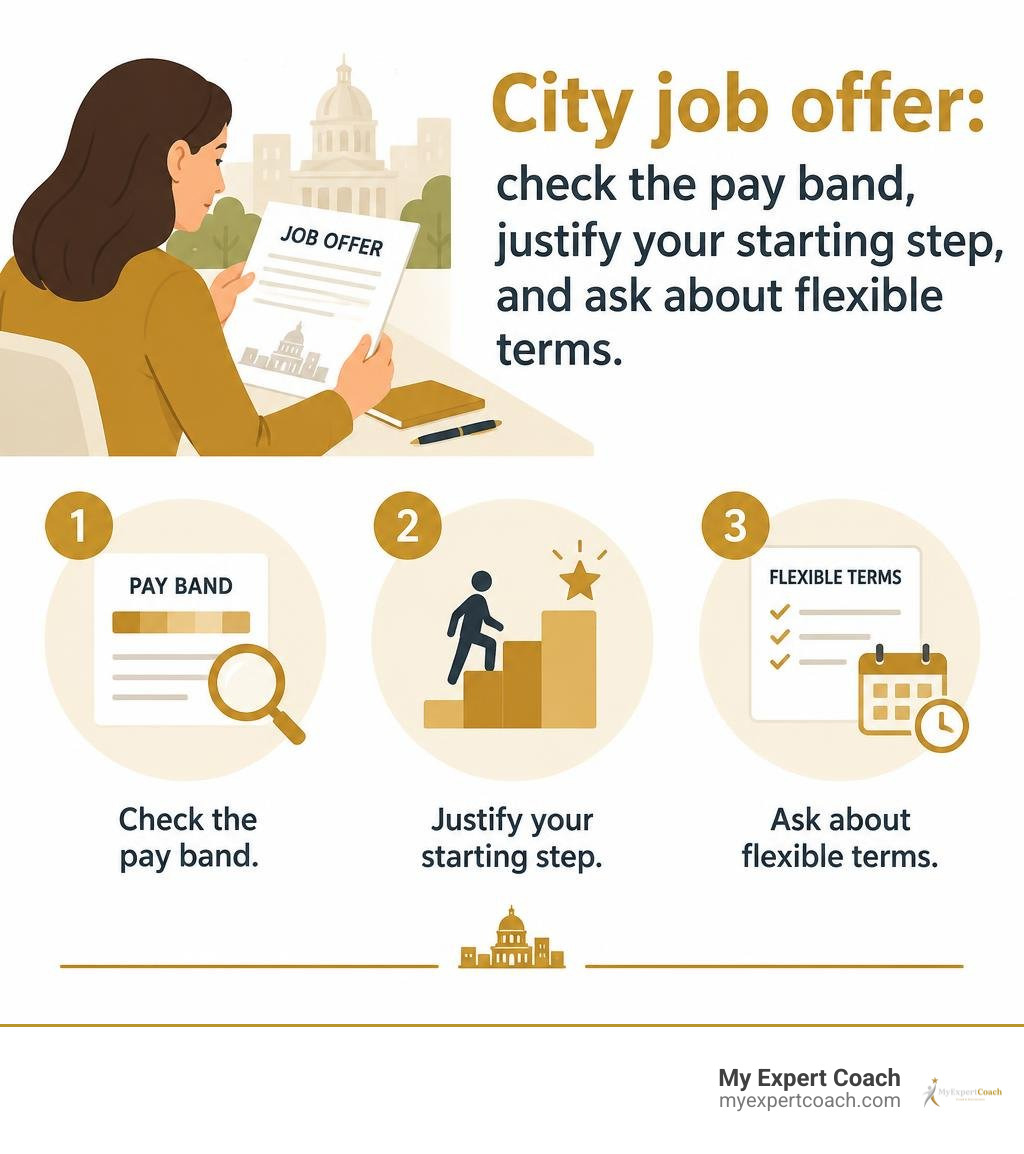
Yes, you can ask to negotiate a city job offer, but the city may have less room to move than a private employer. Before you counter, check the posted pay range and ask HR how starting pay is set. If the role has salary steps, use your relevant experience and skills to request a higher starting step. If pay is fixed by a union agreement or city policy, ask which other offer terms are flexible.
I’m Sandy Spencer, a career coach with 38 years of experience in HR and executive recruiting, and I help leaders answer the question, “can you negotiate salary for a city job?” I’ve helped advance more than 10,000 careers; here, I’ll show you how to make a strong case while respecting city pay rules.
Many professionals assume public sector compensation is completely set in stone. A pervasive myth suggests that accepting a municipal position means quietly accepting whatever entry-level figure Human Resources types into your offer letter. While municipal budgets operate under statutory constraints, civil service pay bands and salary step structures often contain built-in room for adjustment if you know how to build a defensible case.
According to labor research, 58% of workers have never negotiated their starting pay. Yet workers who negotiate their starting salary earn an average of $5,000 more per year than those who simply take the initial offer. Over a full career, missing that initial conversation can compound into more than $600,000 in lost earnings. When evaluating public employment, learning how to present your case within formal parameters is essential.
Understanding Public Sector Pay Scales: Can You Negotiate Salary for a City Job?
To navigate municipal hiring, you must understand how local governments structure compensation. Unlike private corporations that may rely on discretionary merit pools or informal manager sign-offs, city agencies operate within structured civil service classifications, salary schedules, and step progression systems.
When you receive an offer, the agency assigns the position a specific pay grade. Within that grade sits an established salary schedule consisting of numbered increments called “steps.” Standard city hiring guidelines often default to offering Step 1 to new personnel. However, administrative rules typically allow appointing authorities to hire above the minimum step when a candidate demonstrates superior qualifications or when market conditions warrant an adjustment.
To execute effective salary negotiation strategies, you must recognize the differences between public and private pay design:
| Compensation Feature | Civil Service Step System | Private Sector Merit Range |
|---|---|---|
| Salary Structure | Fixed grades with defined step intervals (typically 2.5% to 5% increments) | Broad minimum-to-maximum ranges with variable placement |
| Pay Progression | Time-in-grade milestones, step advancements, and cost-of-living adjustments | Discretionary annual merit increases, individual bonuses, and equity |
| Salary Visibility | Public records, municipal transparency portals, and published city council schedules | Often confidential or shared as broad target bands on job postings |
| Negotiation Flexibility | Focused on starting step placement, creditable service, and select benefits | Wide flexibility across base pay, signing bonuses, equity, and variable incentives |
| Approval Protocol | Formal HR justification, civil service commission rules, or department head review | Hiring manager and corporate compensation team discretion |
As outlined in the Wage Atlas guide on government wage benchmarks, public wage data provides complete visibility into pay curves. By reviewing these public schedules, you can determine where your background fits within the established step framework.
Pay Bands, Salary Grades, and Step Increments
City government pay structures frequently mirror the federal General Schedule (GS) framework. A municipal job title maps to a specific pay grade, and that grade is divided into successive steps. Each step usually represents an increase of roughly 3% to 5% over the previous step.
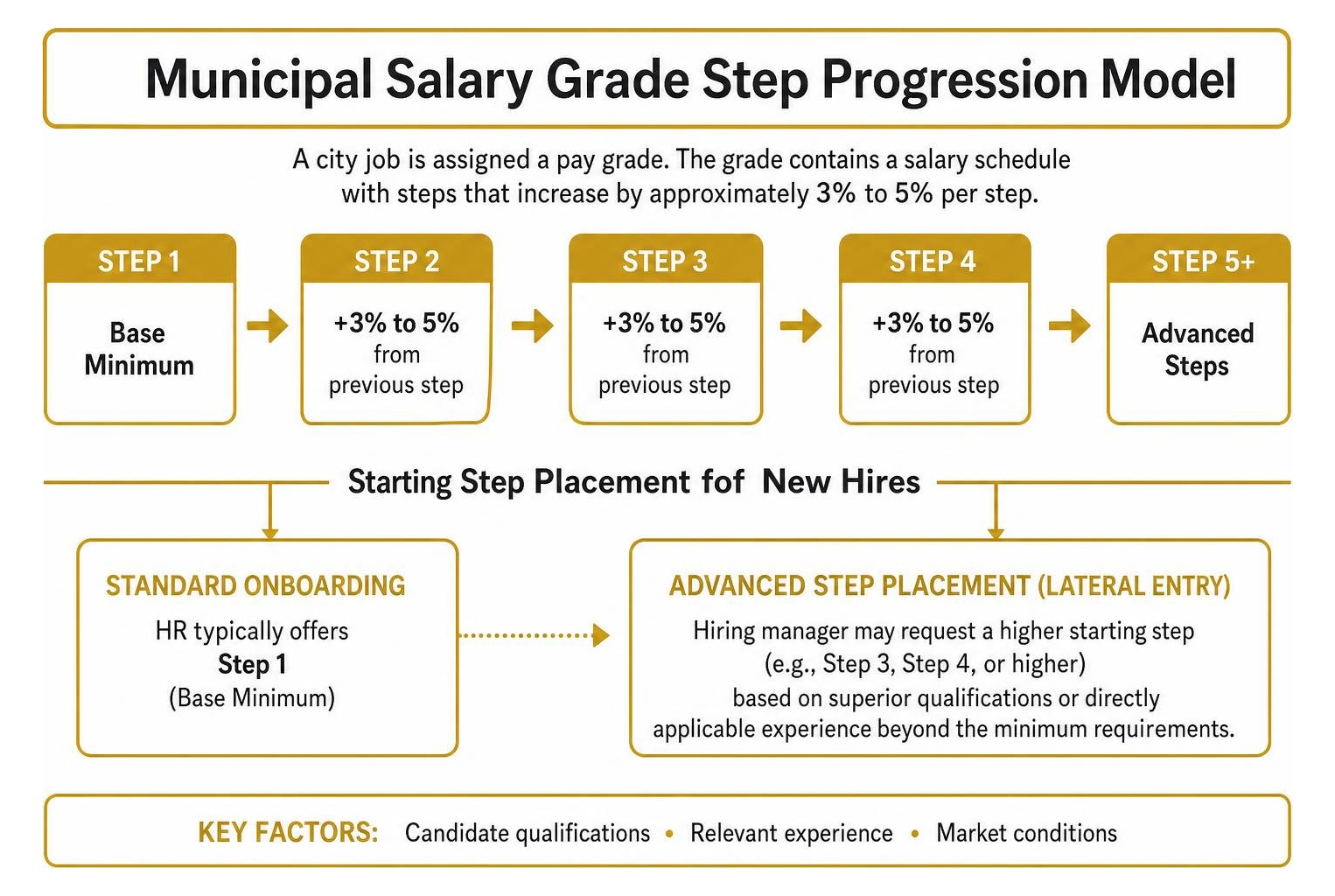
Standard onboarding policies usually direct human resources to offer Step 1. However, civil service rules routinely include provisions for “lateral entry” or “advanced step placement.” These provisions allow hiring managers to request Step 3, Step 4, or higher if the candidate’s years of directly applicable experience exceed the minimum qualifications required for the grade.
Factors Determining When You Can Negotiate Salary for a City Job
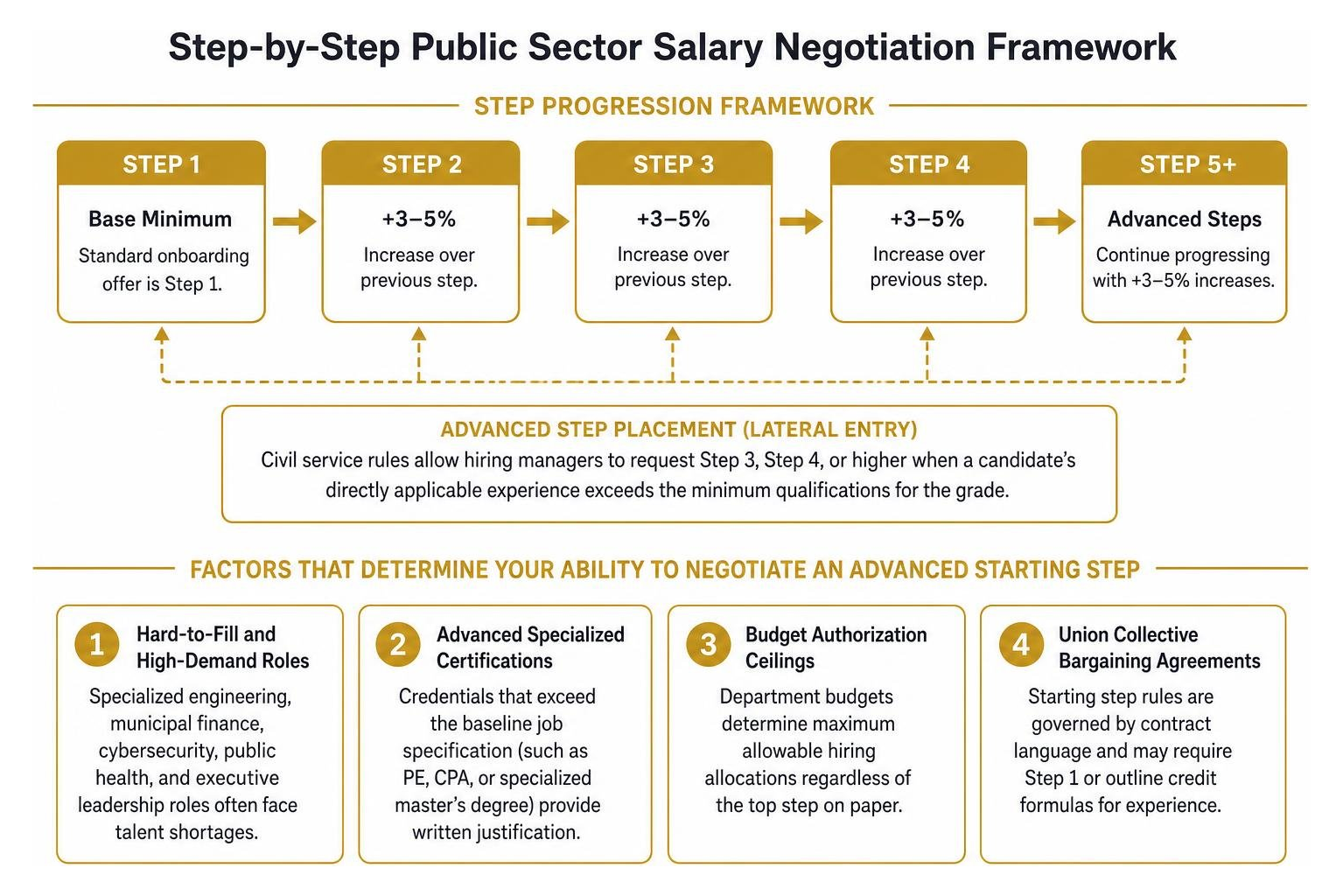
Your ability to secure an advanced starting step depends on several distinct factors:
- Hard-to-Fill and High-Demand Roles: Specialized engineering, municipal finance, cybersecurity, public health, and executive leadership roles often face talent shortages, giving agencies greater incentive to approve higher steps.
- Advanced Specialized Certifications: Possessing credentials that exceed the baseline job specification (such as a Professional Engineer license, CPA, or specialized master’s degree) provides HR with the written justification required by civil service bylaws.
- Budget Authorization Ceilings: Department budgets determine maximum allowable hiring allocations regardless of the top step on paper.
- Union Collective Bargaining Agreements (CBAs): If a union represents the bargaining unit, starting step rules are governed by contract language. Some collective bargaining agreements mandate entry at Step 1, while others explicitly outline credit formulas for external experience.
Step-by-Step Strategy to Negotiate Municipal Compensation
Negotiating a municipal salary requires a structured, evidence-based approach. Public sector human resources specialists cannot adjust compensation based on subjective requests or personal living expenses; they must justify every dollar to city auditors, civil service boards, and elected officials.

Before countering, take time to calculate your market value and determine how much you should ask for in a new job offer. Using resources like the AffordMap city salary comparison data, you can cross-reference municipal pay against regional cost-of-living metrics and official Bureau of Labor Statistics (BLS) percentiles.
Step 1: Research Official Pay Tables and Transparency Data
Municipal transparency laws make salary data accessible. Before initiating any conversation, review:
- City Council Salary Resolutions: Municipalities publish their complete civil service pay matrices, showing every grade and step.
- Public Employee Payroll Databases: Review current salaries for peers in identical or comparable municipal job titles.
- Regional Locality Differentials: Evaluate local cost-of-living adjustments and regional municipal pay bands for surrounding counties or sister agencies.
Pull the 50th, 75th, and 90th BLS percentiles for your occupation within your metropolitan area. This data provides an objective foundation for your conversation with HR.
Step 2: Establish Your Target Grade and Step Placement
Avoid providing arbitrary figures or unsupported requests. Instead, identify the specific step within the published pay grade that matches your background.
A realistic target for professional candidates entering civil service with significant outside experience is Step 3 through Step 5—frequently representing an adjustment of 6% to 15% above the baseline offer. Establish three clear numbers:
- Anchor Number: The specific step you will formally request (backed by documented qualifications).
- Target Number: The step you realistically aim to secure.
- Walk-Away Baseline: The minimum compensation package required for you to accept the role.
Step 3: Presenting Why You Can Negotiate Salary for a City Job Above the Starting Step
When speaking with the hiring authority, frame your request around municipal value, mission readiness, and quantifiable achievements.
Present your rationale clearly:
“I am excited about the opportunity to join the department as Senior Project Manager. Based on the position’s requirements, my eight years of direct infrastructure oversight, and my active PMP and PE credentials—which exceed the baseline requirements—I would like to request starting placement at Grade 18, Step 4 ($92,400). This reflects my lateral private-sector experience and enables me to lead active capital improvement initiatives without an extended onboarding curve.”
After delivering your request, practice strategic silence. Allow the hiring manager or HR representative time to process your points and explain the formal approval process.
Step 4: Structuring a Professional Public Sector Counteroffer
Public sector hiring managers often want to support your request, but they require documentation to present to HR directors or compensation boards. Provide a concise, professional letter or memo summarizing your case.
This document should outline:
- Your enthusiasm for the agency’s public mission.
- A side-by-side comparison of the job’s minimum requirements versus your advanced qualifications.
- The exact grade and step requested.
- A clear commitment that you will accept if the agency meets the requested step.
Understanding proper tactics for negotiating after offer receipt ensures you protect your professional standing throughout the approval process.
Negotiating Beyond Base Pay: High-Value Municipal Benefits
If a city agency cannot adjust base salary due to rigid collective bargaining rules or budget constraints, evaluate the entire compensation package. Public sector employment includes substantial non-salary benefits that can outweigh private sector alternatives.
As noted in Jordan Gerth’s analysis of public sector step increases, municipal and government systems offer unique levers around service credit, leave tiers, and schedule structures. Furthermore, the American Chemical Society compensation guide emphasizes that benefits packages can comprise 30% to 40% of your total compensation value.
Alternative Work Schedules and Telework
Workplace flexibility is often discretionary at the department level. High-value schedule adjustments include:
- Compressed Work Schedules: Standard municipal schedules often include “9/80” arrangements (working 80 hours over nine days with every other Friday off) or “4/10” structures.
- Hybrid Telework Agreements: Securing two designated remote days per week can eliminate commuting expenses and save thousands of dollars annually in fuel, transit, and vehicle maintenance.
- Flexible Core Hours: Adjusting your start and end times to bypass peak traffic hours.
Recruitment Incentives, Relocation, and Leave Accrual
Depending on municipal charter provisions and administrative rules, you can often negotiate several non-salary items:
- Accelerated Annual Leave Accrual: In many public systems, new hires start at the lowest vacation accrual tier (e.g., two weeks per year). You can request that HR grant “creditable service” for your prior private-sector years, immediately advancing you to the three- or four-week annual leave tier.
- Relocation Assistance and Signing Incentives: For critical or hard-to-fill technical and leadership positions, agencies may offer one-time relocation stipends or recruitment incentives ranging from $3,000 to $10,000.
- Tuition Assistance and Professional Development: Requesting dedicated funding for annual conferences, professional certifications, or continuing education credits that the department covers directly.
Handling Rigid Municipal Constraints and Transparency Laws
Modern salary transparency regulations have changed the negotiation landscape across municipal and private sectors alike.

Under laws such as New York City’s salary transparency statutes, employers with four or more workers must state good-faith salary ranges on public job postings. Combined with statutory protections detailed in the NYC Human Rights salary history ban overview, municipal employers cannot ask about your prior earnings. This ensures starting compensation is based solely on candidate qualifications and role requirements rather than past wage history.
For broader strategies on leveraging these mandates, consult the NYC salary transparency negotiation guide.
How to Pivot When Base Pay Is Non-Negotiable
When an agency representative states that starting base pay is completely non-negotiable due to civil service rules or strict union step placement, pivot constructively.
- Request an Accelerated Six-Month Performance Review: Ask in writing if you can be evaluated for an early step increase at six months rather than waiting for the standard twelve-month annual review.
- Inquire About Transit Subsidies and Parking: Many cities offer pre-tax commuter benefits, municipal transit passes, or subsidized parking access that reduce daily out-of-pocket costs.
- Compensatory Time Off (Comp Time): Clarify how overtime or excess hours are logged, ensuring you receive compensatory time off for hours worked beyond the standard schedule.
These approaches allow you to secure better terms without entering counteroffer conflicts.
The Impact of Salary Transparency and Salary History Bans
Salary history bans and pay transparency laws give candidates significant leverage:
- Anchoring within the Top Half of the Range: Because the full pay band is disclosed upfront, you can target the upper tiers of the posted scale using objective market data.
- Eliminating Past Pay Disparities: If you were previously undercompensated in the private sector or non-profit space, city agencies cannot use that baseline to limit your starting step.
- Predictable Earning Trajectories: Public step schedules allow you to calculate your exact compensation growth over a 5-to-10-year period, factoring in step increments and cost-of-living adjustments.
Frequently Asked Questions About City Job Negotiations
How much above a city job offer is realistic to counter?
For municipal positions with published step scales, requesting an adjustment of one to two steps (typically 6% to 10% above the initial offer) is standard practice. If you bring extraordinary qualifications, advanced credentials, or deep private-sector leadership that directly fulfills department priorities, requesting a placement in the top third of the salary grade (Step 4 to Step 6) is reasonable, provided you supply supporting documentation.
Can a municipal agency rescind an offer if you try to negotiate?
A professional, data-backed request for an advanced starting step will not cause an agency to rescind an offer. Civil service hiring involves significant recruitment time and background verification; agencies invest substantial resources into selecting their top candidate. As long as you maintain a collaborative tone, avoid ultimatums, and anchor your request in published civil service criteria, HR will simply evaluate the request and either approve an adjusted step or confirm that Step 1 remains the maximum allowable entry rate.
Does prior private sector experience count toward municipal pay steps?
Yes. Most civil service classification systems include “superior qualifications” or “creditable service” provisions. These rules allow hiring managers to credit relevant outside private-sector or non-profit experience toward your initial step placement. To take advantage of this, ensure your resume clearly highlights your years of direct experience and maps your past duties directly to the city job description.
Conclusion
Securing a city position offers long-term career stability, comprehensive benefits, and meaningful public service. While municipal compensation follows structured civil service guidelines, you do not have to settle for the entry-level minimum if your background warrants higher placement.
By understanding pay grades, identifying the appropriate step, leveraging non-salary benefits, and presenting clear documentation, you can confidently secure a fair offer. If you are preparing for public sector leadership interviews or want to refine your professional positioning, our team at MyExpertCoach is here to assist. Explore our executive career coaching and resume optimization services to elevate your career and maximize your earning potential.