
table of contents
How to Ask for a Raise With Another Offer Without Making It an Ultimatum
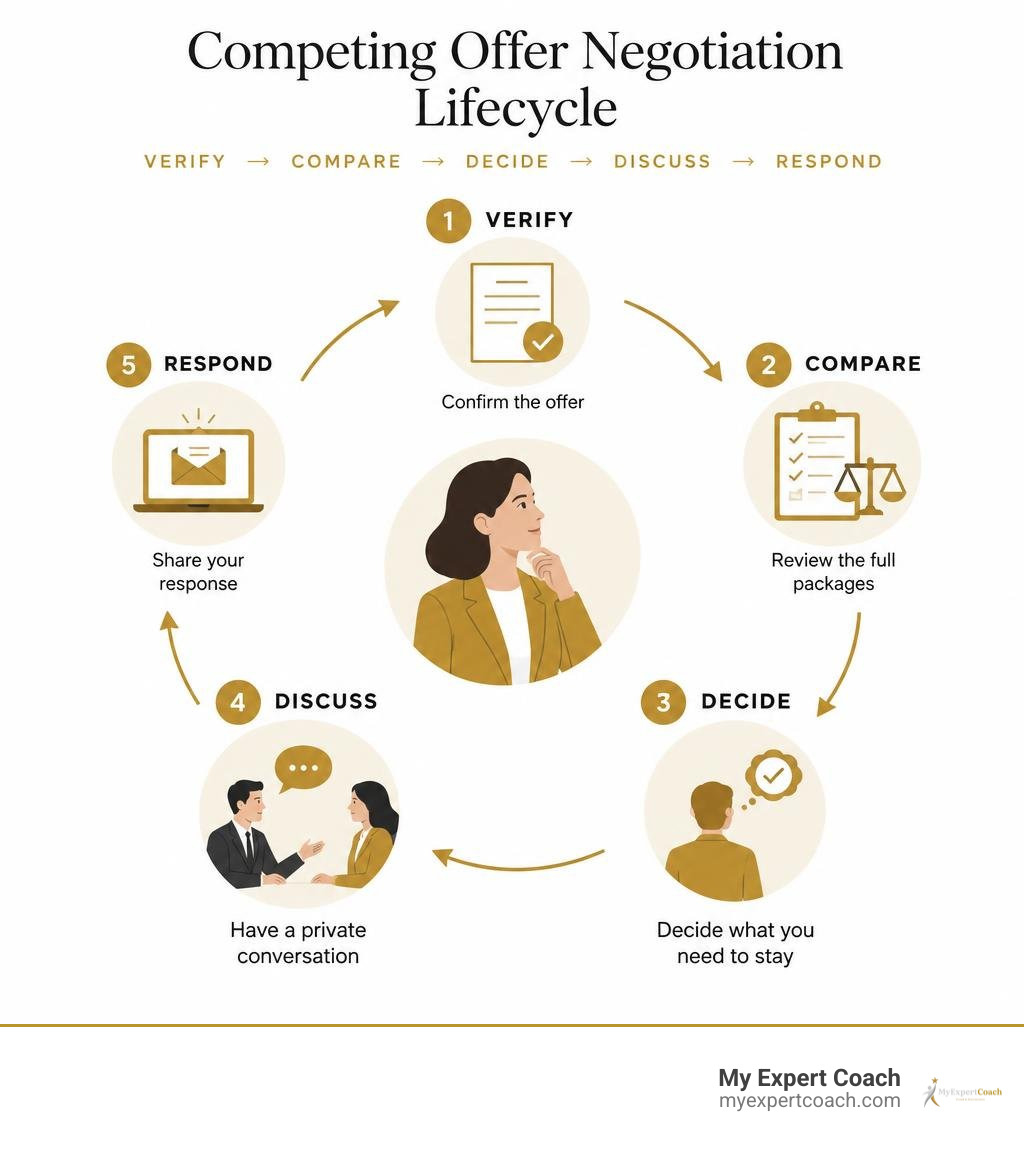
You can ask for a raise with another offer by treating it as a conversation about your value, not a threat to leave. First, confirm the offer and compare the full packages. Decide what you need to stay. Then meet privately with your manager, share your recent contributions, explain that you would like to stay, and ask whether the company can improve your pay or role. Give your manager time to check what is possible.
Only raise the offer if you would seriously consider taking it. A higher salary may not fix limited growth or a role you no longer want.
I’m Sandy Spencer, a career coach with 38 years of experience in HR and executive recruiting. That perspective helps me guide senior leaders who want to ask for a raise with another offer while protecting their career options.
Weighing the Risks and Rewards of Competing Offer Leverage
Using an outside offer to negotiate compensation is one of the highest-stakes moves in executive career management. When executed with precision, it establishes a clear market valuation for your skills and accelerates your earnings. Research shows that more than half of job seekers accept their initial offers without negotiating, yet candidates who counter initial offers capture an average compensation increase of 12.45%—roughly $27,000 annually.
However, presenting an external offer to your current employer introduces complex organizational dynamics. Your leadership team may suddenly perceive you as a flight risk. Once a manager believes you have one foot out the door, psychological trust can erode, potentially affecting future project assignments, leadership succession planning, and discretionary bonuses.
Before initiating this discussion, consider the trade-offs between staying under a matched counteroffer and transitioning to the new organization:
| Factor | Staying with a Matched Counteroffer | Accepting the New External Role |
|---|---|---|
| Immediate Compensation | Matches or nears market rates without onboarding friction. | Secures immediate market-rate base, bonus, and equity upside. |
| Internal Trust & Optics | Risk of being labeled a flight risk if handled confrontationally. | Clean slate with an organization actively investing in your arrival. |
| Underlying Issues | Workload, culture, and management friction remain unchanged. | Opportunity for fresh leadership, new scope, and strategic alignment. |
| Career Trajectory | May reset expectations or delay the next promotion cycle. | Immediate title elevation and expanded cross-functional visibility. |
| Long-Term Retention | High statistical probability of departing within 12 to 18 months. | Multi-year vesting schedules and renewed professional momentum. |
Assessing Genuine Intent vs. The Bluffing Risk
The cardinal rule of competing offer negotiations is simple: never bluff. Fabricating an offer or exaggerating a verbal conversation to extract a raise is a catastrophic error. Seasoned HR leaders and executive recruiters easily spot vague, unverifiable claims. If your manager calls your bluff and encourages you to take the external opportunity, you risk severe reputational damage and the loss of your current role.
You must hold a verifiable, written offer in hand with confirmed terms—including base pay, performance incentives, equity grants, and start dates—before initiating a salary review. Furthermore, you must possess the genuine emotional and logistical readiness to walk away. If you want to secure better pay without falling into the dangerous counteroffer trap, ensure your decision to stay is based on long-term career growth rather than short-term comfort.
When to Ask for a Raise with Another Offer vs. Walk Away
A higher paycheck cannot rehabilitate a fundamentally broken work environment. Before bringing an external offer to your executive leadership, conduct an honest diagnostic of why you explored outside opportunities in the first place:
- Organizational Culture: If you are dealing with toxic management, institutional instability, or misaligned core values, extra cash will not provide long-term career satisfaction.
- Growth Plateaus: If your current organization lacks upward mobility or has frozen advancement tracks, matching your external offer merely delays an inevitable departure.
- Budget Constraints: If your employer is undergoing structural restructuring or revenue contraction, an off-cycle raise may paint a target on your back during future overhead reductions.
If your primary dissatisfaction stems solely from market compensation disparity while your team dynamics, strategic alignment, and daily work remain fulfilling, initiating a collaborative counteroffer discussion makes strategic sense.
How to Prepare Your Leverage Strategy Before Talking to Your Boss
Approaching executive leadership requires substantial preparation. You are presenting a strategic business case for market-rate talent retention, not an emotional plea for a raise.

Begin by aligning all relevant timelines. Review your competing offer letter to determine your formal response window, ensuring you give your current employer at least three to five business days to navigate internal compensation bands and HR approval chains. For deeper academic context on these dynamics, the Program on Negotiation at Harvard Law School explores strategic framing principles for salary requests.
Benchmarking Your Market Value and Total Package
Do not assess your value based on base salary alone. Modern executive compensation relies heavily on total rewards structures. When evaluating external offers against your current package, evaluate:
- Annual performance-based short-term incentives (cash bonuses)
- Long-term incentive plans, such as stock options or Restricted Stock Units (RSUs)
- Retirement contribution matching, executive health stipends, and deferred compensation plans
- Work-model flexibility, commuting expectations, and paid leave allowances
Understanding these total compensation benchmarks helps you establish your baseline walk-away number. If you are also evaluating outside opportunities in different sectors, learning how much to ask for in salary at a new role ensures your expectations reflect current industry baselines.
Building a Business-Case Value Inventory
To justify an off-cycle salary adjustment, assemble an executive value inventory that demonstrates undeniable return on investment. Document your recent wins across five core pillars:
- Revenue Acceleration: Concrete metrics on enterprise deals closed, client portfolios expanded, or new market channels established.
- Operational Efficiency: Quantifiable cost savings, vendor contract renegotiations, or workflow optimizations that improved margin performance.
- Strategic Milestones: Successful cross-functional initiatives, product launches, or system implementations delivered on time and under budget.
- Talent Leadership: Retention rates of key direct reports, internal promotions fostered, and team culture improvements.
- Specialized Expertise: Rare technical, regulatory, or operational capabilities that would be costly and time-consuming to replace in the open market.
Step-by-Step Guide: How to Ask for a Raise with Another Offer
Executing the negotiation meeting requires emotional intelligence, collaborative language, and executive poise. You want your manager to feel like an ally working alongside you to solve a talent-retention challenge, rather than an adversary backing into a corner. Mastering comprehensive salary negotiation strategies starts with intentional scheduling and message framing.
Framing the Conversation Around Loyalty and Impact
When meeting with your manager, frame the external interest as an unsolicited approach rather than an aggressive job hunt. This protects internal trust by demonstrating that you were not actively looking to abandon the organization, but felt obligated to evaluate an exceptional inbound opportunity.
Emphasize your strong preference to remain with your current team. Highlight your dedication to ongoing initiatives and express a sincere desire to find a mutually beneficial solution that aligns your current compensation with prevailing market rates.
Exact Scripts for the Negotiation Meeting
Use the following phrasing templates to guide your conversation naturally:
Opening the Discussion:
“Thank you for meeting with me today. I wanted to discuss my ongoing role and long-term future here. I am deeply committed to our team’s strategic goals, particularly our upcoming enterprise rollout. Recently, an executive recruiter approached me with an unsolicited opportunity that has progressed to a formal written offer. The scope aligns with my background, but the total compensation package is substantially above my current tier. Because my genuine preference is to build my career here, I wanted to bring this to you transparently to see if we can find a way to align my compensation with my current market value.”
Addressing the Numbers Specifically:
“The external package sits at an annual base of $185,000 with a 20% performance bonus and equity grant, representing a roughly 18% lift over my current structure. Given the impact we’ve achieved across our product division over the past year—including the $1.4M operational savings we realized—I would love to stay if we can bridge this gap. What flexibility do we have on our side to adjust my compensation?”
Navigating Key Conversational Pivots:
- When asked for a copy of the offer letter: “I am happy to discuss the exact compensation structure, scope, and numbers openly, though I need to keep the proprietary company details of the other firm confidential.”
- When leadership needs time to consult HR: “I completely understand that this requires internal review and budget coordination. The other organization has requested a final decision by Thursday at 5:00 PM. Let’s touch base Wednesday afternoon so we can review what is possible.”
- When base salary cannot move due to rigid pay bands: “If our current band restricts base salary movement, I would be very open to exploring adjustments to my incentive bonus, equity grant, or an accelerated review cycle to bridge the difference.”
Negotiating Beyond Base Salary and Navigating Counteroffer Responses
Internal pay equity constraints and pre-set departmental bands can sometimes limit a manager’s ability to match base salary figures dollar for dollar. When navigating counteroffers, expand your focus to encompass total rewards and professional flexibility.

Understanding how to structure these holistic terms prevents friction, especially when handling negotiations after offer acceptance or balancing competing executive opportunities across multiple organizations.
Expanding Beyond Cash: Equity, Bonuses, and Flexibility
If your organization faces short-term base salary constraints, consider negotiating high-value alternative levers:
- One-Time Retention or Signing Bonuses: Departmental budgets often permit one-off discretionary cash payments even when annual recurring payroll is capped.
- Equity and Long-Term Incentives: Request an accelerated vesting schedule, additional stock option grants, or performance-contingent RSUs.
- Title and Scope Elevation: Pair an incremental compensation adjustment with a formal promotion to Director, Vice President, or Senior Executive level, positioning you for higher compensation bands in the next annual cycle.
- Contractual Review Timelines: Establish a binding written agreement to revisit base compensation in six months based on concrete, agreed-upon operational milestones.
- Lifestyle and Flexibility Terms: Secure guaranteed hybrid or remote work arrangements, executive development allowances, or additional paid time off.
What to Do If Your Employer Declines to Match
If your employer values your contributions but cannot adjust your package due to budget constraints or policy caps, handle the outcome with complete professionalism:
- Express Sincere Gratitude: Thank your manager for their transparency, mentorship, and advocacy throughout your tenure.
- Execute a Graceful Departure: Provide standard executive notice (typically two to four weeks depending on seniority) and offer to build a comprehensive transition document.
- Preserve Professional Relationships: Keep your network intact. Colleague and leadership endorsements remain invaluable assets throughout your broader career trajectory.
- Formalize Acceptance with the New Employer: Sign and deliver your written acceptance to the outside firm, confirming your start date and onboarding prerequisites.
Common Mistakes When You Ask for a Raise with Another Offer
Avoid these frequent strategic pitfalls that can derail an otherwise sound negotiation:
- Issuing Ultimatums: Demanding an immediate match under threat of walking out burns bridges and triggers defensive managerial reactions.
- Overplaying Your Leverage: Belittling your current team’s compensation practices or bragging about external interest breeds internal resentment.
- Using Ambiguous Numbers: Citing vague ranges rather than precise data points undermines your credibility.
- Neglecting Cultural Context: Public sector organizations, highly regulated utilities, and early-stage non-profits operate under rigid compensation structures that may not accommodate rapid off-cycle counteroffers.
- Prolonging the Process: Dragging out your decision past agreed deadlines frustrates both employers and risks having the external offer rescinded.
Frequently Asked Questions About Competing Offer Negotiations
Can my current employer fire me or rescind my role if I ask for a match?
In at-will employment environments, employers legally maintain broad discretion over termination. However, retaliatory terminations following a polite, collaborative compensation inquiry are exceedingly rare. According to research from organizational behavior specialists, managers rescind opportunities or terminate discussions far less frequently than professionals fear. As long as you maintain a respectful, loyalty-focused tone and avoid disruptive ultimatums, your current role remains secure while discussions proceed.
How much higher should I counter when I have another job offer?
A standard counteroffer of 10% to 20% above your current base is generally considered reasonable when backed by verifiable market data or an outside written offer. When anchoring your request, select a single, precise figure grounded in your value inventory rather than a broad, ambiguous range. If the external offer represents an extreme compensation jump (such as 40% to 50%), understand that internal equity bands rarely accommodate such massive single-cycle leaps without an accompanying promotion or substantial expansion of executive scope.
Is it better to discuss a competing offer over email or in person?
Always initiate the core conversation verbally—either in person or over a secure video conference. Verbal communication allows you to convey nuance, warmth, and genuine commitment while gauging your manager’s real-time emotional and operational reactions. Once you conclude the verbal discussion, follow up immediately with a concise, professional email summarizing the key figures, context, and agreed timeline. This establishes a clean paper trail for HR while keeping the interpersonal dynamic positive and collaborative.
Conclusion
Leveraging an outside job offer to secure a raise is a powerful career catalyst when approached with strategy, data, and emotional poise. By framing your conversation around long-term impact rather than confrontation, you protect workplace relationships while ensuring your compensation reflects true market value.
If you are navigating an executive transition, weighing a complex counteroffer, or preparing for high-stakes compensation reviews, partner with our team at MyExpertCoach for executive career and resume services. With more than 25 years of insider HR and executive recruiting expertise, we provide the personalized strategy and negotiation frameworks you need to advance your career with confidence.