
table of contents
How to Negotiate Your Amazon Salary Offer
Start with the full offer, not just the salary. Ask your recruiter for a written breakdown of base pay, Year 1 and Year 2 sign-on bonuses, and restricted stock units (RSUs). Compare what you would actually receive in each of the first four years. Then make a specific counteroffer: ask for more sign-on cash if the early years fall short, more RSUs for long-term value, or a level review if the role’s scope supports it.
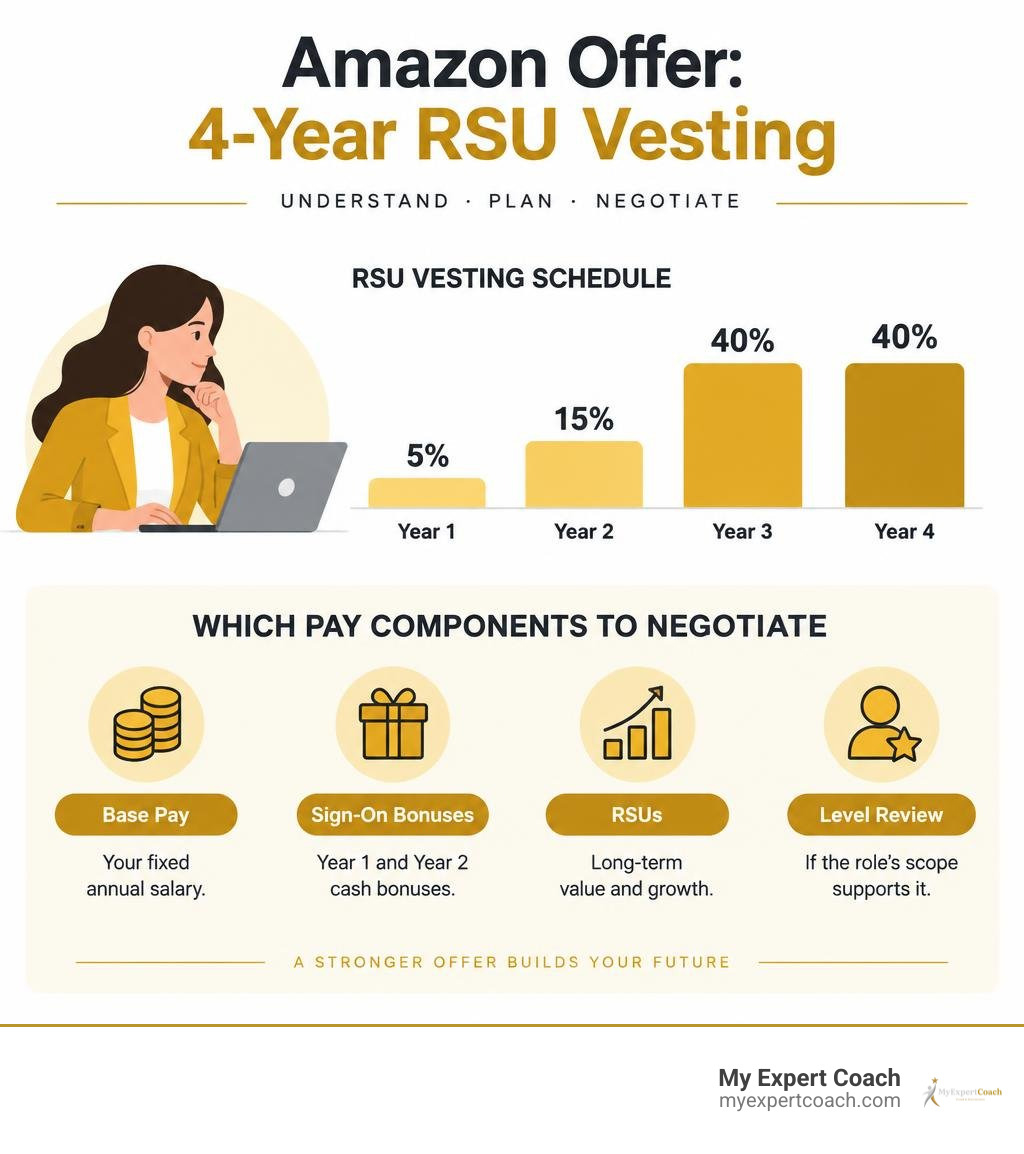
That year-by-year view matters because a typical Amazon RSU grant vests 5% in Year 1, 15% in Year 2, and 40% in each of Years 3 and 4. Sign-on bonuses help fill the gap early on, but they end. An offer that looks strong today may look different in Year 3.
I’m Sandy Spencer, and my approach to Amazon salary negotiation draws on more than 38 years in HR and executive recruiting. I’ll walk you through how to assess the offer, choose your strongest ask, and respond to recruiter pushback.
Deconstructing the Amazon Compensation Structure
When approaching an Amazon salary negotiation, you must understand that their compensation architecture is fundamentally different from nearly every other major technology employer. While peers like Google and Meta historically offer balanced or front-loaded equity alongside annual performance bonuses, Amazon structures compensation around a rigid four-year framework.
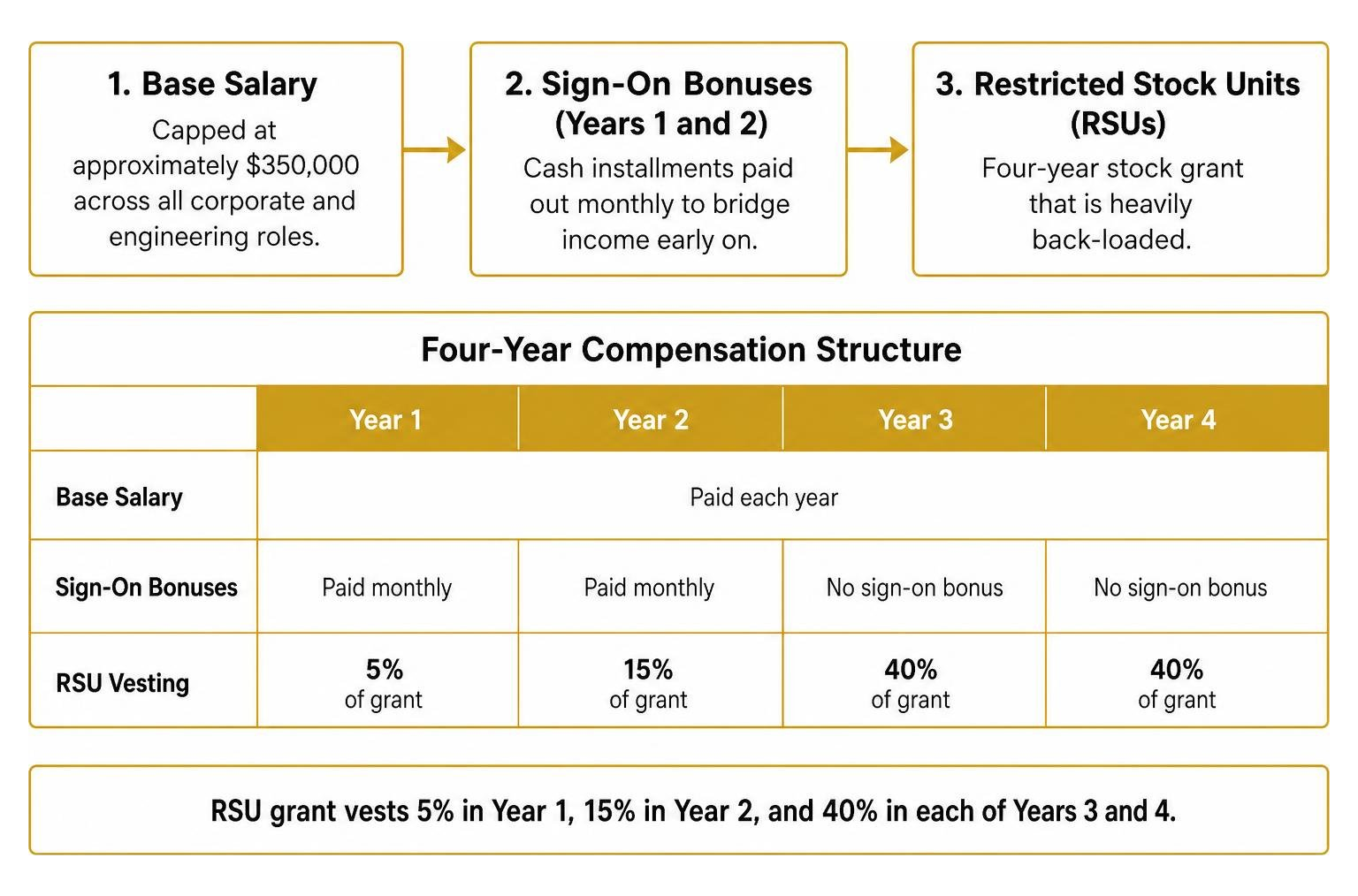
The entire mechanism is designed around three distinct pillars:
- Base Salary: Capped at approximately $350,000 across all corporate and engineering roles.
- Sign-On Bonuses (Years 1 and 2): Cash installments paid out monthly to bridge your income during the initial low-equity vesting window.
- Restricted Stock Units (RSUs): A four-year stock grant that is heavily back-loaded.
Amazon does not provide targeted annual performance bonuses. Your total compensation (TC) is strictly calculated from these three elements. When navigating the Amazon interview process: From phone screens to interview loops, candidates often assume they can push their base salary straight to the ceiling. In reality, base salary is strictly banded by location and level, with the cash cap dictating where your real negotiation leverage lives.
| Compensation Component | Amazon Structure | Traditional Big Tech Structure |
|---|---|---|
| Base Salary | Hard cap at $350K (band-dependent) | Market-driven, flexible bands |
| Equity Vesting (4 Years) | 5% / 15% / 40% / 40% (Back-loaded) | 25% / 25% / 25% / 25% (Equal or front-loaded) |
| Sign-On Structure | Split across Year 1 and Year 2 (Monthly payout) | Single lump sum at hire |
| Annual Target Bonus | None (Performance factored into stock refreshers) | 10% to 25%+ annual cash target |
The 5/15/40/40 Equity Vesting Mechanism
The core engine of Amazon’s equity model is the 5/15/40/40 vesting curve. When you receive an initial offer, your total stock allocation vests across four years in this specific distribution:
- Year 1: 5% of your total RSU grant
- Year 2: 15% of your total RSU grant
- Year 3: 40% of your total RSU grant
- Year 4: 40% of your total RSU grant
For example, on a $400,000 total RSU grant, you realize only $20,000 in equity during Year 1 and $60,000 in Year 2. The remaining $320,000 is locked until Years 3 and 4.
This model functions as built-in retention architecture. Amazon internally evaluates offers assuming a baseline stock appreciation rate (historically modeled around 15% annually). If the stock trades flat, you face an equity shortfall in later years unless you secure stock refreshers or maximize your initial grant up front.
Sign-On Bonuses: Bridging the Early Years
Because equity payout is minimal during the first 24 months, Amazon deploys Year 1 and Year 2 sign-on bonuses as a cash bridge.
Rather than delivering your sign-on bonus as a single lump sum on your start date, Amazon distributes both Year 1 and Year 2 bonuses in monthly installments alongside your base pay. This keeps your cash flow steady while your stock vests.
However, these bonuses feature clawback clauses if you depart before completing the designated year. More importantly, when Year 2 ends, that cash bridge evaporates completely. In Year 3, your take-home pay relies entirely on base salary and that 40% stock cliff.
Leveling Architecture from L4 to L7
Your level directly determines your compensation ceiling. Amazon operates on a strict leveling scale:
- L4: Entry-level (e.g., Software Development Engineer I)
- L5: Intermediate level (e.g., SDE II)
- L6: Senior level (e.g., Senior SDE / Lead Product Manager)
- L7: Principal level (e.g., Principal SDE / Senior Manager)
A candidate entering as an L6 Senior Software Engineer operates within a radically higher band than an L5. Top-of-band packages for an L6 can feature a base salary near $185,000 to $200,000, $700,000 in four-year equity, a Year 1 sign-on bonus of up to $380,000, and a Year 2 bonus reaching $245,000. Understanding what is the highest Amazon software engineer salary across levels highlights why securing the correct level during the loop is the single most valuable lever in your offer package.
Strategic Levers for Amazon Salary Negotiation Success
Negotiating an offer is not about asking for more money across the board; it is about knowing which levers have internal corporate flexibility. In tech hiring, strategic salary negotiation means identifying where the compensation team can approve adjustments without triggering executive escalation.

Moving the 80%: Year 1 and Year 2 Sign-On Bonuses
Approximately 80% of successful adjustments at Amazon occur within the Year 1 and Year 2 sign-on bonuses. Recruiters have substantial discretionary leeway with cash bonuses because they do not permanently raise long-term structural payroll costs.
When evaluating how much should I ask for salary in a new job, focus on early cash flow parity. If you are leaving unvested equity, an annual bonus, or retirement contributions at your current employer, present these exact figures. Frame your counter-proposal around closing that near-term cash deficit through an expanded Year 1 or Year 2 signing bonus.
Maximizing Equity: The Playbook for RSUs
Equity is your secondary lever, but it carries the highest multi-year upside. When counter-proposing RSUs, calculate both your “blended total compensation” (base plus sign-on plus 5% stock) and your “steady-state total compensation” (base plus 40% stock in Years 3 and 4).
If an initial offer creates a pay cliff in Year 3 because the Year 2 sign-on bonus falls off faster than the 40% equity fills the void, use that calculation directly in your response. Request an expanded RSU grant to ensure your steady-state earnings remain competitive across the full four-year commitment.
Level Adjustments: The Highest-Leverage Strategy
If your interview loop scores were exceptionally high, appealing your level represents the greatest compensation leap possible. A shift from L5 to L6 can increase your four-year total earnings by $150,000 to $300,000 or more.
Level adjustments require evidence that your interview performance met the scope, autonomy, and complexity required for the next band. If a recruiter informs you that your offer is at the top of the L5 band, your best move is often not fighting for an extra $5,000 in base pay, but asking: “Based on my scope and track record, what would we need to demonstrate to position this role at the L6 band?”
Step-by-Step Playbook: How to Negotiate an Amazon Offer
Amazon salary discussions move quickly. Once an offer is extended, the negotiation window typically lasts between 3 and 10 business days. Following a structured sequence ensures you do not surrender leverage prematurely.
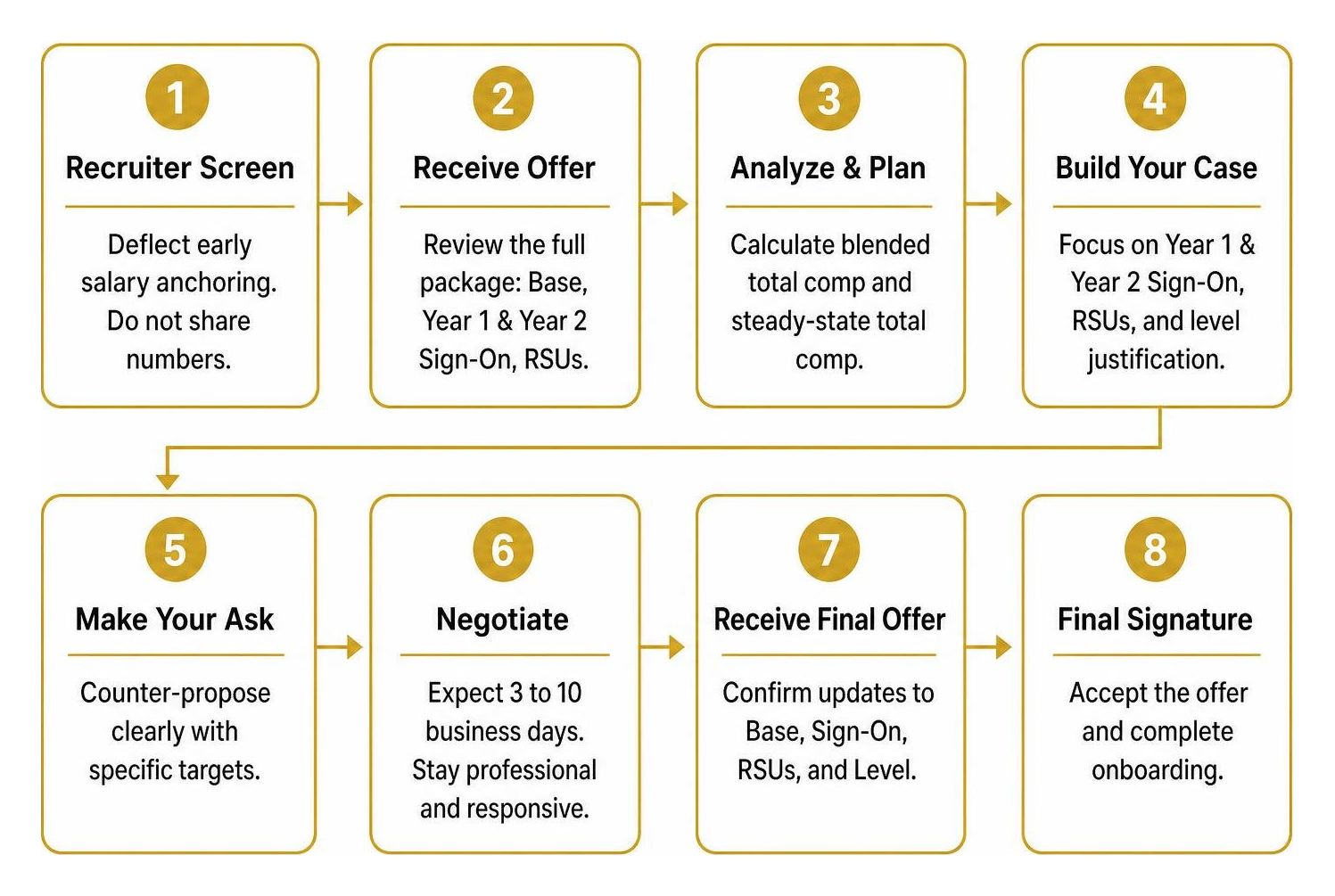
Step 1: Deflecting Early Salary Anchoring in the Recruiter Screen
Your negotiation begins during the initial recruiter screening call. Sharing an explicit salary number or your past compensation history too early creates an artificial anchor that limits your final package. A premature anchor can easily cause a $30,000+ swing in your eventual offer.
When the recruiter asks for your target compensation or current earnings, deflect gracefully:
“Right now, my priority is fully understanding the team’s roadmap, the scope of the role, and demonstrating my value through the interview loop. Once we determine this is a mutual fit, I am confident we can agree on a package that reflects the market rate and the level of impact required.”
Step 2: Deconstructing and Benchmarking Your Written Offer
When the recruiter delivers your verbal offer, express gratitude, take comprehensive notes, and request the complete package in writing before committing to any figures.
Break the offer down into its discrete components for each of the four years:
- Year 1: Base Salary + Year 1 Sign-On Bonus + 5% RSUs
- Year 2: Base Salary + Year 2 Sign-On Bonus + 15% RSUs
- Year 3: Base Salary + 40% RSUs
- Year 4: Base Salary + 40% RSUs
Analyze where the gaps exist. Is Year 1 cash insufficient to justify leaving your current employer? Does Year 3 suffer from an equity shortfall? Identify the specific deficiency before preparing your counter-proposal.
Step 3: Delivering the Counter-Offer with Precision Scripts
Deliver your counter-proposal via email to ensure your business case reaches the compensation committee intact. Present your ask as an objective bridge based on market data, unvested equity, or competing timelines.
Sample Email Counter-Offer Script
When managing multiple conversations, ensure you secure better pay without falling into counteroffer traps that risk damaging your professional relationships. negotiating after offer acceptance carries significant risks, so resolve all core compensation terms before signing your final paperwork.
Step 4: Overcoming ‘Top of Band’, Exploding Deadlines, and Recruiter Pushback
During discussions, Amazon recruiters frequently deploy standard negotiation scripts. Understanding their internal incentives helps you respond strategically:
- “This is the top of the band for this level.”
- Response: Pivot immediately to unbanded levers. “I understand base salary is at the band threshold. Let’s look at adjusting the Year 1 sign-on bonus or the total RSU grant to bridge the gap.”
- “This is our best and final offer.”
- Response: Acknowledge their position and offer a concrete closing condition. “I appreciate your transparency. If we can adjust the Year 1 bonus by an additional $15,000 to offset my forfeited year-end bonus, I will sign the agreement today.”
- “We need an answer within 48 hours.”
- Response: Do not panic. Thank them for the timeline, reiterate your high interest, and request a reasonable extension to review the full details with your family.
Frequently Asked Questions About Amazon Salary Negotiation
What is the Amazon TC cap and how does it restrict negotiations?
Amazon enforces a base salary ceiling of approximately $350,000 for standard engineering, product, and corporate roles. While base pay cannot exceed this limit, your total compensation can scale significantly higher through larger Year 1 and Year 2 sign-on bonuses and increased RSU grants. Once base pay reaches the band ceiling for your level, all subsequent negotiation must target equity and upfront cash.
How can you negotiate an Amazon offer without a competing offer?
You do not need a competing offer to negotiate successfully. Strong interview loop data, high-demand technical or leadership expertise, and forfeited compensation (such as unvested equity, upcoming annual bonuses, or 401(k) vesting timelines at your current employer) provide substantial leverage. Presenting objective market rate data and articulating your specific business impact gives the recruiter the justification they need to request compensation committee approval.
Why does Amazon back-load RSUs to 5/15/40/40 instead of equal vesting?
Amazon uses the 5/15/40/40 vesting model as a long-term retention and ownership strategy. By distributing 80% of your equity in Years 3 and 4, the company incentivizes employees to remain past the two-year mark. To balance this back-loaded structure, Amazon provides Year 1 and Year 2 sign-on cash bonuses that supplement your monthly income until the major equity tranches begin vesting.
Conclusion
Negotiating your compensation package at Amazon requires looking past simple base salary figures and mastering the interplay between sign-on bonuses, leveling bands, and the four-year 5/15/40/40 vesting curve. By avoiding early salary anchoring, analyzing your year-over-year cash flow, and targeting the flexible levers in your offer, you can secure substantial increases in both upfront liquidity and long-term equity value.
If you are preparing for an upcoming loop or evaluating an active offer, our team at MyExpertCoach is here to help you navigate every stage of the process. Leverage our executive career coaching and LinkedIn optimization services to ensure your personal brand, interview narrative, and offer strategy reflect your full professional value.