
table of contents
C-Suite Executive Resume Examples That Show Boardroom Impact
The best c-suite executive resume examples show business results, not a list of duties. A CEO might lead with revenue growth and market expansion. A CFO might highlight capital decisions and risk reduction. A COO might show how they improved operations at scale. In each case, the resume should name the challenge, show the decision the leader made, and quantify the result where possible.
Your resume should also make your next move clear. A short personal brand statement and a few core achievements can tell a board or search committee what you bring to this role before they reach your work history.
I’m Sandy Spencer. My background in HR, executive recruiting, and career coaching has helped me guide senior leaders on the strategy behind c-suite executive resume examples and their own career stories.
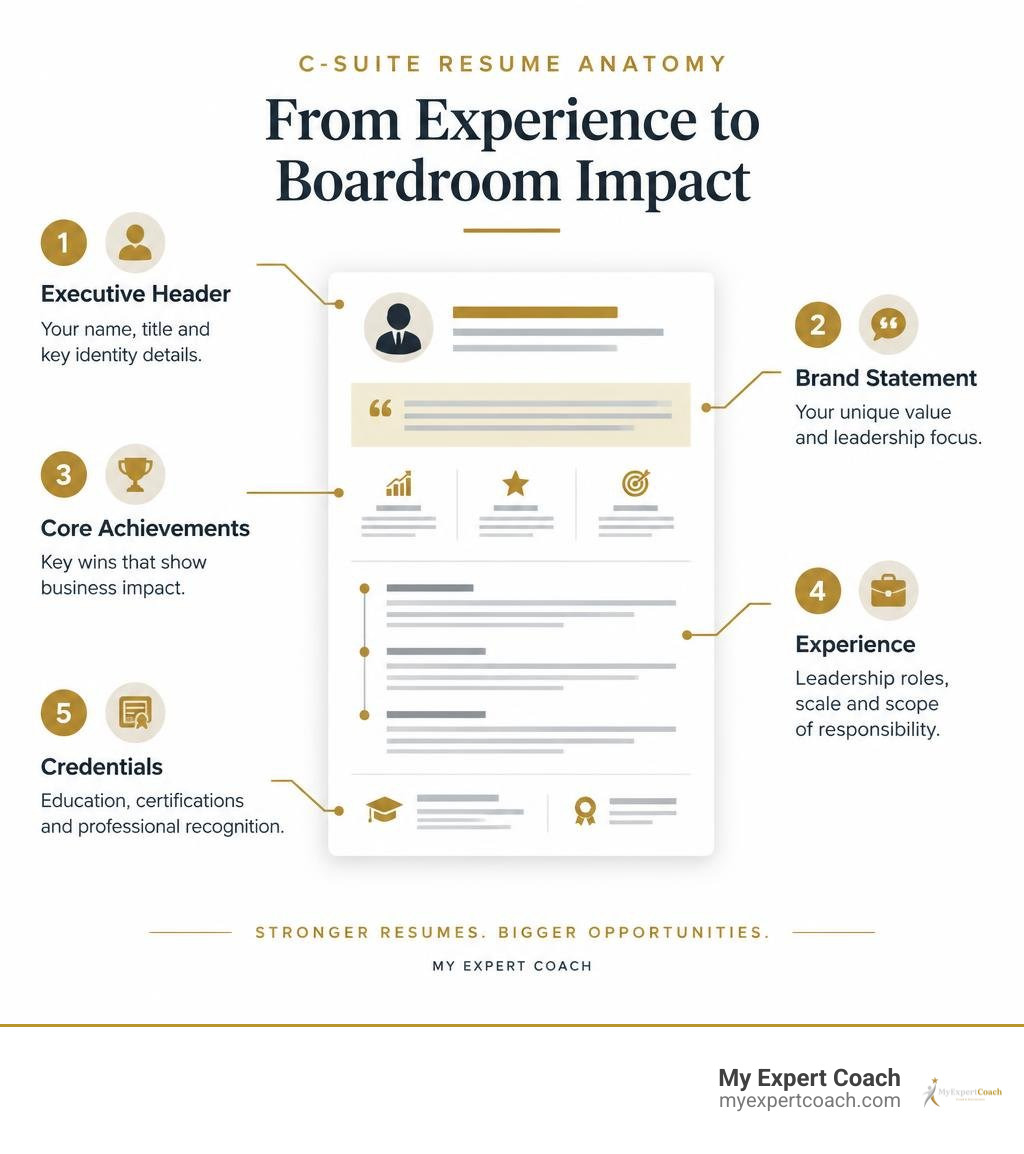
Anatomy of a Board-Level Resume: Essential Sections and Structure
Writing for the boardroom requires a distinct shift in perspective. Mid-level resumes focus on task execution and tactical competencies. In contrast, chief-level documents focus on enterprise governance, strategic foresight, capital allocation, and shareholder value creation. Understanding this distinction is critical when reviewing proven executive resume best practices to ensure your messaging aligns with what executive search committees expect in 2026.
| Resume Element | Standard Executive Resume (VP / Director) | C-Suite Executive Resume (CEO, CFO, COO, CTO) |
|---|---|---|
| Primary Focus | Departmental management and project execution | Enterprise strategy, shareholder return, and vision |
| Top Section | Summary of skills and functional expertise | Personal brand statement and core impact matrix |
| Financial Scope | Departmental or program budgets | Enterprise P&L oversight, EBITDA, and M&A deals |
| Career Window | Detailed history spanning 20+ years | Curated, high-impact focus on the last 15 years |
| Governance | Internal operational leadership | Board advisory, fiduciary duties, and investor relations |
To communicate your executive scope quickly, structure your document into distinct, easily scannable sections that emphasize business outcomes over administrative duties.
1. Value Proposition and Executive Header
Your header and introductory profile establish your executive presence immediately. Beyond your name, contact information, and clean LinkedIn profile URL, this section must convey your personal brand and highest credentials.
- Targeted Chief Officer Title: Clearly identify your target function (e.g., Chief Executive Officer | Global Enterprise Transformation).
- Personal Brand Statement: A concise, punchy headline capturing your leadership philosophy.
- Executive Profile: A brief narrative detailing your leadership scale, industry authority, and governance capabilities, serving as an executive summary of your professional executive bio.
- Board and Advisory Roles: Prominent placement of corporate or non-profit board seats to demonstrate fiduciary trust.
2. Quantified Core Achievements and Impact Matrix
Directly beneath your executive profile, include an impact matrix highlighting your most significant career milestones. Search committees and executive recruiters evaluate senior talent through metrics, capital efficiency, and organizational growth.
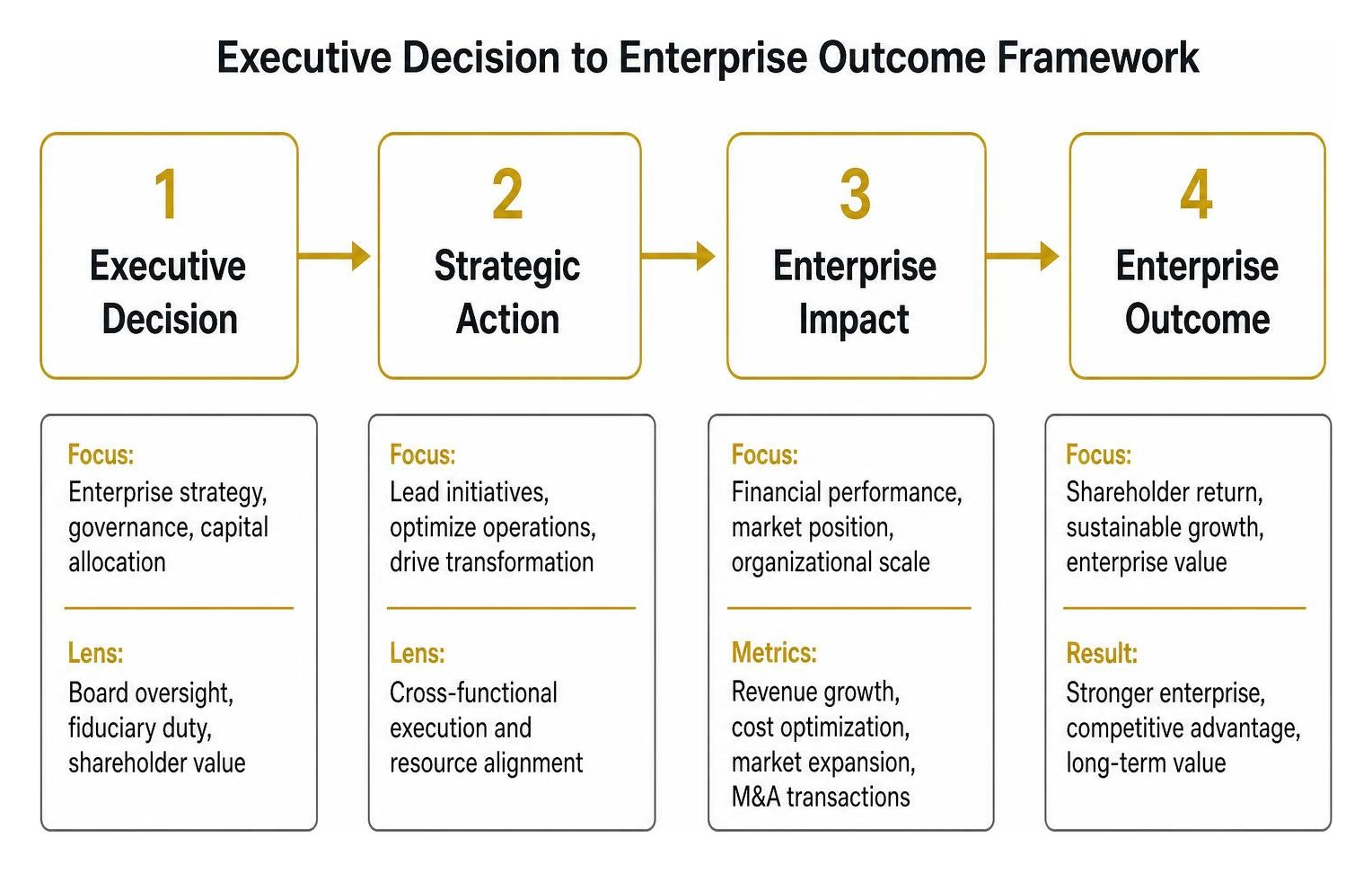
When analyzing a strong C-suite resume sample, notice how top executive profiles foreground high-level metrics before detailing chronological employment history. Focus on outcomes such as:
- Top-Line and Bottom-Line Growth: Expanding annual revenue by 20% in 12 months or optimizing operations to reduce overhead by 25%.
- Market Expansion: Driving strategic product rollouts that expand market share by 15% across competitive sectors.
- M&A Transactions: Directing multi-million dollar acquisitions, integrations, and divestitures.
- Enterprise Optimization: Spearheading organizational restructurings that boost employee engagement by 40% while lowering operating expenses.
3. Strategic Experience and Leadership Chronology
Your professional history should tell a cohesive story of continuous value creation. Follow the 15-year career window rule: detail your last two to three executive roles thoroughly, while summarizing earlier career foundations concisely.
Structure each position using high-level context followed by outcome-focused bullet points, applying modern executive resume tips to maintain clarity:
- Enterprise Context: Begin each role with a short description of the company profile, operational scale, direct reports, and total P&L responsibility.
- Action + Decision + Result: Frame every achievement around the strategic challenge, the operational decision made, and the measurable business outcome.
- Executive Action Verbs: Lead your accomplishments with decisive language like Orchestrated, Spearheaded, Pioneered, and Directed.
4. Education, Board Appointments, and Credentials
Most chief-level candidates hold advanced master’s degrees, doctorates, or elite postgraduate credentials. Because your recent executive impact carries the most weight, position this section toward the end of your resume unless you are preparing a comprehensive academic or research-oriented executive curriculum vitae.
Include:
- Graduate and Doctoral Degrees: MBA, MS, JD, or Ph.D. credentials, noting honors or distinction.
- Governance and Industry Certifications: Board certifications (e.g., NACD.DC), CPA, CFA, or specialized enterprise credentials.
- Executive Education: High-impact leadership programs completed at top institutions.
High-Impact C-Suite Executive Resume Examples by Leadership Role

Chief officers collaborate across executive functions, but each role requires a tailored strategic focus on the resume.
Enterprise CEO and COO C-Suite Executive Resume Examples
Chief Executive Officers and Chief Operating Officers must showcase overall corporate governance, operational excellence, and enterprise value expansion. While reviewing executive director resume writing strategies, you will notice that C-suite documents demand an even stronger emphasis on shareholder returns and board engagement.
Chief Executive Officer (CEO) Resume Example
CHIEF EXECUTIVE OFFICER
Enterprise Scale | Market Capitalization | Culture & Innovation
Executive Profile
Visionary Chief Executive Officer with over 15 years of leadership directing $500M+ global enterprises through market expansion, digital evolution, and turnaround initiatives. Proven track record of scaling top-line revenue, driving operational efficiency, and building high-performance executive teams.
Core Enterprise Highlights
- Spearheaded organic and acquisitive growth strategies resulting in a 20% increase in revenue within 12 months.
- Directed company-wide operational restructuring, cutting operating expenditures by 25% while maintaining product delivery standards.
- Pioneered an enterprise innovation culture, launching three proprietary product lines that captured a 15% market share increase.
Professional Experience
Apex Global Enterprises | New York, NY
Chief Executive Officer | 2021 – Present
Oversaw $650M multinational manufacturing firm with 3,500 employees across 12 countries.
- Orchestrated post-merger integration of a $120M competitor, achieving full operational synergy within nine months and exceeding EBITDA targets by 18%.
- Championed comprehensive sustainability and supply-chain initiatives, reducing energy consumption by 25% and waste production by 30%.
- Elevated employee engagement scores by 40% across all operational hubs through transparent executive communications and restructured leadership pathways.
Chief Operating Officer (COO) Resume Example
CHIEF OPERATING OFFICER
Global Supply Chain | Operational Infrastructure | Margin Expansion
Executive Profile
Results-driven Chief Operating Officer specializing in modernizing enterprise workflows, optimizing multi-tier supply chains, and driving sustainable margin growth across complex organizations.
Professional Experience
Vanguard Logistics Network | Chicago, IL
Chief Operating Officer | 2020 – Present
Direct operational governance for a $400M supply chain network managing 22 distribution centers.
- Engineered an automated fulfillment network that reduced operational turnaround time by 35% and increased capacity by $85M without adding real estate overhead.
- Streamlined enterprise vendor procurement, renegotiating major carrier agreements to capture $14M in recurring annual savings.
- Built a cross-functional operational risk team that reduced supply disruption events by 60% during global market volatility.
Technology and Finance C-Suite Executive Resume Examples
Chief Technology Officers (CTO), Chief Information Officers (CIO), and Chief Financial Officers (CFO) must balance deep technical and fiscal acumen with high-level enterprise strategy.
Chief Financial Officer (CFO) Resume Example
CHIEF FINANCIAL OFFICER
Capital Allocation | Corporate Finance | M&A & Enterprise Risk
Executive Profile
Strategic Chief Financial Officer with deep expertise in capital structure optimization, fiscal governance, debt restructuring, and investor relations for public and private-equity-backed corporations.
Professional Experience
Summit Horizon Capital | San Francisco, CA
Chief Financial Officer | 2019 – Present
Lead fiscal oversight, treasury, compliance, and financial planning for a $350M SaaS portfolio.
- Secured $150M in Series D debt and equity financing on favorable terms to fund international market expansion.
- Redesigned enterprise financial reporting frameworks, reducing quarterly close cycles from 14 days to 4 days and boosting audit efficiency by 55%.
- Guided risk management and liquidity models that maintained positive cash flow during major interest-rate shifts.
Chief Technology Officer (CTO) Resume Example
CHIEF TECHNOLOGY OFFICER
Enterprise Architecture | Cloud Scale | Artificial Intelligence & Security
Executive Profile
Visionary technology leader with extensive experience modernizing legacy architectures, driving secure cloud transformations, and commercializing AI-driven enterprise products.
Professional Experience
Nexis Enterprise Solutions | Austin, TX
Chief Technology Officer | 2021 – Present
Direct 400+ engineering, product, and cybersecurity professionals for an enterprise software platform.
- Led migration of on-premise infrastructure to a secure, multi-cloud environment, cutting annual infrastructure spend by $8M while boosting uptime to 99.99%.
- Commercialized a machine-learning analytics suite that generated $35M in net-new annual recurring revenue within two years.
- Established zero-trust cybersecurity protocols across enterprise platforms, achieving SOC 2 Type II and ISO 27001 certifications.
How to Tailor and Draft a C-Suite Executive Resume

When preparing your leadership dossier, careful tailoring ensures your profile directly addresses the strategic priorities of prospective boards and executive search consultants. Learning how to draft a resume at this level requires aligning your achievements with organizational pain points.
- Diagnose the Mandate: Determine whether the hiring board needs a growth champion, a turnaround expert, an M&A specialist, or an operational stabilizer.
- Adjust Your Brand Statement: Align your opening value proposition with that specific operational mandate.
- Respect Confidentiality and NDAs: Frame sensitive transactions, acquisitions, or restructuring projects around scale and percentage metrics (e.g., “Negotiated an eight-figure divestiture in the logistics sector”) without breaching non-disclosure agreements.
- Ensure ATS Compatibility for Search Portals: Executive search firms frequently run proprietary databases. Use clean formatting, standard typography, and clear section headers to ensure parsing accuracy.
Common C-Suite Resume Pitfalls to Avoid
Even highly accomplished executives can make missteps on their resumes that obscure their strategic impact. Investing in polished, expert resume writing helps you avoid these common traps:
- Listing Day-to-Day Tasks: Boards expect you to lead teams, manage budgets, and attend meetings. Focus exclusively on strategic decisions and measurable outcomes.
- Omitting Quantifiable Metrics: Avoid vague assertions like “improved company performance.” State the precise financial and operational metrics.
- Overcrowded Layouts: Dense, small text without white space makes rapid review difficult for busy board members.
- Including Distant Early Roles: Detail your accomplishments from the last 15 years; summarize early career foundations in a brief “Early Career History” section.
Frequently Asked Questions About C-Suite Resumes
How far back should a C-suite executive resume go?
As a general rule, detail the most recent 15 years of your career. This ensures search committees can clearly evaluate your modern leadership impact, relevant technological competencies, and strategic agility. Earlier roles can be consolidated into a simple one- or two-line summary at the end of your experience section.
How does a C-suite resume differ from an executive director resume?
While an executive director resume focuses on divisional execution, operational leadership, and team development, a C-suite resume centers on enterprise-wide governance, total P&L responsibility, investor relations, and long-term shareholder value.
Should a C-suite resume be one page or two pages?
For C-level professionals with 15 to 25+ years of progressive leadership, a two-page resume is the industry standard. This provides enough space to detail complex business transformations, M&A transactions, board appointments, and quantified achievements without sacrificing visual clarity.
Conclusion
Your executive resume is the strategic narrative that positions you for boardroom leadership. By curating your recent achievements, quantifying your business results, and maintaining a clear value proposition, you make it easy for search committees to recognize your enterprise impact.
If you are preparing for your next chief-level transition, you can partner with executive resume and LinkedIn strategists to refine your career assets and stand out in senior executive searches.