
table of contents
How to Write an Executive Curriculum Vitae That Shows Your Impact
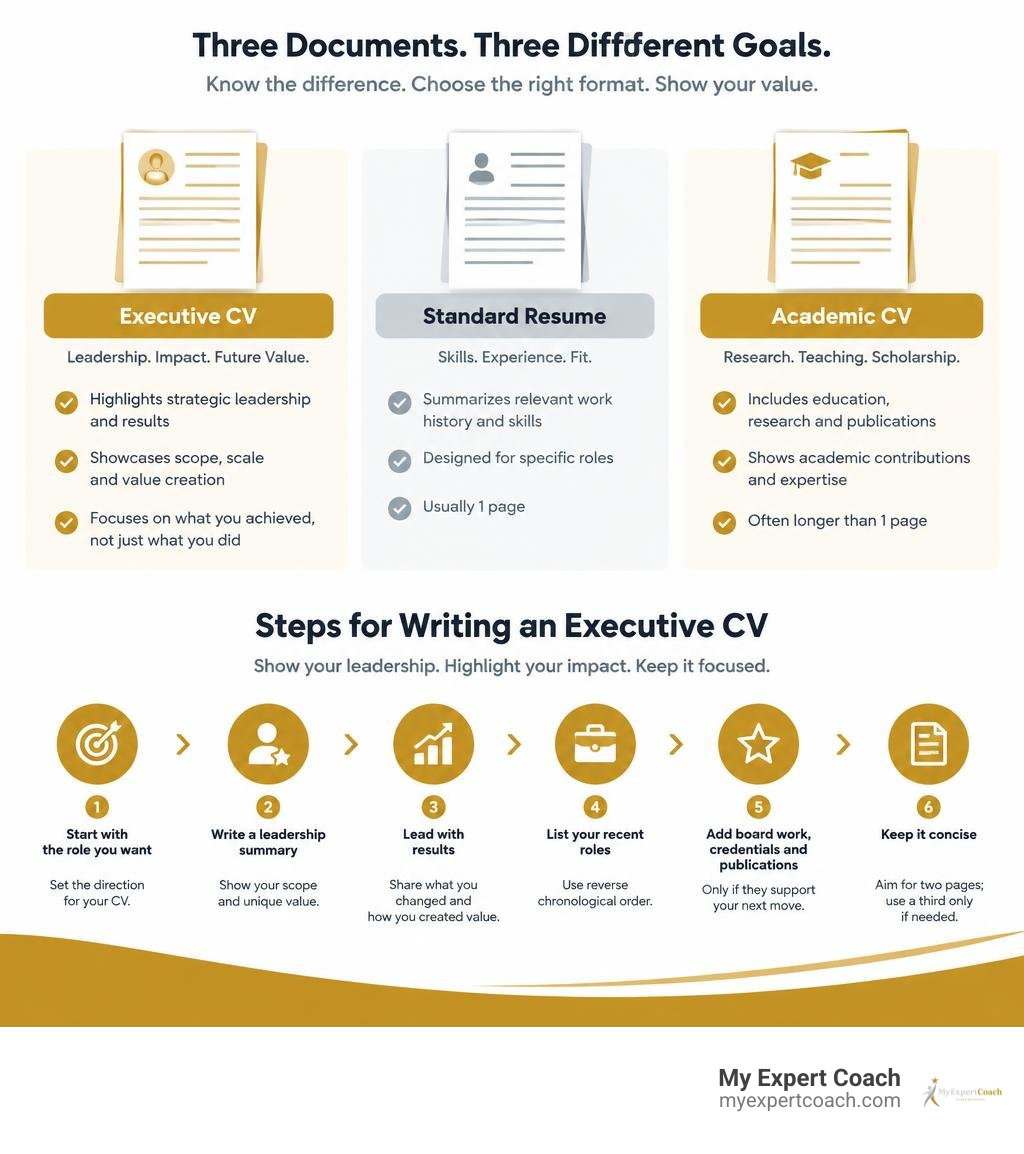
To write an executive curriculum vitae, start with the role you want. Add a short summary of your leadership scope, then lead with results: revenue grown, costs reduced, teams led, or outcomes improved. List your recent roles in reverse order, and include board work, credentials, and publications only when they support your next move. Aim for two clear pages; use a third only if relevant experience needs the space.
The key is to show what changed because you led. A hiring committee should be able to see the size of your responsibility and the results you delivered without digging through a list of duties.
I’m Sandy Spencer, a career coach with more than 38 years of HR and executive recruiting experience. I’ve helped senior leaders turn complex careers into a focused executive curriculum vitae that makes their value easier to see.
Understanding the Strategic Value of an Executive Curriculum Vitae
At the C-suite and board level, hiring decisions carry multi-million-dollar stakes. Executive search committees and nomination boards are not looking for a tactical list of daily tasks. They want to see enterprise governance, strategic vision, and evidence that you can navigate organizational complexity.
An executive curriculum vitae serves as a high-level leadership profile. It frames your entire career trajectory around value creation, capital stewardship, and operational scale. When orchestrating high-stakes career moves, executive career transitions demand strategy far beyond the standard resume because your audience evaluates your capacity to deliver future returns, not just your past employment history.
| Dimension | Standard Professional Resume | Executive Curriculum Vitae | Academic Curriculum Vitae |
|---|---|---|---|
| Primary Audience | Hiring managers, recruiters, HR | Search committees, boards of directors, C-suite peers | Academic deans, tenure committees, grant boards |
| Core Focus | Tactical execution and functional responsibilities | Enterprise leadership, governance, ROI, strategic vision | Scholarly research, publications, teaching, grants |
| Typical Length | 1 to 2 pages | 2 to 3 pages maximum | 5 to 20+ pages (unlimited) |
| Metric Emphasis | Project delivery, task efficiency, sales targets | EBITDA growth, enterprise valuation, P&L scale, M&A | Citation counts, grant dollar amounts, course loads |
| Key Inclusions | Core skills, recent jobs, basic education | Board seats, governance committees, speaking, credentials | Full publication bibliography, peer reviews, symposia |
When to Deploy an Executive CV vs. a Standard Resume
A traditional one-page resume suits mid-level management roles where direct functional execution is the primary metric. You need to deploy an executive CV when:
- You are pursuing C-level mandates (CEO, CFO, COO, CIO, CMO) or general manager appointments.
- You are pitching for public, private, or non-profit board directorships where committee governance and fiduciary stewardship matter.
- You are stepping into health system executive leadership, higher education administration, or multilateral enterprise organizations.
- You are competing in global markets where senior leadership profiles require extensive background context, including language competencies, international trade exposure, or security credentials.
Public sector and international bodies frequently demand this comprehensive approach. For example, federal resources like The Curriculum Vitae: Tips for Executives – Canada.ca emphasize treating an executive CV like an executive briefing: focused strictly on management of people, budgets, and change, while leaving off irrelevant personal demographic disclosures.
Structuring Your Executive Curriculum Vitae for High-Impact Roles
A strong executive CV follows a clean, two-page layout, expanding to a third page only when extensive board appointments, global governance roles, or patents warrant the space. We structure the layout so the top third of the first page immediately proves your executive capability.
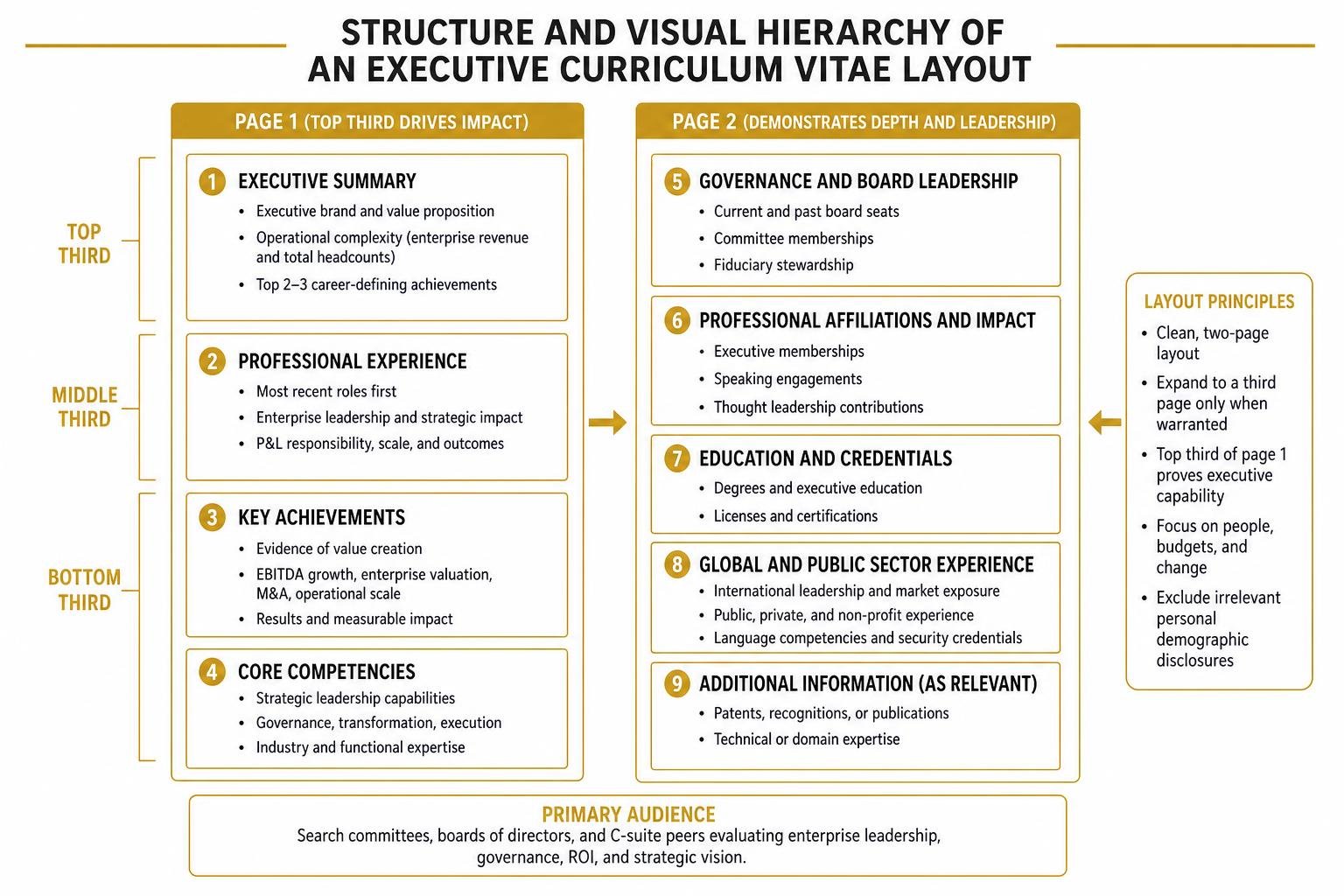
To optimize your presentation, align your document with established executive resume best practices. Your executive summary should act as an elevator pitch. It states your executive brand, the operational complexity of your recent roles (such as enterprise revenue and total headcounts), and your top two or three career-defining achievements.
Essential Sections to Build for Executive and Board Leadership
A complete executive document uses a deliberate visual hierarchy to showcase your qualifications without clutter.

Every executive curriculum vitae should feature these primary sections:
- Header & Contact Information: Name, target executive title, phone number, professional email, location (City, State), and customized LinkedIn profile URL.
- Executive Summary & Value Proposition: A high-impact 3–4 line narrative defining your leadership scope, industry footprint, and top-line results.
- Core Executive Competencies: A structured grid of 6–9 high-level strategic capabilities.
- Career Milestones & Key Highlights: An upfront callout section highlighting 3–4 career-defining metrics.
- Professional Leadership Experience: Reverse chronological career history emphasizing enterprise context, executive scope, and quantified impact bullets.
- Board Appointments & Governance: Non-executive directorships, advisory roles, and committee assignments.
- Education & Executive Development: Degrees, honors, and advanced leadership programs.
- Thought Leadership, Patents, & Media: Keynote appearances, published white papers, and relevant industry recognition.
Core Competencies and Strategic Milestones
Your competencies section must demonstrate strategic authority rather than basic software proficiencies or soft skills. As outlined in our guide to executive resume tips 2026, modern search firms look for executive agility, multi-million-dollar resource allocation, and technological modernization.
Prioritize competencies such as:
- Enterprise P&L Management & Capital Allocation
- Mergers & Acquisitions (M&A) Integration
- Digital Transformation & AI Strategy Implementation
- Global Supply Chain Resilience & Risk Mitigation
- Cross-Functional Organizational Restructuring
- Strategic Partnerships & Joint Venture Negotiation
Position a “Key Strategic Milestones” box directly below your summary to capture attention within the first five seconds of review:
Career Leadership Milestones
- Enterprise Growth: Scaled enterprise value from $120M to $480M over four years across North American and European markets.
- Operational Turnaround: Engineered an operational restructuring program that eliminated $42M in operating inefficiencies within 18 months.
- Market Expansion: Directed cross-border entry into 14 countries, creating a new $85M annual recurring revenue (ARR) business line.
Board Involvement, Governance, and Publications
Board experience belongs in its own distinct section to demonstrate your governance capability to nominating committees. Detail your specific committee appointments, fiduciary oversight, and tenure.
Public enterprise disclosures, such as standardized curriculum vitae frameworks, highlight the importance of clearly differentiating executive operating duties from non-executive committee assignments (such as Audit, Safety, Compensation, or Risk Governance).
How to Quantify Leadership Impact and Drive Measurable Results
The biggest mistake on executive applications is describing duties rather than measurable outcomes. At the executive level, you do not simply “oversee operations”; you “optimize cost-to-serve ratios by 18% across 6 fulfillment hubs.”

Search firms and hiring executives look for scale, complexity, and specific returns. For instance, when framing senior leadership experience, our executive director resume examples and writing strategies demonstrate that placing the metric upfront in the bullet creates an immediate visual hook.
Key Skills to Showcase on an Executive Curriculum Vitae
Ensure your CV showcases your high-level executive toolkit:
- Financial Stewardship: EBITDA acceleration, working capital management, enterprise valuation enhancement, and cost of capital reduction.
- Change Leadership: Multi-entity consolidations, cultural realignments during post-merger integration, and succession planning.
- Strategic Vision: Long-range scenario planning, go-to-market disruption, and market diversification.
- Crisis Management & Stakeholder Alignment: Navigating regulatory scrutiny, leading media management, and managing activist investor engagements.
Transforming Operational Metrics into C-Suite Accomplishments
Use the C-A-R Formula (Context, Action, Result) to turn standard duties into measurable executive achievements:
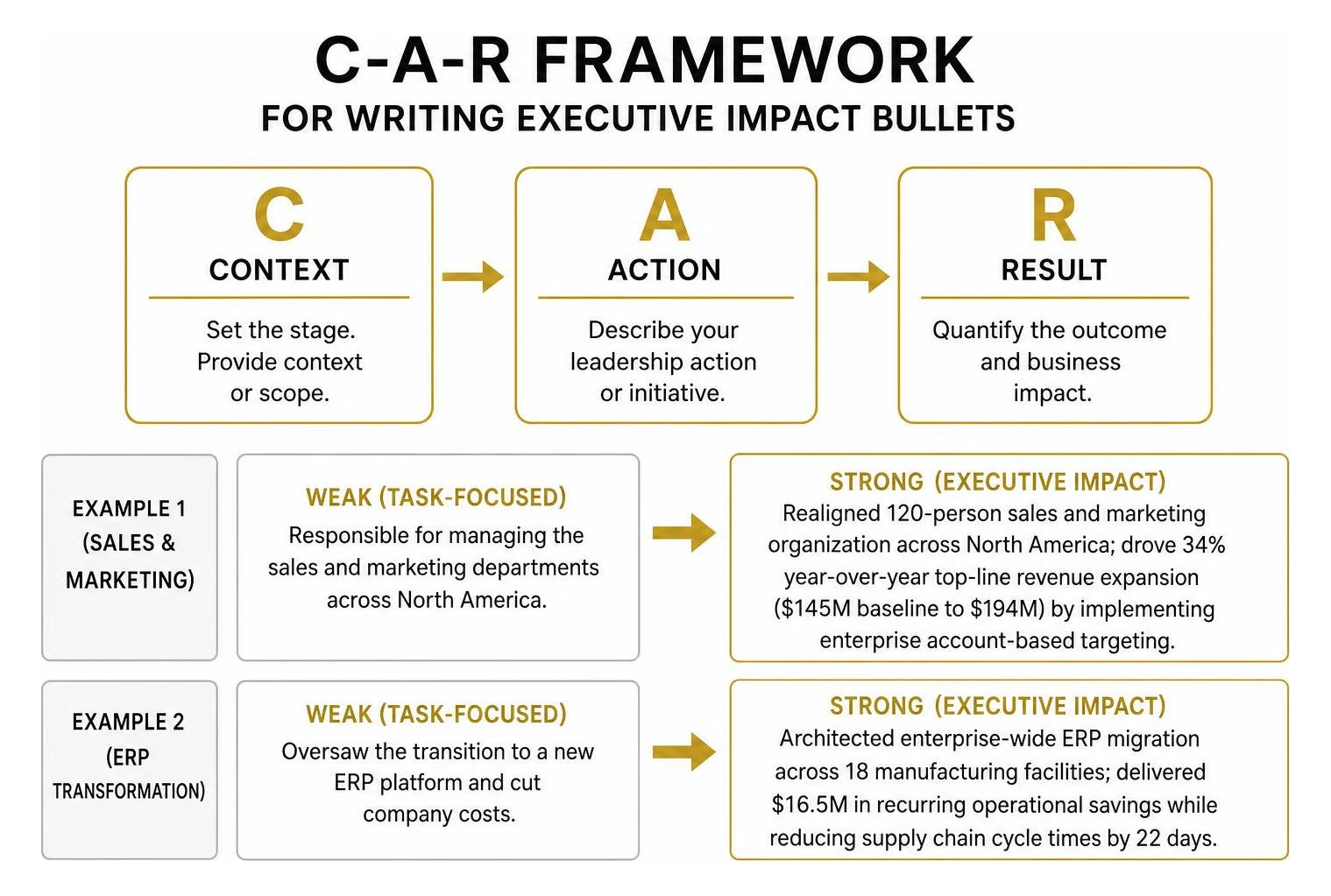
- Weak (Task-focused): Responsible for managing the sales and marketing departments across North America.
- Strong (Executive Impact): Realigned 120-person sales and marketing organization across North America; drove 34% year-over-year top-line revenue expansion ($145M baseline to $194M) by implementing enterprise account-based targeting.
- Weak (Task-focused): Oversaw the transition to a new ERP platform and cut company costs.
- Strong (Executive Impact): Architected enterprise-wide ERP migration across 18 manufacturing facilities; delivered $16.5M in recurring operational savings while reducing supply chain cycle times by 22 days.
Navigating Specialized Transitions: Physician Leaders and Industry Pivots
Transitioning from technical, specialized, or academic backgrounds into broader corporate and health system executive roles requires reframing your achievements. Physician leaders frequently struggle with this transition. Early in their clinical careers, they maintain a multi-page academic CV heavy with grants, teaching responsibilities, and research publications.
When pursuing leadership positions—such as Chief Medical Officer, VP of Medical Affairs, or Health System Chief Operating Officer—search committees expect an executive document. Insights from executive search firms like WittKieffer’s guide on physician leaders moving to executive resumes emphasize shifting focus from scholarly bibliographies to health system operations, bed capacity utilization, clinical quality improvements, and operating budgets.
When undertaking complex transitions like these, working with specialized resume writing services helps translate clinical or specialized terminology into clear enterprise leadership value.
Balancing Academic Credentials with Executive Capabilities
When shifting from an academic or clinical track to an executive role, structure your document around these elements:
- Administrative Scope Over Research Details: Highlight the number of clinical departments, physicians, nurses, and staff under your leadership rather than listing every clinical procedure.
- Institutional Financial Impact: Quantify your oversight of operating and capital budgets (e.g., “$85M annual department budget managed with continuous under-budget variance”).
- Quality & Safety Metrics: Frame clinical outcomes as enterprise metrics (e.g., “reduced 30-day patient readmission rates by 14% and improved HCAHPS patient satisfaction scores from 72% to 91%”).
- Condense Scholarly Work: Instead of listing 40 journal articles across eight pages, create a concise section titled “Selected Thought Leadership & Academic Appointments.” Feature your top 3–5 publications along with a summary statement: “Author of 35+ peer-reviewed publications in major journals including The Lancet and NEJM; 1,200+ citations.”
Formatting, Modern Tools, and Common Pitfalls to Avoid
An executive CV must pass both digital Applicant Tracking Systems (ATS) and the review of senior search committee chairs.
Follow these layout standards:
- Length: Strict 2-page preference; 3 pages allowed for complex careers with extensive board, publication, or global footprints.
- Typography: Clean, executive typefaces (such as Calibri, Arial, Helvetica, Georgia, or Garamond) set between 10 pt and 11.5 pt for body text. Headings should range between 13 pt and 16 pt.
- Margins & White Space: Maintain 0.5 to 0.75-inch margins to provide adequate breathing room and avoid visual fatigue.
- Color Usage: Use color sparingly. A deep navy or slate header adds polish; bright, multi-colored layouts distract the reader.
- File Format: Export as an ATS-compliant PDF unless the search consultant or portal specifically requests a Microsoft Word (.docx) document.
Avoid these critical executive pitfalls:
- The Comprehensive Career Trap: Listing every role you have held since the 1990s. Focus your detailed impact bullets on the last 10 to 15 years. Earlier career history can be condensed into an “Early Career Milestones” section.
- First-Person Pronouns: Never use “I,” “me,” or “my.” Write in an active, telegraphic executive voice starting with strong action verbs (e.g., Negotiated, Orchestrated, Spearheaded, Restructured).
- Passive Duty Descriptions: Phrasing such as “Accountable for managing…” diminishes executive authority. State your direct action: “Directed enterprise risk framework…”
- Demographic and Personal Disclosures: Exclude photos, birth dates, marital status, or home street addresses. In modern recruiting, these create compliance challenges and take up valuable space.
While AI builders and basic templates can help draft initial ideas, they often produce generic, repetitive phrasing that fails to capture the nuance of true executive leadership. Building an authentic executive brand requires tailored positioning that reflects your specific strategic impact.
Frequently Asked Questions About Executive CVs
What is the ideal length for an executive curriculum vitae?
The ideal length for an executive CV is two pages. This provides enough room to detail 10 to 15 years of senior leadership, enterprise metrics, board roles, and credentials without overwhelming the reader. A third page is acceptable for executives with extensive governance history, international appointments, patents, or specialized thought leadership.
How does an executive CV differ from a standard resume?
While a standard resume emphasizes individual tasks, tools, and tactical responsibilities, an executive CV focuses on enterprise stewardship. It highlights P&L ownership, organizational transformation, governance, long-term strategic planning, and overall business valuation growth.
What common mistakes derail an executive CV?
The most frequent missteps include:
- Focusing on routine managerial duties instead of measurable outcomes.
- Omitting organizational scale (such as annual revenue and team size).
- Over-formatting with multi-column graphics or text boxes that confuse ATS software.
- Failing to tailor executive value propositions to the strategic challenges of the target organization.
Conclusion
Your executive curriculum vitae is your personal business case. It demonstrates your ability to guide strategy, protect shareholder value, and inspire high-performing teams. By replacing duty-focused lists with measurable enterprise accomplishments, you position yourself as a strategic leader ready to deliver meaningful results.
At MyExpertCoach, we combine over 25 years of insider recruiting and HR expertise to help senior leaders build compelling, custom career assets. If you are preparing for your next C-suite, board, or executive career transition, explore our personalized resume and LinkedIn services to elevate your executive brand and unlock new leadership opportunities.