
table of contents
Asking for a Raise When You’re Underpaid Starts With Market Evidence
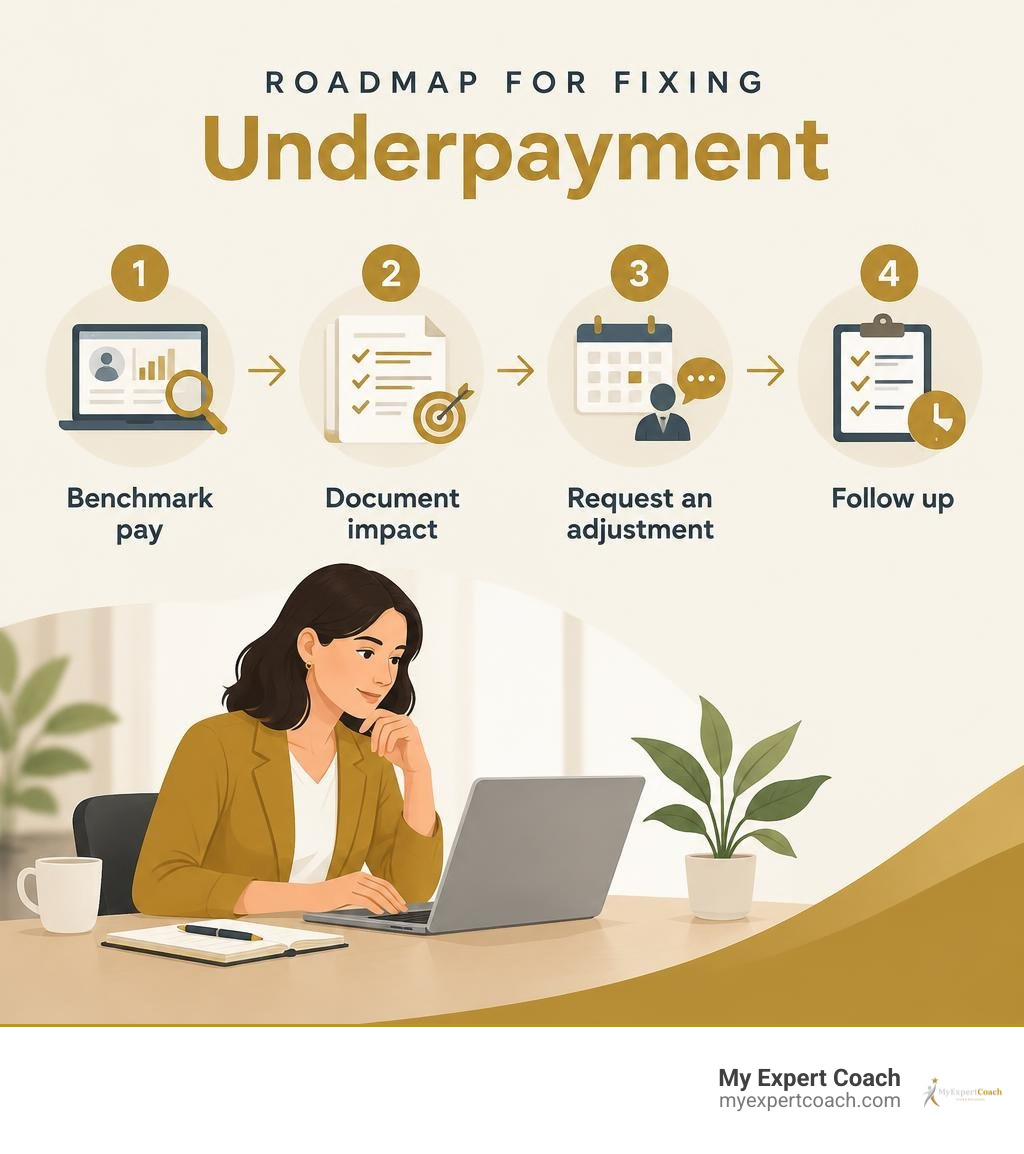
Compare your pay with similar roles at your level, then document the responsibilities you own and the results you have delivered. Schedule a dedicated meeting to request a market adjustment based on that evidence. Bring a salary range you can support, and ask when you can expect a decision.
If you are a senior leader, compare total compensation, including bonuses and equity, not just base salary. A gap in market pay calls for a different conversation than a routine merit raise.
I’m Sandy Spencer, an executive career coach with more than 38 years of HR and recruiting experience. That background shapes my advice on asking for a raise when you’re underpaid: make your business impact clear, and know the market before you negotiate.
Signs You Are Underpaid and How to Benchmark Your Market Value
Discovering you earn less than your peers often starts with a quiet realization: a job listing appears on your feed displaying a baseline salary well above yours, or a newly hired team member casually mentions their starting package. Feeling undervalued is painful, but fixing it requires moving away from gut feelings and focusing strictly on verifiable market data.
At MyExpertCoach, our 25+ years of insider HR and recruiting experience shows that compensation discrepancies rarely stem from malice. Instead, they occur because corporate systems inherently reward silence. If you do not actively evaluate your worth against external labor trends, your pay can quickly fall behind prevailing rates.
The data proves self-advocacy works: 70% of employees who have asked for a pay bump have received one. However, asking for a raise when you re underpaid requires an entirely different framework than requesting an annual merit bump.
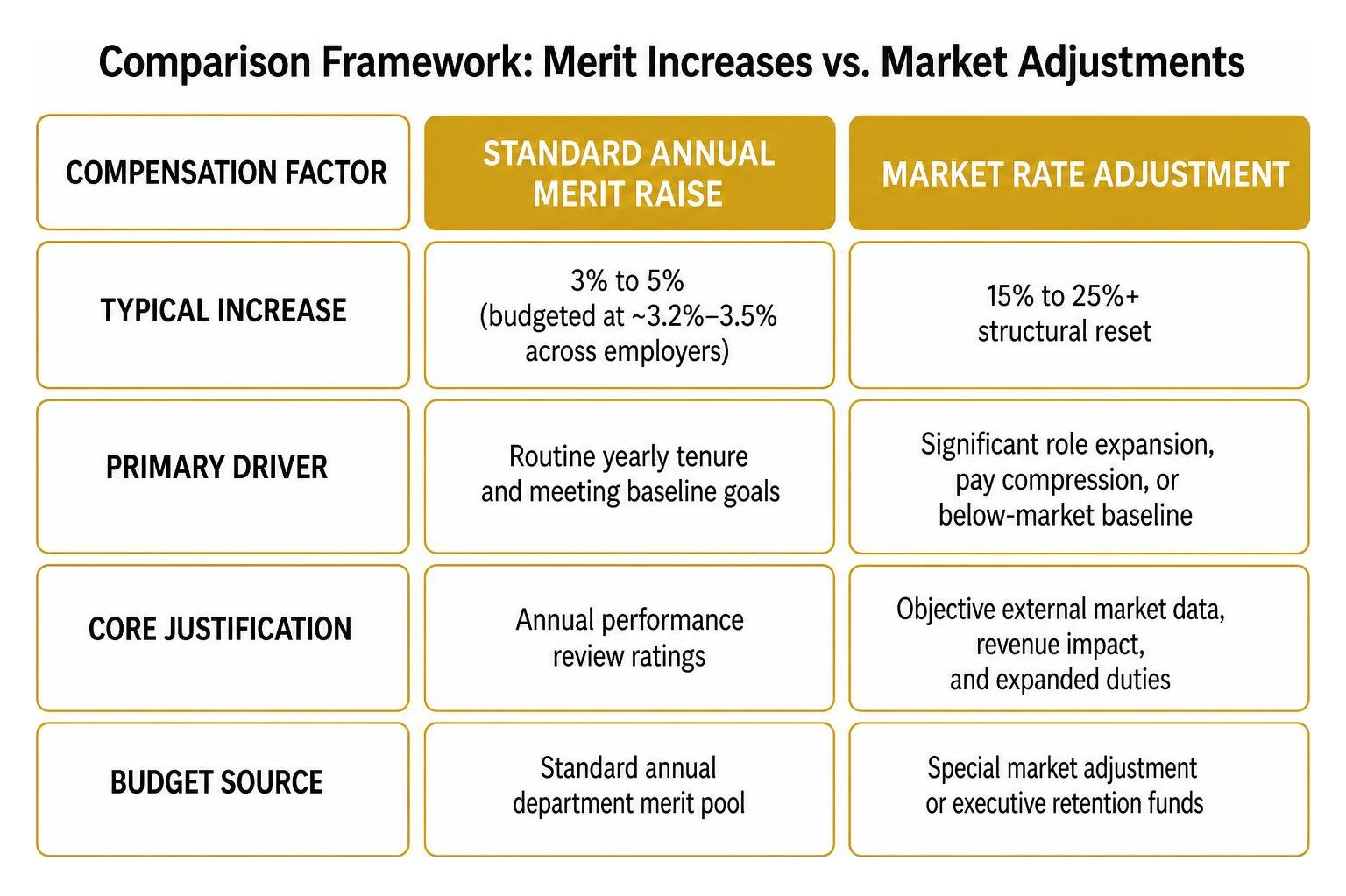
| Compensation Factor | Standard Annual Merit Raise | Market Rate Adjustment |
|---|---|---|
| Typical Increase | 3% to 5% (budgeted at ~3.2%–3.5% across employers) | 15% to 25%+ structural reset |
| Primary Driver | Routine yearly tenure and meeting baseline goals | Significant role expansion, pay compression, or below-market baseline |
| Core Justification | Annual performance review ratings | Objective external market data, revenue impact, and expanded duties |
| Budget Source | Standard annual department merit pool | Special market adjustment or executive retention funds |
Identifying Pay Compression and Role Scope Creep
Two main internal mechanisms systematically suppress compensation over time: role scope creep and pay compression.
- Role Scope Creep: This occurs when high performers absorb the duties of departed colleagues, take on unbackfilled positions, or manage larger budgets without an updated title or pay increase. When an organization leaves an open position unfilled, it saves substantial payroll budget—frequently at the direct expense of the remaining employees who absorb the extra work.
- Pay Compression: This happens when external talent markets drive up starting salaries for incoming hires faster than internal annual merit pools grow. A long-tenured employee who consistently receives standard 3% annual merit increases may find themselves earning significantly less than a brand-new hire stepping into the exact same role with identical or lesser experience.
To demonstrate scope creep, map out two distinct operational lists:
- Original Scope: The explicit duties, budget oversight, and headcount you were hired to manage.
- Current Scope: The expanded projects, cross-functional initiatives, strategic leadership, and direct reports you oversee today.
Conducting Market Research Without Internal Pay Transparency
As of late 2024, 57.8% of U.S. job postings included pay information, up from 52.2% a year earlier due to expanding pay transparency laws. Even if your organization lacks internal transparency, external market intelligence makes benchmarking straightforward.
To determine your baseline value:
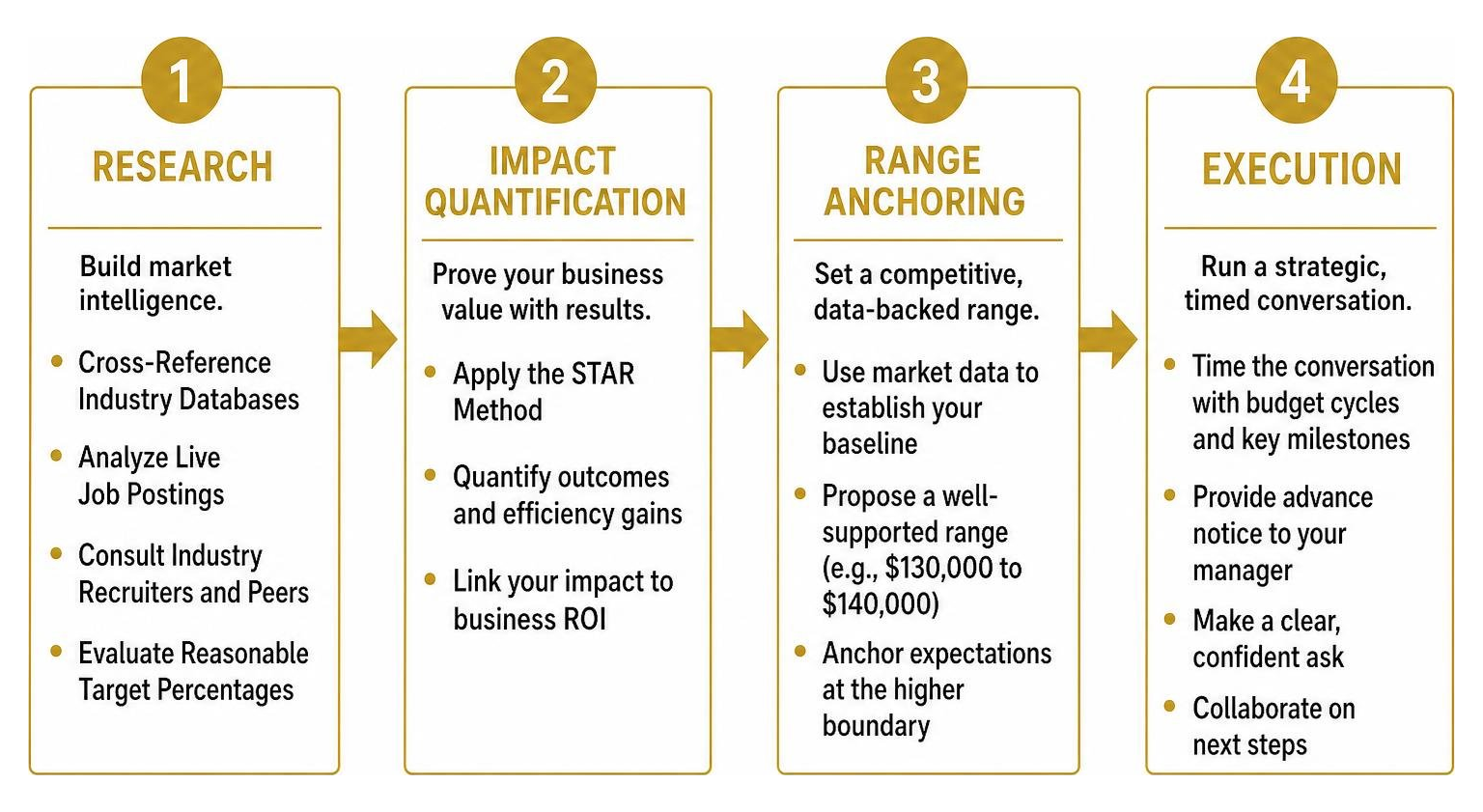
- Cross-Reference Industry Databases: Use comprehensive compensation databases like Payscale, Glassdoor, and professional association reports. In early 2026, Glassdoor reported base pay growth averaging 3.3% year over year, illustrating that market rates continuously evolve.
- Analyze Live Job Postings: Review job advertisements for comparable titles in your geographic tier, industry vertical, and company size. Pay special attention to postings from organizations in jurisdictions mandating public pay ranges.
- Consult Industry Recruiters and Peers: Reach out to trusted executive recruiters and network contacts to gather anecdotal compensation data for your seniority level.
- Evaluate Reasonable Target Percentages: Learn more about determining how much is reasonable to ask for a raise so your target figures align with practical corporate compensation bands rather than arbitrary requests.
The Strategic Process for Asking for a Raise When You’re Underpaid
Approaching compensation negotiations like a courtroom proceeding—where your accomplishments and market research serve as undeniable evidence—removes emotion and positions you as a strategic business asset.

Timing Your Approach: When Asking for a Raise When You’re Underpaid Works Best
Effective compensation conversations depend heavily on organizational context and fiscal timing. While you should avoid high-stress quarters, peak retail seasons, or periods of active company downsizing, review AP News guidance on career strategies for negotiating in shifting economic conditions to see why asking for fair pay remains essential even during broader market slowdowns.
To maximize your leverage, schedule discussions around:
- Fiscal Budget Planning Cycles: Most organizations plan budgets two to three months before their fiscal year ends. Initiating conversations during budget planning ensures managers can allocate funds before annual pools are locked.
- Major Value-Delivery Milestones: Initiate discussions immediately following a major project wrap-up, successful product launch, or high-value client acquisition.
- Off-Cycle Structural Reviews: If you discover a significant compensation gap (e.g., 15% to 25%), do not feel forced to wait for an annual review cycle. Significant market misalignments justify dedicated, off-cycle compensation evaluations.
Structuring a Data-Backed Market Adjustment Request
When proposing a market correction, ground your request in concrete numbers rather than personal financial needs or inflation rates. Managers cannot easily justify compensation increases based on personal living costs, but they can easily advocate for business ROI, operational efficiency, and market parity.
- Apply the STAR Method: Frame your impact by defining the Situation, Task, Action, and quantifiable Result (e.g., “Optimized team delivery workflows, saving 10 operational hours weekly and driving a 15% increase in departmental throughput”).
- Deploy Range Offers: Review the Harvard Program on Negotiation’s research on range offers and negotiation strategies, which demonstrates that proposing a well-supported range (such as $130,000 to $140,000) signals collaborative flexibility while anchoring expectations at the higher boundary.
- Determine Competitive Baselines: Explore proven frameworks on pricing strategies for new compensation targets to establish your exact baseline before scheduling the conversation.
Executing the Pitch and Conversation Scripts
Never ambush your manager with a sudden salary demand during a standard check-in. Giving leadership advance notice allows them to consult HR compensation bands and review departmental budgets ahead of time.

Conversation Scripts: Exactly What to Say When Asking for a Raise When You’re Underpaid
Send a direct email to schedule a dedicated conversation:
Subject: Dedicated Meeting: Career Progression & Compensation Alignment
“Hi [Manager Name],
I’d like to schedule 30 minutes next week to review my expanded responsibilities, recent achievements, and how my current compensation aligns with market standards for my role. I look forward to discussing our goals and setting a collaborative plan for the coming year.”
During the live meeting, maintain a professional, confident tone. Avoid weak qualifiers like “I feel,” “I think,” “just,” or “I was hoping.” Use the following script variations to frame your case:
Script 1: Addressing Market Underpayment & Expanded Scope
“Thank you for meeting with me today, [Manager Name]. Over the past [Number] months, my role has expanded significantly—specifically through [mention 2–3 major achievements, absorbed roles, or key initiatives]. I’ve also analyzed current market benchmarks for professionals operating at this level, and data indicates the prevailing compensation range is between $[Lower Range] and $[Upper Range].
Given that my current compensation sits at $[Current Salary], there is an alignment gap with the current market. Because I am fully committed to delivering long-term value for this team, I would like to adjust my base salary to $[Target Number / Target Range] to reflect this market standard and the scope I manage.”
Script 2: Addressing Pay Compression and Team Parity
“I really value the work we are doing here and want to ensure my career progression remains closely aligned with company growth. Over the last year, my duties have evolved to include [mention expanded responsibilities].
In looking at industry compensation standards and current hiring benchmarks for roles with this operational footprint, the market standard sits between $[Lower Range] and $[Upper Range]. I’d like to collaborate on adjusting my compensation to bring my base pay in line with this baseline.”
Negotiating Total Compensation Beyond Base Salary
If your manager expresses genuine willingness to increase your pay but faces strict, short-term corporate budget constraints, negotiate the broader package. Base pay is only one element of executive and professional earnings:
- Performance-Based Milestone Bonuses: Establish clear commercial targets that trigger guaranteed quarterly or annual cash bonuses upon completion.
- Equity or RSU Grants: Request additional stock options or accelerated vesting schedules.
- Workplace Flexibility: Negotiate permanent remote days or optimized flexible working schedules.
- Professional Development & Executive Coaching: Secure dedicated enterprise budgets for executive education, specialized certifications, or professional coaching.
- Additional Paid Time Off (PTO): Request an extra week of annual leave or structured personal days.
How to Handle Rejection, Budget Freezes, and External Leverage
A manager’s initial hesitation or refusal rarely means the conversation is permanently closed. In fact, 33% of employees denied a raise are given no concrete reason—and 70% of those employees leave for a new job within six months. You can avoid career drift by turning an ambiguous rejection into a clear, structured roadmap.
Turning a “No” Into a Structured Performance Roadmap
If leadership states that budgets are currently frozen or declines an immediate raise, maintain composure and establish mutual accountability:
- Ask Clarifying Questions: Inquire constructively about what specific milestones, metrics, or budgetary conditions are necessary to secure the adjustment.
- Lock In Review Dates: Secure a firm agreement to revisit the market adjustment in three to six months.
- Follow Up in Writing: Send an immediate post-meeting summary outlining discussed points, agreed objectives, and target review dates.
Written Recap Template:
“Hi [Manager Name], thank you for the productive discussion today regarding my compensation and career progression. As discussed, while current departmental budgets prevent an immediate market adjustment to $[Target Salary], we agreed to revisit this on [Specific Date in 3–6 Months]. In the interim, my focus will be on executing [Milestone 1, Milestone 2, and KPI 3]. I appreciate your ongoing partnership and look forward to tracking these goals together.”
Navigating Outside Offers and Knowing When to Move On
If your employer consistently refuses to address substantial, documented underpayment, testing the broader market is often the most practical next step. Average promotion increases sit around 8.7%, whereas changing companies often yields structural compensation increases of 15% to 25%+.
If you secure an external job offer, consider how to handle that leverage carefully:
- Learn the right protocols for navigating raise requests with an outside offer so you can present external data constructively without issuing ultimatums.
- Understand the real-world dynamics of evaluating risks in counteroffer employment situations before agreeing to stay with an organization that only adjusts pay under the threat of departure.
- Read our complete breakdown on avoiding dangerous counteroffer traps to protect your long-term career standing.
Replacing a seasoned professional can cost an organization up to four times their annual salary in recruitment fees, lost productivity, and team onboarding. Communicating your value clearly gives leadership every opportunity to retain you before you explore external opportunities.
Frequently Asked Questions About Underpaid Salary Reviews
What is the difference between a standard merit raise and a market adjustment?
A standard annual merit raise typically ranges from 3% to 5% (with employer budgets projecting around 3.2% to 3.5% merit increases and 3.5% total pay increases). It is designed to reward annual goal attainment and track general cost-of-living shifts.
A market adjustment is a structural compensation correction (often 15% to 25%+) designed to realign an underpaid employee whose current salary has fallen significantly below market benchmarks due to rapid role expansion, industry wage growth, or internal pay compression.
How should I ask for a raise if my company has a salary freeze?
If your organization has implemented an official salary freeze, emphasize that you understand broad budget constraints while ensuring your case is documented for when freezes lift.
Focus the discussion on securing:
- A written agreement to conduct an off-cycle compensation review as soon as budgets reopen.
- Alternative, non-cash compensation (e.g., performance bonuses payable in the next fiscal period, extra PTO, hybrid flexibility, or professional development funding).
- A structured performance roadmap outlining the exact business KPIs that will trigger a salary adjustment once corporate constraints ease.
Can I ask for a raise if I have been at the company for less than a year?
While conventional wisdom suggests waiting twelve months, you can reasonably request a salary review at the six-month mark if your actual operational scope has expanded significantly beyond your original job description. If you have absorbed a departed colleague’s role, managed unbackfilled responsibilities, or driven measurable revenue or cost savings well outside your initial onboarding goals, scheduling a six-month alignment discussion is entirely appropriate.
Take Control of Your Career and Compensation
Allowing systemic underpayment to persist does not just impact your current monthly income—it reduces your lifelong earning power, 401(k) matching, bonus baselines, and future compensation benchmarks. Advocating for fair pay using objective data and clear business impact is a routine, professional process.
At MyExpertCoach, we help executives, senior leaders, and high-performing professionals build compelling business cases, elevate their personal brands, and master high-stakes compensation discussions. If you are ready to secure compensation that accurately reflects your true market value, explore our specialized executive salary negotiation coaching and advisory services today.