
table of contents
Before You Accept an Employment Counteroffer
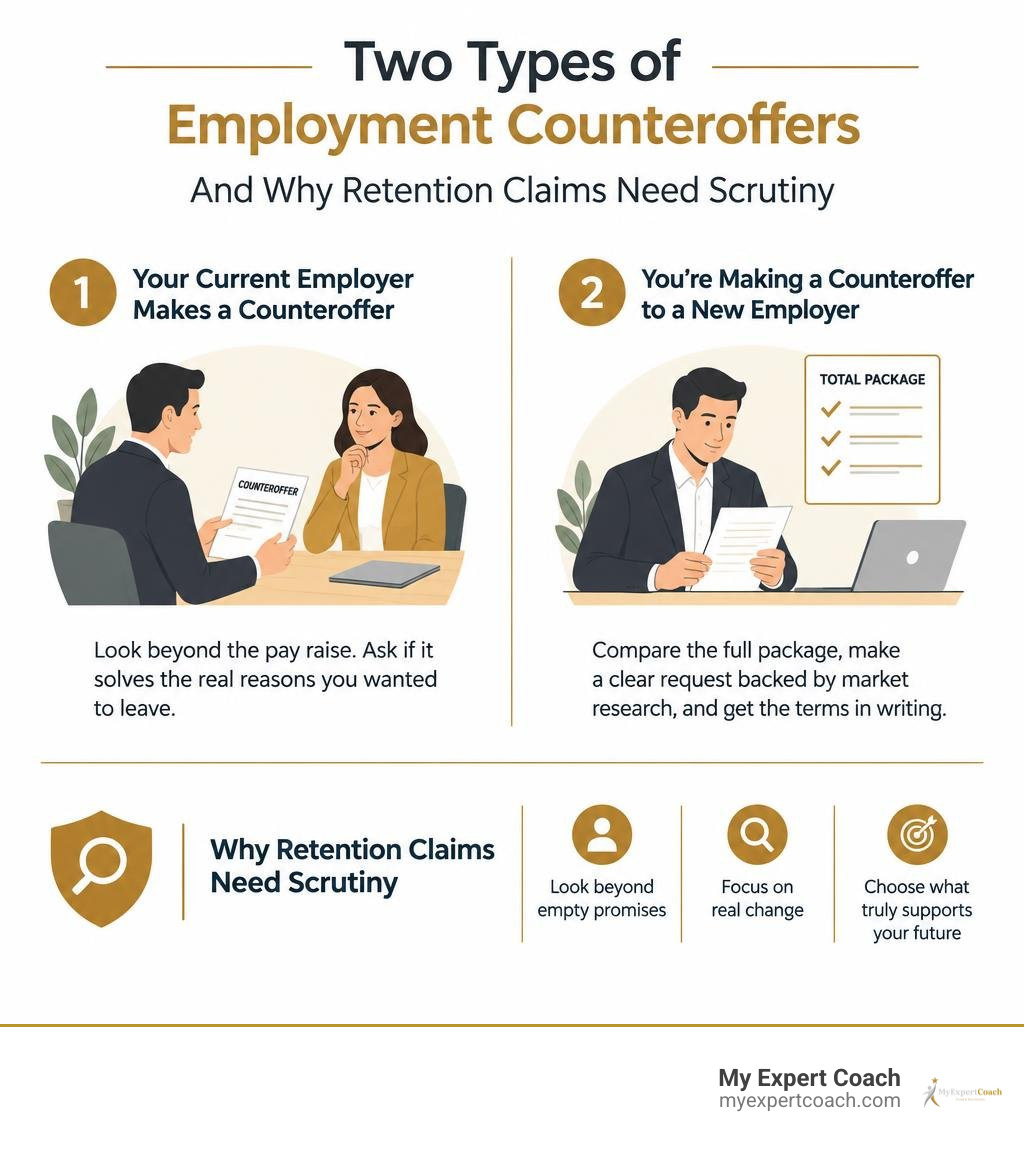
If your current employer makes a counteroffer to keep you, don’t judge it by the pay raise alone. Ask whether it fixes the reasons you wanted to leave, such as limited growth or a difficult work environment. If you’re making a counteroffer to a new employer, compare the full package, make a clear request backed by market research, and get the final terms in writing.
With extensive insider HR and executive recruiting experience helping leaders navigate critical career decisions, we treat every employment counteroffer decision as a choice about your future, not just your next paycheck.
Mastering the Counter Offer Employment Strategy: Two Distinct Realities
When navigating a transition in your career, the term “counteroffer” shows up in two entirely separate scenarios. Conflating the two is one of the most common mistakes we see senior leaders make.

The first scenario is candidate-initiated: you receive an initial job offer from a prospective company, and you propose adjusted terms before signing. The second scenario is employer-initiated: you hand in your resignation to your current boss, and they suddenly scramble to present you with a retention offer to stop you from walking out the door.
Both dynamics require careful preparation, objective market data, and emotional poise. Whether you are aiming to increase starting pay or evaluating whether to stay at your current organization, mastering strategic salary negotiation allows you to protect your market value without burning professional bridges.
Defining the Candidate Counteroffer vs. Boss Retention Offer
A candidate counteroffer occurs during the final hiring phase. A prospective employer extends an offer outlining base pay, equity, bonuses, and perks. Because starting offers frequently sit near the midpoint of an internal salary band, proposing an evidence-backed counter is a normal, expected step in the hiring conversation.
An employer retention counteroffer, by contrast, is a defensive reaction. When you give notice, your company faces immediate disruption. Replacing an employee costs an estimated 33 percent of annual salary for entry-level workers, and anywhere from 50 to 200 percent for specialized and executive roles when factoring in recruiter fees, lost output, and onboarding time.
To maintain operational continuity, your boss may quickly offer a 10 to 15 percent salary bump, an accelerated promotion, or remote flexibility. While that sudden generosity can feel validating, it rarely addresses the structural issues that prompted you to look elsewhere in the first place.
Establishing Baseline Value and Setting Negotiation Timelines
The moment an offer lands on the table, the clock starts ticking. Rushing into an immediate verbal “yes” surrenders your leverage, while waiting too long signals disinterest or indecision.
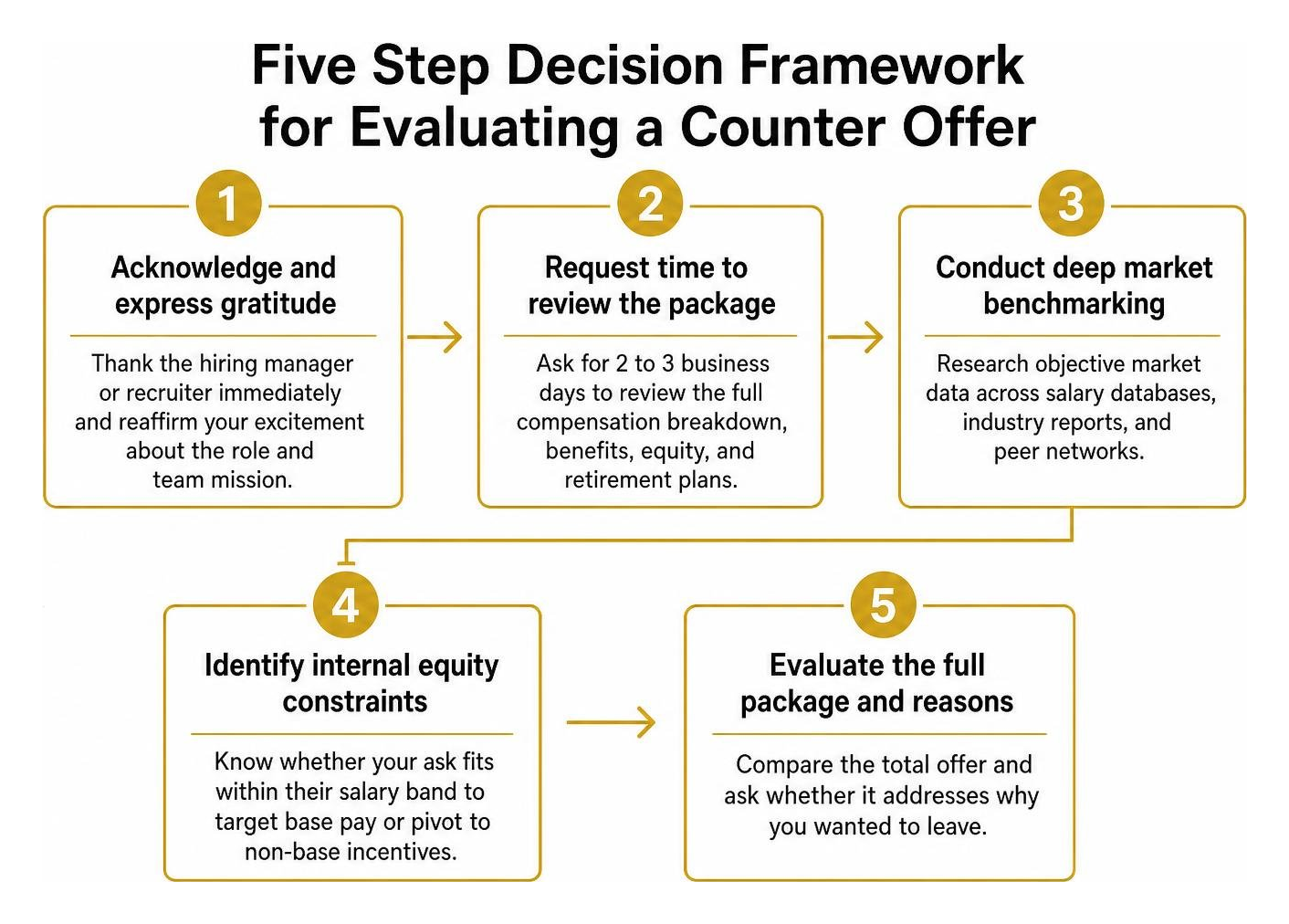
We recommend observing the 24-to-48-hour response window:
- Acknowledge and express genuine gratitude: Thank the hiring manager or recruiter immediately upon receiving the offer. Reaffirm your excitement about the role and team mission.
- Request time to review the comprehensive package: Ask for 2 to 3 business days to review the full compensation breakdown, health coverage, equity vesting schedules, and retirement plans.
- Conduct deep market benchmarking: Research objective market data across salary databases, industry compensation reports, and peer networks. If you are uncertain about regional ranges, reviewing how much to ask for in a new role helps establish an accurate baseline.
- Identify internal equity constraints: Large enterprises often maintain strict salary bands to ensure parity among peers. Knowing whether your ask fits within their band helps determine whether to target base pay or pivot toward non-base incentives like signing bonuses or equity grants.
The Hidden Risks of Accepting Your Boss’s Retention Counteroffer
When your current boss presents an unexpected raise or a new title to convince you to stay, your initial instinct might be relief. Staying feels comfortable; you know the systems, the people, and your commute.
However, industry data reveals a sobering pattern: 80 percent of professionals who accept a retention counteroffer leave within 6 months, and 90 percent depart within 12 months. In fact, roughly 50 percent of candidates who accept counteroffers resume their active job search within 60 days.
Before you agree to stay, review the insights in Harvard Business Review on counteroffer evaluation and our deep-dive analysis on falling into the dangerous counteroffer trap.
Why do counteroffers fail so consistently?
- Unresolved root causes: Money rarely fixes micromanagement, toxic workplace dynamics, lack of alignment with leadership, or dead-end career paths. Once the initial excitement of a pay raise fades, the same daily frustrations return.
- The “flight risk” stigma: Handing in your notice reveals that you had one foot out the door. Even if leadership is friendly, management may consciously or unconsciously question your long-term loyalty. When future promotion cycles or high-visibility projects are assigned, leaders often favor employees they view as fully committed.
- Buying time on their terms: A counteroffer often gives an employer 3 to 6 months of stability while they quietly cross-train teammates or search for your eventual replacement.
- Future raise cannibalization: That 15 percent raise granted under duress is frequently treated by HR as an advance on future earnings, often resulting in frozen compensation during subsequent annual review cycles.
Weighing the Risks: When to Walk Away from an Internal Counter Offer Employment Deal
To evaluate an internal retention pitch objectively, compare what staying truly offers against the long-term potential of stepping into a new organization.
| Decision Factor | Accepting Your Boss’s Counteroffer | Moving to the New Employer |
|---|---|---|
| Primary Motivation | Relieves short-term operational panic for the employer; stays inside your comfort zone. | Aligns with proactive career growth and chosen market value. |
| Workplace Trust | Often compromised; leadership may view you as an active flight risk. | High; you enter as a top-choice candidate with a clean slate. |
| Underlying Issues | Cultural friction, poor management, or burnout remain completely unchanged. | New leadership, fresh organizational culture, and expanded scope. |
| Compensation Trajectory | Future raises may be delayed or capped to offset the sudden adjustment. | Baseline pay reset at higher market tiers, establishing higher future compounding value. |
| Professional Network | External job offer must be declined, potentially closing the door on that relationship. | Expands your executive network and brings cross-functional industry exposure. |
Navigating Leverage When You Want to Stay
There is one narrow scenario where entertaining a counteroffer makes strategic sense: when compensation is your only grievance, your performance reviews are stellar, and your relationship with leadership is built on transparent trust.
If you find yourself in this position, focus on asking for a raise using external market data rather than waving a competing offer as an ultimatum.
If you do choose to negotiate a retention package, ensure the terms are concrete:
- Formal contract amendments: Secure updated base salary figures, revised bonus schedules, and modified job titles in writing before declining your external offer.
- Executive equity protections: If equity is part of the retention package, negotiate accelerated vesting provisions or guaranteed retention grants.
- Documented strategic responsibilities: Clearly outline any new authority, direct reports, or project ownership to prevent promises from evaporating once the retention crisis subsides.
Strategic Steps to Propose a Winning Counteroffer on a New Job
When proposing a counteroffer to a prospective employer, your goal is to maximize your total compensation while reinforcing why they chose you over every other candidate.

Academic research on bargaining dynamics, including the core tenets taught by the Harvard Law School Program on Negotiation principles, highlights that successful negotiations are built on collaboration rather than combat. Treat this step as an early demonstration of how you solve high-stakes challenges alongside your new colleagues.
Key Steps to Formulate a Counter Offer Employment Request
- Anchor with a realistic target (10% to 20% rule): A typical salary counteroffer lands between 10 and 20 percent higher than the baseline offer. If the initial offer already sits at the median market average, a targeted ask of 5 to 7 percent is often appropriate. In high-demand sectors like engineering or executive leadership, top-tier compensation can scale rapidly (for instance, tech packages often double from entry levels of roughly $180,000 to senior levels of $355,000 within four years).
- Lead with enthusiasm and alignment: Start every conversation by confirming how excited you are about the team’s direction. Reassure the recruiter that you want to reach an agreement that sets both sides up for shared success.
- Ground every number in business impact: Never cite personal bills, mortgages, or living expenses as justification. Point directly to your track record of generating revenue, optimizing operations, or leading high-performing teams, paired with third-party market data.
- Bundle all requests into a single communication: Submitting demands piecemeal—asking for more base pay, getting it, and then returning to ask for additional vacation days—erodes goodwill rapidly. Present your complete counteroffer as a unified, comprehensive proposal.
- Use constructive framing over ultimatums: Frame your numbers collaboratively: “Based on market data for this scope and my background leading similar initiatives, I would be fully prepared to sign immediately at $145,000. How close can we get to that figure?”
Expanding Total Compensation Beyond Base Salary
If a hiring manager faces strict departmental budget limits or rigid salary bands, do not assume the negotiation is over. Base salary is only one component of your total earnings.
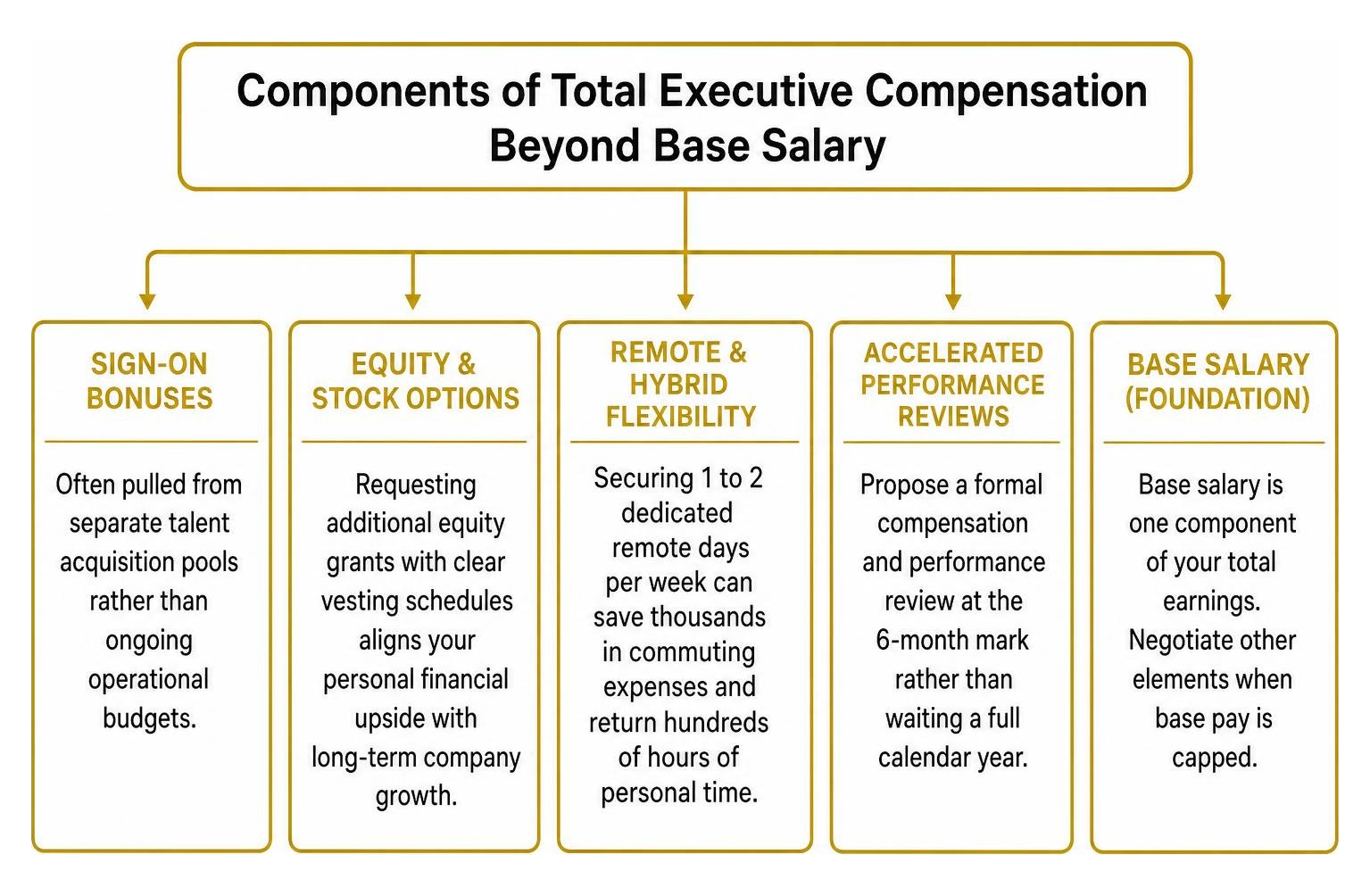
High-value elements to negotiate when base pay is capped include:
- Sign-on bonuses: Often pulled from separate talent acquisition pools rather than ongoing operational budgets, sign-on bonuses can bridge a 1-year compensation gap effectively.
- Equity and stock options: Requesting additional equity grants with clear vesting schedules aligns your personal financial upside with long-term company growth.
- Remote and hybrid flexibility: Securing 1 to 2 dedicated remote days per week can save thousands in commuting expenses and return hundreds of hours of personal time.
- Accelerated performance reviews: Propose a formal compensation and performance review at the 6-month mark rather than waiting a full calendar year.
- Professional development stipends: Negotiate a dedicated annual budget for executive coaching, industry certifications, or board governance training.
- Additional paid time off (PTO): Negotiating an extra week of vacation carries zero immediate payroll drag for the hiring manager, making it a low-friction concession to secure.
Leveraging Competing Offers Without Alienating Recruiters
Holding multiple offers provides clear market validation, but using them clumsily can backfire. If a recruiter feels threatened or perceives they are merely being used to bid up another firm, they may withdraw their offer entirely.
When referencing another opportunity:
- Maintain respect and confidentiality: Avoid revealing sensitive corporate details or playing companies against each other publicly.
- Focus on role alignment: Explain that while another organization has offered a higher financial package, you prefer their company’s culture and vision, and want to explore ways to bring the packages closer together.
- Set clear walk-away criteria: Know your absolute minimum acceptable terms before you begin. If an offer does not meet your baseline and the employer cannot adjust the package, decline politely to preserve the relationship.
- Avoid post-acceptance renegotiation: Once you have verbally accepted and signed an offer, attempting to reopen compensation talks carries severe reputational risks, as detailed in our guide on handling post-acceptance offer negotiations.
How to Structure a Professional Counteroffer Letter or Email
While high-stakes adjustments are often discussed over the phone, submitting a structured counteroffer via email creates a clear, documented record of your requests and reasoning.
Writing your counteroffer allows you to present a polished business case without the pressure of live verbal back-and-forth.
Essential Components of a Persuasive Counteroffer Letter
A high-converting counteroffer letter follows a clean four-part structure:
- The enthusiastic opening: Restate your gratitude for the offer and your genuine interest in the role and company vision.
- The value proposition and market case: Remind the hiring manager of your unique qualifications and present objective salary benchmarks.
- The specific, bundled counterproposal: Detail your exact proposed adjustments (base pay, signing bonus, equity, or PTO) in clear, individual paragraphs.
- The collaborative call to action: Express your readiness to discuss the terms live and finalize the agreement.
Sample Counteroffer Email Template
Preparing for Employer Reactions and Managing Next Steps
Once you submit your counterproposal, the employer will generally respond in one of four ways:
- Full acceptance: The employer updates the formal offer letter with your requested terms. Review the revised contract carefully, sign, and confirm your start date.
- Alternative counteroffer (compromise): The company may not meet your requested base pay, but might offer a partial bump paired with a signing bonus or additional stock grants. Evaluate whether the total package meets your core financial and career objectives.
- Hold firm on original offer: The employer explains that internal equity or strict budget caps prevent any changes. You must then decide whether the role’s growth trajectory, team quality, and culture justify accepting the original terms.
- Offer rescission (rare): Under at-will employment frameworks in the United States, employers technically have the legal right to revoke an offer at any time. However, reputable companies almost never rescind an offer simply because a candidate negotiated professionally; rescissions typically occur only if a candidate makes aggressive demands, acts unprofessionally, or displays poor cultural alignment.
Frequently Asked Questions About Employment Counteroffers
How much higher should your salary counteroffer be?
A standard salary counteroffer is typically 10 to 20 percent above the initial offer. If the employer’s opening offer is already at the upper end of the published salary band or aligned with median market rates, a 5 to 7 percent increase is generally more realistic. Proposing an increase beyond 25 percent is usually viable only if the scope of the role expanded significantly during the interview process or if the initial offer fell drastically below documented market value.
Can a prospective employer rescind an offer if you counter?
While legally possible under at-will employment rules, formal offer revocations are rare during professional negotiations. As long as your counterproposal is grounded in objective market research, delivered with genuine enthusiasm, and framed as a collaborative discussion rather than an ultimatum, hiring managers will typically either accept your numbers, propose a middle ground, or politely state that their initial offer is firm.
What should you do if an employer rejects your counteroffer?
If an employer cannot accommodate your salary request, pivot the discussion toward non-monetary components. Ask for additional paid time off, remote work flexibility, an executive coaching allowance, or a documented 6-month performance and compensation review. If the employer remains completely rigid and the total compensation falls below your walk-away threshold, you can decline the offer politely, confident that you held firm to your professional market worth.
Conclusion
Negotiating your compensation is not an adversarial hurdle; it is an important career milestone and a direct reflection of your professional value. Whether you are constructing a data-backed counterproposal for an exciting new executive role or weighing the hidden retention risks of staying with your current boss, making informed, strategic choices protects your long-term earning potential.
At My Expert Coach, our team brings more than 25 years of insider HR and executive recruiting experience to your corner. Having advanced more than 10,000 careers, we provide tailored, non-template strategies designed to help you command top-tier compensation and step into leadership positions with confidence.
Ready to position yourself for executive career growth? Connect with us for comprehensive executive career coaching and LinkedIn optimization to elevate your brand, master your offer negotiations, and secure the compensation you deserve.