
table of contents
Can You Negotiate a Job Offer After Verbally Accepting?
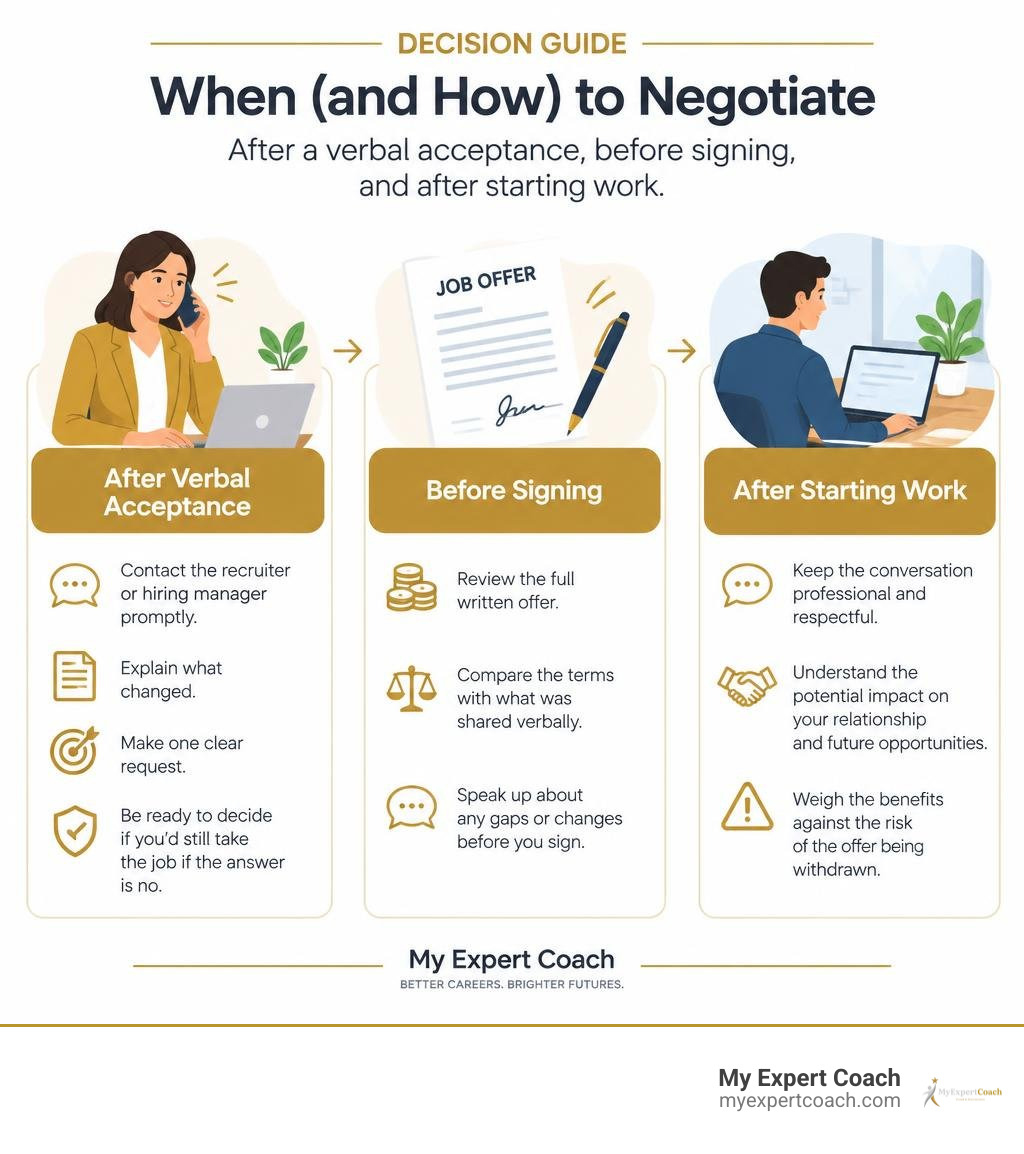
So, can you negotiate a job offer after verbally accepting? Yes, you can ask, but the employer can say no or withdraw the offer. If the pay or terms need to change, contact the recruiter or hiring manager promptly, ideally before signing. Explain what changed, make one clear request, and be ready to decide whether you would still take the job if the answer is no.
A quick yes on an exciting call can feel different once you review the full package. A gap between the spoken offer and the written terms is a strong reason to speak up. Simple regret is a harder case to make.
I’m Sandy Spencer, an executive career coach with 38 years of HR and recruiting experience. I’ve helped senior leaders answer “can you negotiate a job offer after verbally accepting” by weighing the pay gap against the risk to the offer and the relationship.
Can You Negotiate a Job Offer After Verbally Accepting? Risks and Reality
When we examine the mechanics of corporate hiring, giving a verbal “yes” sets off an immediate chain reaction. Sourcing stops, rejection emails go out to runner-up candidates, and recruitment budgets freeze for that requisition. Reopening discussions after this point creates genuine operational disruption for the hiring manager and HR team.
Before taking action, you need to understand the realities of negotiating after offer acceptance risks rewards and exact scripts. While asking is possible, walking back a verbal commitment carries an inherent rescission risk. Hiring managers view verbal commitments as indicators of integrity, decisiveness, and professional reliability.
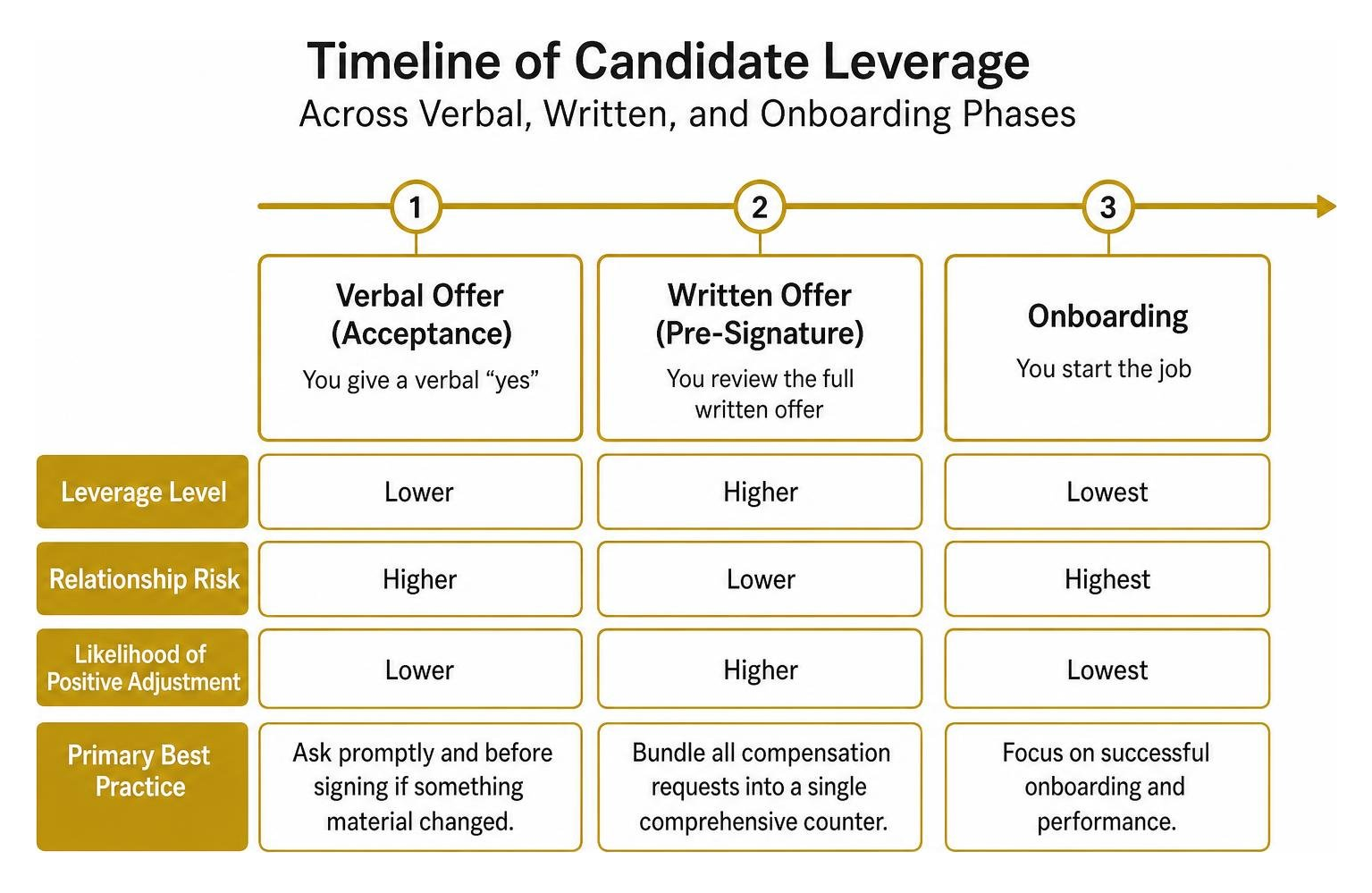
The table below breaks down how your leverage, credibility, and overall risk profile shift across each stage of the hiring timeline:
| Offer Stage | Leverage Level | Relationship Risk | Likelihood of Positive Adjustment | Primary Best Practice |
|---|---|---|---|---|
| Written Offer Received (Pre-Acceptance) | Highest | Minimal (Standard Expectation) | High | Bundle all compensation requests into a single comprehensive counter. |
| Post-Verbal Acceptance (Pre-Contract) | Moderate to Low | Moderate | Moderate (Requires Strong Justification) | Communicate immediately via phone; anchor requests in newly uncovered facts. |
| Signed Written Agreement | Very Low | High | Low | Reopen only if job scope fundamentally changed or you are willing to walk away. |
| Post-Start / Probationary Period | Minimal | Severe | Very Low | Demonstrate bottom-line value first; target the 6-month performance review. |
Why Candidates Ask: Can You Negotiate a Job Offer After Verbally Accepting?
Job seekers frequently find themselves caught off guard by a spoken offer. In the thrill of the moment, adrenaline surges, leading to an instinctive agreement before they have reviewed the complete compensation details.
According to a Robert Half survey of 1,000 professionals, 58% of workers would decline a job if the salary did not suit their needs. When candidates pause to calculate their actual take-home pay or research how much should i ask for salary new job, buyer’s remorse often sets in. Candidates realize that starting underpaid creates long-term career friction, making them seek ways to correct the package before starting day one.
Verbal Agreement vs. Written Contract: Legal Leverage and At-Will Rules
From a legal standpoint, standard employment across most corporate jurisdictions operates under the at-will employment doctrine. Spoken proposals and preliminary acceptances generally do not form binding, fixed-term employment contracts unless explicit, non-contingent guarantees are proven under legal theories like promissory estoppel.
For candidates evaluating options, reviewing a thorough guide on checking terms before job acceptance demonstrates why putting signatures on hold is critical until every clause is clarified. The rules can also shift depending on organizational structure; for example, the processes for how you negotiate salary for a city job involve strict civil service pay bands compared to private sector flexibility.
Valid Grounds and Strategic Levers to Reopen Salary Talks
Attempting to renegotiate simply because you had second thoughts rarely yields positive results. To reopen a conversation without alienating the hiring team, you need objective, fact-based grounds.

Legitimate catalysts for resetting the offer include:
- Material Scope Expansion: The formal contract details significant responsibilities, travel obligations, or direct reports that were never discussed during interviews.
- Uncovered Market Disparities: Verified industry benchmark data reveals that your specific skill set commands a higher base in the local market.
- Total Compensation Shortfalls: Unanticipated deductions, expensive health benefit premiums, or rigid bonus structures that lower overall target earnings.
When presenting your case, understanding how much is reasonable to ask for a raise or counteroffer ensures your request stays grounded in business realities. As outlined in career research on negotiating from Stanford Graduate School of Business, presenting a unified, collaborative proposal backed by market data protects professional relationships while demonstrating executive presence.
Can You Negotiate a Job Offer After Verbally Accepting if the Written Terms Change?
A common and valid justification occurs when the formal written document contradicts verbal promises. If the spoken discussion promised a $140,000 base salary with hybrid flexibility, but the written agreement states $125,000 with mandatory five-day on-site attendance, you have every right to pause.
In these situations, your communication should focus on resolving discrepancies rather than demanding extra pay. Point out the differences calmly using your notes from the offer call. This allows HR to fix administrative errors without putting you in a defensive position, helping you secure better pay without falling into the dangerous counteroffer trap.
Competing Opportunities and Counteroffer Dilemmas
Securing a higher competing offer after giving verbal acceptance creates an awkward dilemma. If another organization extends a superior compensation package, you hold real market leverage, but how you communicate it matters.
Reviewing the dynamics of a counter offer employment scenario will show you that threatening an employer with a rival offer can easily backfire. If you choose to leverage another opportunity, approach the hiring manager with appreciation, explaining that an unexpected competing proposal arrived with terms you cannot ignore. If you decide to ask for a raise with another offer in hand, be fully prepared for the possibility that the employer may wish you well and retract their initial offer on the spot.
How to Reset the Offer Conversation Step-by-Step
When you must reset expectations after a premature “yes,” execution speed is vital. Waiting days while internal teams draft formal paperwork only amplifies frustration.

Follow this four-step sequence to handle the conversation:
- Request an Immediate Phone Conversation: Never renegotiate sensitive terms solely through email. Send a brief note requesting a brief 10-minute call regarding the written paperwork.
- Own the Misstep Transparently: Open the call by acknowledging that your initial verbal acceptance was premature due to your genuine enthusiasm for the team.
- Present Concrete, Objective Justification: Clearly explain the new information, scope adjustment, or compensation gap that requires adjustment.
- Signal Immediate Closure: State an exact figure or adjustment that guarantees your immediate signature, removing uncertainty for the hiring team.
Strategic Scripting: What to Say to Reopen Discussions Gracefully
Use this verbal framework when speaking directly with the hiring manager or executive recruiter:
“Thank you for taking the time to speak today. I want to apologize for needing to revisit our discussion. When we spoke earlier, my excitement about joining the team led me to accept verbally before thoroughly evaluating my household budget and the full benefits package.
After reviewing the written terms and running the numbers against industry benchmarks for this scope of work, I realize I need a base salary of $135,000 to make this transition sustainable. If we can make that adjustment to the written agreement, I am ready to sign the contract today and commit fully to our agreed start date.”
This approach pairs accountability with a clear commitment to finalize the deal immediately if your number is met.
Non-Salary Alternatives When Base Pay Is Locked
If the employer states that corporate salary bands prevent any movement on base pay, pivot to flexible compensation levers. Many organizations have rigid base pay limits but substantial discretion in discretionary budgets.
Consider proposing these alternatives:
- A One-Time Signing Bonus: Offsets an initial compensation gap without altering recurring departmental salary baselines.
- Structured Performance Milestones: Securing a written agreement for an accelerated compensation review at three or six months based on concrete KPIs.
- Workplace and Schedule Flexibility: Securing dedicated remote days or additional paid time off to balance lifestyle considerations.
- Relocation or Equipment Allowances: Professional development stipends or home-office allowances that offset personal expenditures.
What to Do if the Employer Refuses or Pulls the Offer
If the hiring manager firmly declines your request, maintain professional composure. You face a clear choice: accept the original written terms with enthusiasm, or decline the position politely.
When weighing the ethics of rejecting an offer you verbally accepted, starting a role feeling underpaid breeds resentment that damages your performance and career trajectory. If the compensation falls below your walkaway threshold, decline the offer with gratitude, ensuring you do not burn industry bridges.
Frequently Asked Questions About Post-Acceptance Offer Negotiations
Is a verbal job acceptance legally binding in standard employment?
In most standard corporate environments operating under at-will employment, a verbal acceptance does not form a legally binding employment contract. Either party can typically withdraw before the written agreement is signed. However, reneging on a verbal agreement carries professional and reputational consequences within your industry network.
Will an employer automatically rescind an offer if I try to renegotiate?
Not automatically, but the risk is real. When you attempt to reopen terms, some employers may view the move as a lack of commitment or bad-faith negotiation and choose to move forward with a backup candidate. Framing your conversation around newly discovered details and industry data reduces this risk significantly.
How much time should I request before giving a verbal job acceptance?
Standard professional etiquette allows for a 24 to 48-hour window to review any verbal offer. When an employer extends an offer over the phone, express sincere enthusiasm, take detailed notes, and politely request 1-2 business days to review the complete written terms with your family before giving a definitive answer.
Conclusion: Navigating High-Stakes Career Decisions
Managing high-stakes career moves requires balancing tactical negotiation with long-term professional credibility. While saying “yes” too quickly happens, knowing how to reset the conversation objectively protects both your earning potential and your professional reputation.
At MyExpertCoach, our team brings over 25 years of insider HR and recruiting leadership to executive career consulting. Having advanced more than 10,000 careers, we partner with senior leaders on custom interview preparation, personal branding, and high-stakes salary negotiation strategies. Navigating compensation discussions with data, strategic framing, and clear boundaries ensures you enter your next executive chapter valued, respected, and set up for long-term success.