
table of contents
Compensation Negotiation Tips: Start With the Offer, Not the Ask
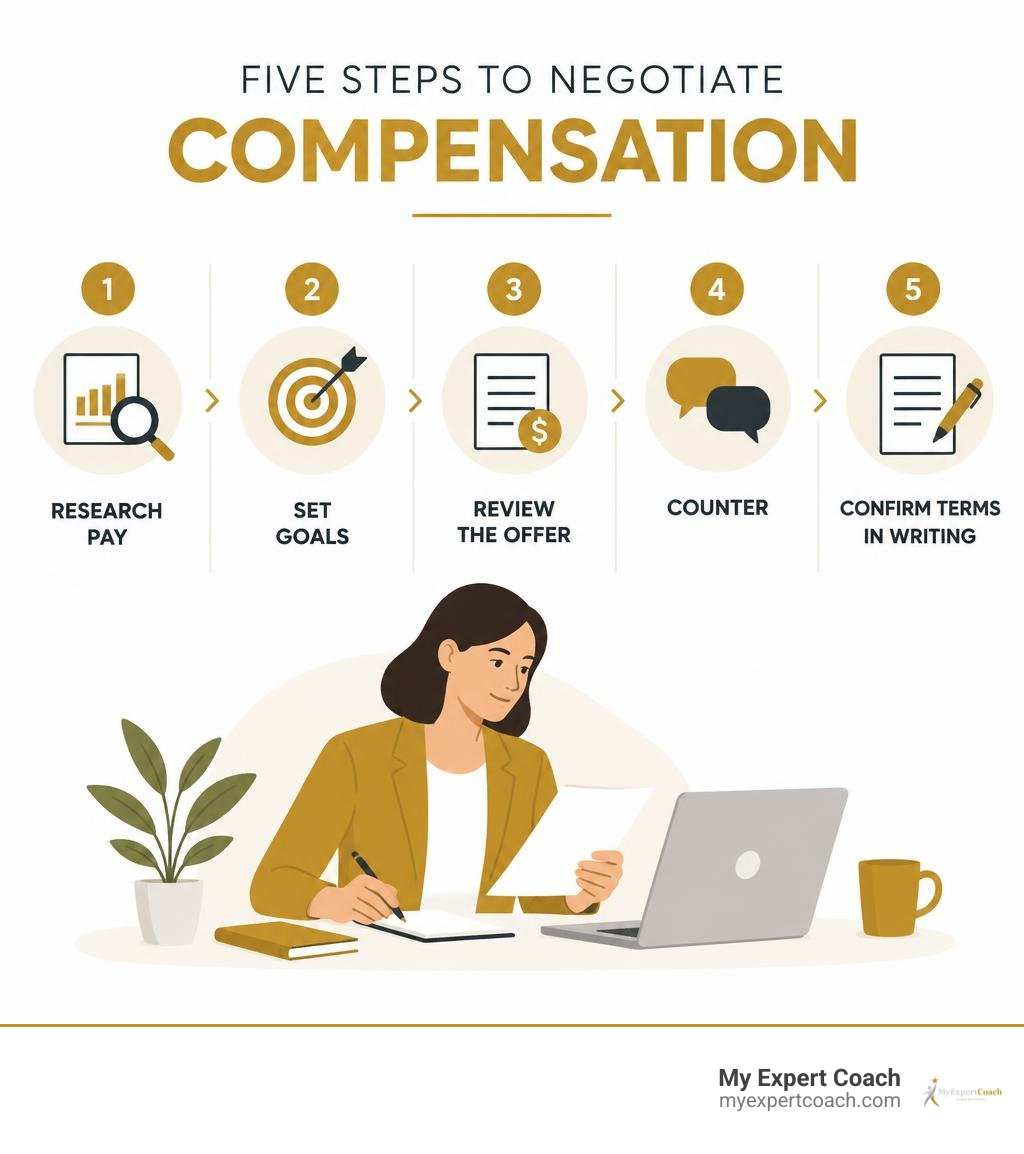
The most useful compensation negotiation tips are simple: research pay for your role, set a target and a walkaway number, and write down the results you have delivered. You can ask about the pay range early, but wait for an offer before making a detailed counteroffer. Then make a specific, evidence-backed request and consider the full package, not just base salary. Get every agreed term in writing before you accept.
That preparation matters. Your starting salary can shape future raises, yet it is easy to focus on what you hope the employer will say instead of what you can show you bring to the role.
I’m Sandy Spencer, a career coach with more than 38 years of experience in HR and executive recruiting. These compensation negotiation tips draw on that insider view and my work helping senior leaders make stronger career moves.
Leaving money on the table is remarkably common. Roughly 64% of job seekers accept the first number they are offered, and nearly 60% of experienced professionals aged 45 to 54 admit they do not negotiate at all. Among younger professionals, 58% accept their starting pay without a counteroffer, often because 38% of workers feel uncomfortable asking for higher salaries. Yet the upside is undeniable: 87% of professionals who negotiate their salary receive at least some of what they requested, gaining an average starting bump of $5,000 that compounds dramatically over a lifetime.
When you consider that in 2022 American women earned roughly 82 cents for every dollar earned by men, strategic self-advocacy becomes essential. Negotiating is not about being pushy; it is an exercise in professional communication and mutual value creation.
Essential Compensation Negotiation Tips Before You Speak

Before stepping into any compensation discussion, your leverage depends entirely on the preparation you do behind the scenes. Walking into a salary discussion without data is like navigating a new city without a map—you might eventually get somewhere, but you will likely take an expensive wrong turn.
Determining Your True Market Value
Establishing your market worth requires triangulation across objective data sources rather than personal financial desires. Start by analyzing reputable compensation aggregators like Payscale, Glassdoor, Salary.com, and the Bureau of Labor Statistics Occupational Outlook Handbook. Account for geographic cost differences, industry trends, and the premium associated with your specialized certifications or leadership tenure.
To refine your approach when evaluating a new role, take time researching how much to ask for in a new job salary so your numbers align with real-time hiring budgets. In addition, consult trusted mentors and industry peers to gather qualitative pay data within your specific niche.
Establishing Your Target, Baseline, and Stretch Goals
Before negotiating, establish three distinct numbers:
- Your Walkaway Baseline (Reservation Point): The absolute minimum compensation package required for you to accept the role.
- Your Target Salary: A realistic, data-backed figure that genuinely satisfies your market value.
- Your Initial Ask (Stretch Goal): A figure typically 5% to 15% above your target salary.
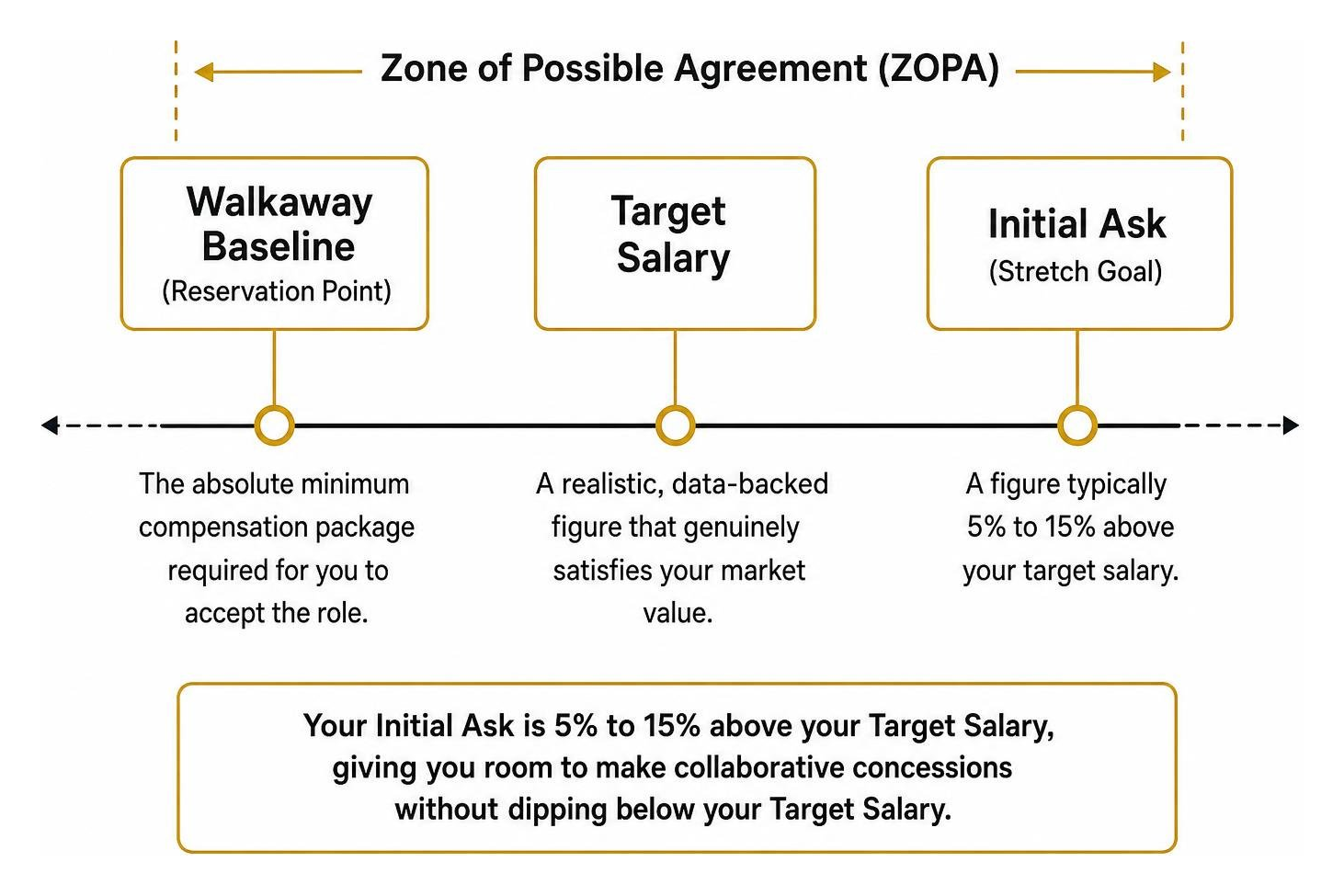
This structure ensures you define your Zone of Possible Agreement (ZOPA) clearly. Setting an initial ask 5% to 15% above your target gives you room to make collaborative concessions without dipping below your target compensation.
Deflecting Premature Salary Inquiries in Early Interviews
During early screening calls, recruiters often ask for your salary expectations to filter candidates out. Naming a rigid figure too early removes your leverage before the employer understands the full scope of your value. Furthermore, in many jurisdictions, asking for your salary history is legally prohibited.
If pressed early, deploy a polite deflection:
“I want to ensure the position is a strong mutual fit first. Could you share the approved salary range for this role?”
Alternatively, utilize what negotiation researchers call a “non-offer offer”:
“Based on initial market benchmarks for roles with this level of operational scope, I understand compensation typically falls between $130,000 and $145,000 depending on total rewards. I am flexible and excited to evaluate the complete package once we determine if I am the right fit.”
Strategic Playbook: Making Your Counteroffer and Nailing the Pitch

Once you receive a formal written offer, your leverage peaks. The hiring manager has invested significant time, eliminated other candidates, and chosen you. Now is the time to execute a structured counter-proposal.
Timing the Conversation and Anchoring High
When an offer is extended, express immediate enthusiasm, but never accept on the spot. Request a standard 24 to 48 hours to evaluate the complete package. Review the terms against industry-specific baselines using our structured salary negotiation process, or examine company-specific compensation models such as Amazon salary negotiations if you are navigating large tech frameworks.
Academic research from the Harvard Law School Program on Negotiation research on salary bargaining highlights the psychological power of anchoring: the first concrete number introduced heavily shapes the final outcome. Countering near the upper end of a defensible market range sets a strong psychological anchor that pulls final offers upward.
Proven Compensation Negotiation Tips for Crafting a Compelling Case
Your counteroffer must focus entirely on return on investment (ROI), not personal living expenses. Prepare a concise, one-page summary highlighting your quantified business impact:
- Revenue generated or pipeline expanded
- Operational cost reductions or efficiency improvements
- Leadership achievements and specialized expertise
Backing your counter-proposal with objective logic makes it easier for hiring managers to justify budget adjustments to their finance departments, a strategy supported by Harvard Law School insights on negotiating higher pay.
Sample Verbal Counteroffer Script:
“Thank you again for extending this offer. I am genuinely excited about the prospect of leading this team and tackling the product launch we discussed. Based on the scope of the role, regional market benchmarks, and my recent track record of growing regional revenue by 28%, I was anticipating a base salary closer to $140,000. If we can reach that figure, I am ready to sign today.”
Leveraging Tactical Silence and Managing the Back-and-Forth
Once you state your counteroffer, stop talking. Resisting the urge to fill conversational silence is one of the most powerful negotiation tools available. Give the hiring manager time to process and respond.
Keep the dialogue collaborative rather than adversarial. Limit counteroffer rounds to one or two exchanges to maintain goodwill. Never issue ultimatums unless you are fully prepared to walk away immediately.
Expanding Beyond Base Pay: Total Rewards and Equity
Base pay is only one piece of your financial picture. When organizations face strict internal salary bands, total compensation can often be significantly improved by negotiating non-salary elements.
| Compensation Component | Standard Negotiability | Common Trade-off Strategies |
|---|---|---|
| Base Salary | Moderate to High | Anchor high; support with quantified business ROI |
| Sign-on Bonus | High | Offset unvested equity or bridge initial salary gaps |
| Annual Incentive / Bonus | Moderate | Negotiate performance thresholds or guaranteed minimums |
| Equity / RSUs / Options | High (Startups & Tech) | Request accelerated vesting or larger grant allocations |
| Paid Time Off (PTO) | Moderate | Request an extra week if base salary is rigid |
| Remote / Hybrid Flexibility | High | Document specific days in office vs. remote work |
| Standard Health / 401(k) | Low to Fixed | Usually governed by company-wide ERISA plan rules |
Advanced Compensation Negotiation Tips for Non-Salary Perks and Equity
If base salary is capped, review which alternative terms are flexible. Resources like MIT Career Advising on job offer negotiability categorize perks into tiers of flexibility.
Consider proposing these valuable additions:
- Sign-on Bonuses: A one-time cash payment that comes from a different budget pool than base recurring salary.
- Equity and RSUs: Negotiate shorter vesting cliffs, accelerated vesting upon change-of-control, or extended post-termination exercise windows.
- Accelerated Performance Reviews: Request a documented 6-month compensation review tied to specific, measurable milestones rather than waiting a full 12 months.
- Professional Development: Ask for dedicated stipends covering executive coaching, certifications, or conference attendance.
Handling Low Offers, Budget Constraints, and the Reluctance Trap
If an employer states their budget is firmly capped, ask open-ended questions:
“What flexibility exists within performance incentives, sign-on bonuses, or equity grants to help bridge the gap?”
If you are negotiating while currently employed, exercise caution. Before leveraging an outside offer to demand higher pay internally, consider evaluating counteroffer employment risks and learn strategies for avoiding the dangerous counteroffer trap, as accepting a reactive counteroffer from a current employer frequently leads to strained workplace relationships. If an offer fails to meet your baseline requirements and the employer offers zero flexibility, politely decline to preserve your professional relationship.
Negotiating an Internal Raise and Securing Written Commitments
Advocating for higher pay in your existing position requires careful timing and thorough documentation.
Building a Business Case for an Off-Cycle or Performance Review Raise
The optimal time to request a raise is directly following a stellar performance review or upon taking on substantial new responsibilities.
- Document Your Impact: Build a concise “brag sheet” outlining key deliverables, cost-savings, and team leadership.
- Benchmark Internal and External Pay: Determine how much is reasonable to ask for a raise—typically 3% to 5% for standard merit increases, or 10% to 20% for expanded roles and promotions.
- Handle Outside Leverage Carefully: If asking for a raise with another offer in hand, present it professionally without creating an antagonistic environment, following Harvard Division of Continuing Education guidelines on salary increases.
Finalizing Terms and Securing Written Documentation
A verbal agreement is not final until it is committed to paper. Once terms are settled, request an updated offer letter detailing:
- Exact base salary and incentive structures
- Signing bonus payment schedules and retention stipulations
- Equity grant details and vesting schedules
- Agreed-upon start dates and remote work policies
Securing everything in writing prevents future misunderstandings and avoids the complexities of negotiating after formal offer acceptance.
Frequently Asked Questions About Compensation Negotiation
Can an employer rescind a job offer if I negotiate?
While theoretically possible, rescinding an offer simply because a candidate negotiated is exceptionally rare. Employers expect candidates to advocate for themselves. As long as you maintain an enthusiastic, collaborative tone, anchor your requests in market data, avoid aggressive ultimatums, and counter within a reasonable timeframe, your offer remains secure.
What is the ideal percentage to ask for above an initial offer?
A standard, effective counteroffer is typically 5% to 15% above the employer’s initial number. Asking for an increase in this range leaves room for compromise while remaining anchored in realistic market bands. If your ask exceeds 15%, ensure you provide robust data demonstrating specialized technical skills, niche credentials, or a competing written offer.
How should I respond if an offer is presented verbally over the phone?
Express genuine gratitude and excitement immediately, but avoid accepting or countering on the spot.
Phone Response Script:
“Thank you so much! I am thrilled to receive this offer and excited about the team. Could you please send over the complete written offer details, including benefits and bonus structures? Once I review the full package over the next 24 to 48 hours, I’ll follow up with any questions.”
Conclusion
Negotiating compensation is a cornerstone of long-term career growth. By knowing your market value, establishing clear targets, leading with quantified business impact, and evaluating total rewards, you position yourself as a high-value leader from day one.
At My Expert Coach, we bring over 25 years of insider HR and executive recruiting experience to help senior professionals land top-tier opportunities. If you are preparing for your next career move, explore our tailored executive resume and LinkedIn optimization services to elevate your personal brand and maximize your earning potential.